A gritty mystique has long surrounded the multidisciplinary Mexican artist Teresa Margolles, who for three decades has made it her project to stare death in the face.
Early in her career, she did this literally — working in a Mexico City morgue as a forensic technician in the 1990s, and producing art that used residue from the processing of the bodies of crime victims. It was transgressive work, at times ethically borderline, but rendered with bravura and conceptual clarity. In her 2003 installation “Aire,” she took water that had been used in the morgue to wash cadavers before autopsy and then vaporized it into a museum gallery.
Her work is less gory now, but no less poignant and percussive, as demonstrated by “Teresa Margolles: En el lugar de los hechos” (At the Scene), a timely survey at MoMA PS1. The exhibition gathers some of her most important installations — notably ones stemming from her research in the 2010s in northern Mexico in a time of extreme cartel and state violence and widespread femicide — along with both earlier and new work made in the United States, underscoring the brutal entanglements that bind the two countries.
The insistence in Margolles’s art, then and now, is that violence stays in the air: Murder, abduction and disappearance hover long after the fact, suffuse both the physical and the psychic landscape, and implicate not just victim and perpetrator, but all of society. So she gathers traces, like missing-person notices, garish tabloid headlines, rubble from demolitions, objects left behind. And if physical traces are gone — faded, forgotten, erased — she summons conceptual ones, using artistic methods to map and mine the psychogeography.
In late 2016, for example, Margolles visited Dallas, and, working with collaborators, performed a kind of ritual at 111 sites where a murder had taken place earlier that year. At each location, a member of the team sponged a rectangle on the pavement, drawing water from one bucket and draining it, after each passage, into another bucket — somehow infusing the water with the essence of the place. (Margolles calls this kind of action “signalization.”)
Her film that compiles these operations, “El agua de la ciudad, Dallas” (The Water of the City, Dallas), greets visitors at the start of the PS1 show. It runs nearly three hours, intercut by screen cards that provide police-blotter information (“Shot,” “Shot multiple times,” “Discovered beaten and unresponsive in a parking lot”). Projected on a large screen, it plunges visitors into the scale of the crisis it charts, the sprawl of the urban terrain and the antlike, tenacious artistic process.
Born 1963 in Culiacán, the capital of the state of Sinaloa, Margolles emerged in Mexico City as a photographer and member of a death-metal-oriented performance collective called Semefo — an appropriation of the acronym of the federal forensic agency. She then worked for a time at that agency, drawing on the access in her early individual works after the collective disbanded.
The exhibition gestures toward this phase with “Periferia de la agonía” (Periphery of Agony), a work from 2003 that consists of a 72-foot cloth that was unrolled and placed over cadavers, creating a serial staining pattern that calls up shroud-like liturgy.
Among other early work, “Joya” and “Joya (Cadena),” from 2007, are frankly ornate: a 10-karat gold bracelet and necklace, each inset with fragments from windshields shattered by gunfire in Culiacán, and presented like luxury objects in dramatically lit vitrines.
In the 2010s, Margolles worked in Ciudad Juárez, across the Rio Grande from El Paso. She immersed herself in the lives (and deaths) of missing female workers and the families and activists searching for them, along with other vulnerable groups, like trans bar dancers and sex workers. She observed new neighborhoods mushrooming when the border economy boomed, then being abandoned when factories abruptly shut down and workers migrated away.
Two major installations from this period, which cemented Margolles’s international prominence, form the heart of the PS1 exhibition. For “La búsqueda” (The Search), she removed a series of window panes from vacant storefronts in Juárez that were plastered with streaked or torn missing-person posters. The installation, first presented in 2014 (and again in the 2019 Venice Biennale), bathes the panes in bleary light, accompanied by a low-frequency vibration based on the sound of the freight train that traverses the city.
For “La promesa” (The Promise), in 2012, Margolles bought a vacant house in the Juárez outskirts and hired workers to demolish it over 11 days. A large room in the PS1 show is devoted to a sculpture made from 13 tons of this rubble. Originally a long rectangular cuboid, it is being dismantled by hand in one-hour shifts by participants whom the wall text describes as “people with personal experiences of broken promises and unfulfilled dreams.”
A well-conceived side gallery fleshes out this project and context, with materials including Margolles’s video and photographs of the house demolition, which register as an uncanny inversion, like a record played backward; and the installation “PM,” in which she gathered every daily edition in 2012 of the Juárez tabloid newspaper of that name. Each cover featured a lurid red headline blaring out news of some massacre, execution or accident, with a gory photograph, alongside a separate column showcasing a scantily clad female model or actress.
The great strength of this exhibition, which was organized by the MoMA curators Ana Janevski and Inéz Katzenstein, rests in its demonstration of so many artistic methods to contend with the impact of violence, refusing monumentalization or looking away.
It highlights Margolles as a formal experimentalist whose language expands even as she refreshes her signature moves. One room, for instance, updates “Aire,” the vapor installation, now using water that “signalizes” what are described as “sites of violence in New York City.” (The catalog explains that these are places where people were apprehended for deportation.)
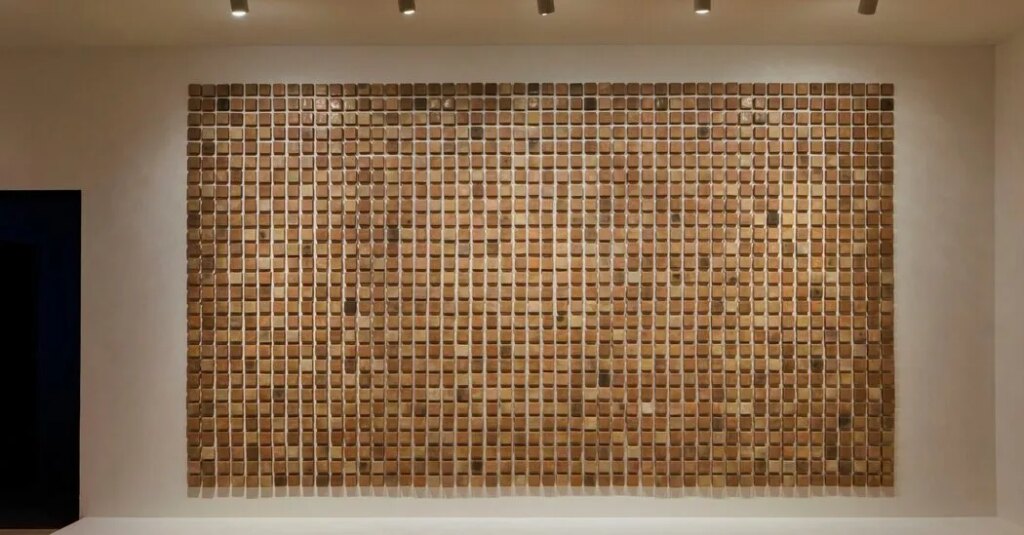
Margolles is a minimalist with a baroque streak and knowing art-historical references. Her rubble cuboids, arrays of tiles, lines cut into walls and stark concrete furniture evoke the work of Donald Judd and others, only with charged materials: clay from the Rio Grande, water or soil from murder sites. A stack of handouts enlarging her receipt for an ammunition purchase — from the Walmart in El Paso where a white supremacist committed a mass shooting in 2019 — emulates the paper stacks of Félix González-Torres.
But most of all, she is a deeply political artist who takes on violence and human degradation for the simple reason that nothing is more important. As she once titled an exhibition: “What else could we talk about?”
What, indeed? If this compelling survey has an awkward note, it dwells in the timid and circuitous phrasings of some of the wall texts, which seem to take shelter in vague formulations the closer the topic approaches current state violence in the United States.
In fact, in preparing the show, Margolles visited Minnesota, where she traveled to the locations where the protesters Renee Good and Alex Pretti were killed by federal agents last January, and where a Minneapolis police officer killed George Floyd in 2020. We learn of this visit only in the catalog, which prints her photographs of these sites.
Near the end of the exhibition, visitors walk between two long shelves that hold a new commission by Margolles, “Vestigios de la ira” (Vestiges of Wrath). On them are heaped hundreds of fused-glass sculptures that melt and distort household objects: plates, ashtrays, mugs, bottles, some still showing labels or residual contents. These items were left behind, we are told, by people who were deported from the United States — an elegy to broken dreams “in the wake of the recent wide-sweeping immigration enforcement campaign.”
The installation focuses on domestic disruption, daily life upended and scattered in the immigration sweeps. It’s also more stylized than much of Margolles’s work, its register melancholy rather than blunt. A bit too subtle, even? In a time of tumultuous political change, here’s hoping that Margolles — and other artists — still stand ready to shock the viewer when necessary, and keep their tools sharp.
Teresa Margolles: En el lugar de los hechos (At the Scene)
Through Feb. 8 at MoMA PS1, 22-25 Jackson Avenue, Queens; 212-708-9400, momaps1.org.
The post An Artist Who Won’t Avert Her Gaze From Violence appeared first on New York Times.