Neither she nor her husband needed glasses until middle age, so Cassia van der Hoof Holstein was a bit surprised to learn that her 8-year-old daughter Viva was struggling to see the board in class.
When Van der Hoof Holstein started reading on nearsightedness in children, that surprise turned into concern. Understanding of pediatric myopia had advanced dramatically since her own school years, when needing glasses seemed little more than an inconvenience.
Now modern life was straining the limits of human vision, at ever younger ages. More hours spent with screens close to our faces and fewer hours in natural light are changing the shape of our eyeballs, elongating the spheres from front to back.
As the years progress, the stretched eyeball weakens and falters: retinal tears, macular degeneration, cataracts and glaucoma. The sooner that process starts in a child’s growing eye, the faster it progresses. Nearsighted kids like Viva face a significantly higher lifetime risk of serious eye problems and potential blindness.
“Eyesight is so, so precious, and it’s scary to think about that potentially being impacted,” Van der Hoof Holstein said recently from her home in San Francisco.
Viva is hardly alone. Over the last few decades, the percentage of children diagnosed with myopia has moved steadily upward, while age at diagnosis appears to be moving down.
“The average age of myopia onset is certainly getting younger and younger,” said Dr. Maria Liu, a professor of clinical optometry and vision science at UC Berkeley and founder of the university’s Myopia Control Clinic. When the clinic started in 2013, diagnosis at age 6 or 7 was considered early onset myopia. Today, she said, the clinic frequently sees patients with myopia at age 3 or 4.
This is a global problem, not just an American one. In 1990, 24.3% of children and adolescents worldwide were myopic, according to a review of hundreds of scientific papers across 50 countries. The rate was 35.8% by 2023 and is projected to reach 39.8% by 2050.
Nearsightedness in childhood can mean headaches, learning difficulties and the cost and inconvenience of glasses or contacts. The bigger worry looms decades ahead, when today’s children are older adults at higher risk of blindness or serious eye disease.
A growing diagnosis rate and aging population mean that half of the world’s population could be myopic by 2050, with nearly 10% — by then, just shy of 1 billion people — dealing with severe eye disease and vision loss.
In parts of Europe, rates of myopia-linked vision loss already are approaching those related to diabetic complications.
“There’s this tidal wave of visual complications from myopia coming, but it’s hard to see when it’s such a slow, insidious process,” said Dr. Sarah Singh, an assistant professor of clinical optometry and vision science at UC Berkeley.
While myopia has a strong genetic component, its increase is too fast and too sharp to be explained by genetics alone, ophthalmologists stressed. Doctors attribute today’s soaring myopia rates to two behavioral changes in childhood: more time spent on close-up viewing and less time spent outdoors.
“Near work,” as eye doctors call it, is a known contributing factor for myopia. Observers have noticed a connection between nearsightedness and voracious reading for about as long as humans have been writing things down; Aristotle reportedly noted sometime around 350 B.C. that squinting seems to help.
The arrival of laptops, tablets and smartphones vastly accelerated the amount of time that children spend focused on surfaces within arm’s reach.
“The more time you spend on near activities, it does increase your risk of myopia progression,” said Dr. Sudha Nallasamy, an associate professor of clinical ophthalmology at Keck School of Medicine of USC. “I tell parents, limit screen time for that reason.”
But screens alone are not to blame, Nallasamy and other eye doctors emphasized. The decline in outdoor time seems to factor equally in the growth of myopia cases. U.S. children’s time outdoors has dropped precipitously over the decades, with many kids now spending less than an hour a day in unstructured outside play.
“It’s an over-simplification to say that screens are the enemy,” said Dr. Annie Nguyen, an assistant professor of clinical ophthalmology at Keck. “We still need that outdoor time … I can’t stress that enough.”
There’s a clear relationship between myopia and the physical adjustment the eye makes during near work. The link between nearsightedness and natural light, however, is not as well understood. One theory is that sunlight releases dopamine, which inhibits the eye’s expansion.
The International Myopia Institute recommends school-age children spend at least 80 to 120 minutes outdoors each day as a preventative measure. But the distribution of those minutes likely matters as well, Liu said.
In animals, the protective “stop” signal that natural light sends to the eye is most effective immediately after a period of elongation, suggesting that time outside right after a screen time session offers the most protection.
The signal’s efficacy also fades over time, meaning that a single long outing to the zoo or park may be less beneficial than multiple outdoor jaunts of at least 30 minutes each.
The American Optometric Assn. recommends that adults follow the “20-20-20” rule during prolonged screen work to prevent eye strain: a 20-second break every 20 minutes focused on an object 20 feet away. For kids, that may not be enough.
“From what we know from the anatomical changes that happen in growing eyes, a 20-second-long break just looking at something else may not be enough to reset the system,” Singh said. To allow the flexible tissue in the back of the eye sufficient time to return to baseline status, the UC Berkeley clinic recommends children’s screen breaks be at least five minutes each.
Myopia isn’t reversible, but emerging treatments may be able to slow its progression.
Significant research has shown that low-dose eye drops of the liquid medication atropine appears to significantly slow myopia progression in children, and it’s commonly prescribed to children who are either diagnosed with myopia or at higher risk of developing it.
Last year, the U.S. Food and Drug Administration allowed the European eyeglass company EssilorLuxottica to begin marketing its Stellest eyeglasses, whose lenses both correct vision and prevent myopia progression in children.
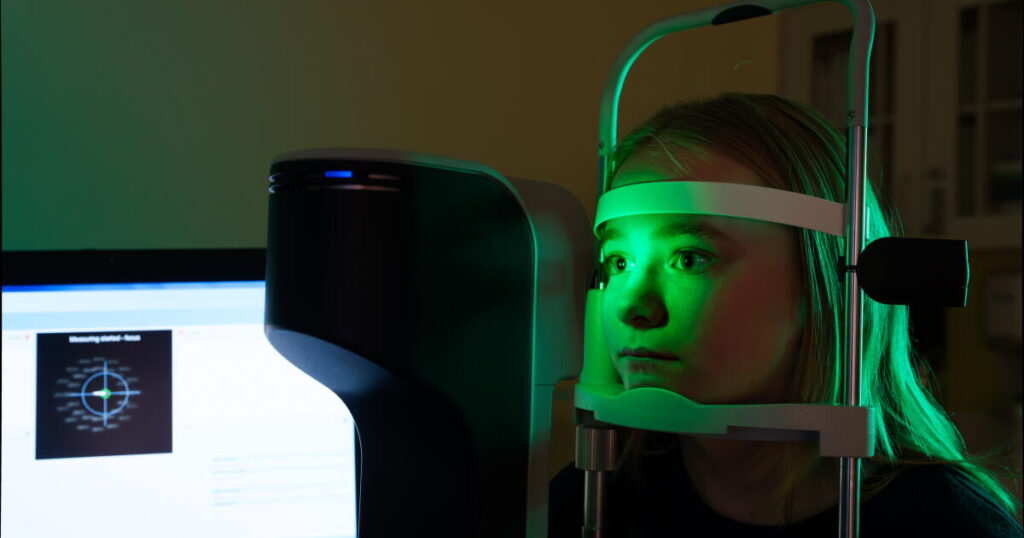
New research tools also are helping science better understand how kids’ behavior influences myopia development. Dr. Elise Harb, a pediatric optometrist and clinical professor at UC Berkeley and UC San Francisco, uses kid-friendly wearable technologies that collect a more detailed picture of a child’s visual environment and daily activities than traditional research questionnaires can provide.
She’s preparing to launch a large, collaborative and international three-year study funded by the American Academy of Optometry Foundation that will follow children in the U.S., Norway, Singapore and Australia to see what factors contribute to myopia development and progression.
“The myopia epidemic really started before device use was ubiquitous in the home,” Harb said. “The general feeling is [screen time] is probably not the only thing to blame, and surely this myopia thing is multifactorial.”
For Viva, who recently turned 13, contacts and glasses haven’t gotten in the way of a busy schedule of sports, theater and horseback riding. She volunteered to participate in an ongoing study from Harb’s lab. For six weeks, she wore glasses fitted with sensors that recorded the light levels and nearness of objects in her field of vision, taking them off only for sleep and horseback riding and diligently charging them each night.
“We have a lot of conversations at home about the scientific method and how research advances … and she was eager to be able to contribute,” Van der Hoof Holstein said. “She thought it was pretty cool that her data could be useful for other children.”
The post A ‘tidal wave’ of severe eye disease is looming. It starts with childhood nearsightedness appeared first on Los Angeles Times.