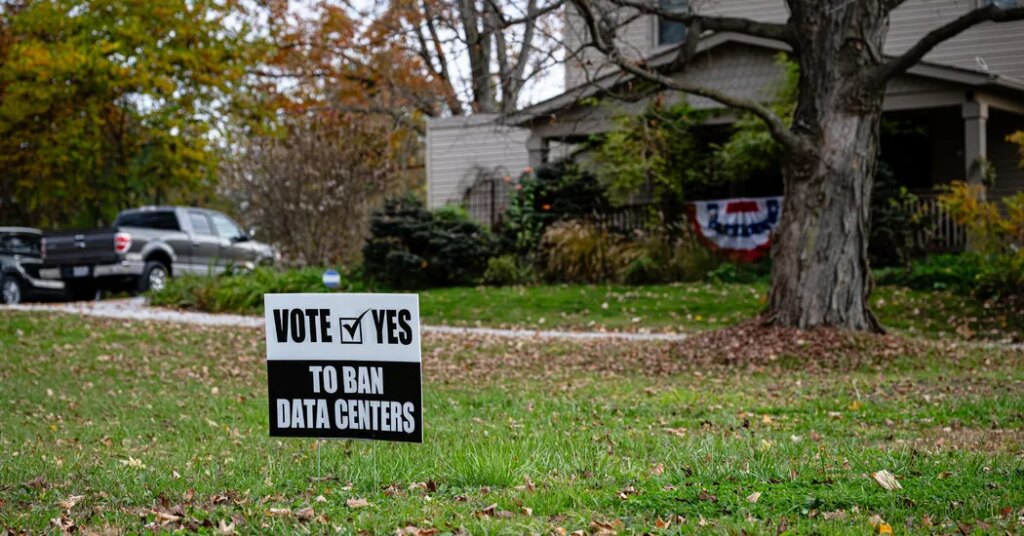
Voters on Tuesday slammed the brakes on data centers and swept in governors and legislators who have promised to protect individuals from threats posed by artificial intelligence.
Despite record donations by tech executives to tech-friendly candidates, voters chose a new Democratic leadership raring to investigate the cozy ties between A.I. companies and the administration.
In 40 out of 41 local ballot initiatives across the country — more than half of them in Ohio — citizens voted to limit or prevent data center development. Governors and congressional candidates who ran on anti-tech platforms in Texas, Ohio, Georgia and other states prevailed. And senior Democrats immediately promised to swing a hammer on the industry.
“Expect a tsunami of new rules and oversight,” said Darrell West, a senior fellow at the Brookings Institution, a think tank.
The Republican-led Congress and White House have done little to regulate the A.I. industry over the past two years as fears escalated over the safety of advanced models, the technology’s risks of obliterating jobs, and even existential threats of A.I.’s ability to end humanity. President Trump took the position that the industry should be largely free of regulations that could impede the nation’s race against China for A.I. leadership.
But the hands-off approach stoked broad anger. Communities across the nation protested the building of giant, energy-hogging data centers near their homes and reluctance by Republican leadership to impose A.I. safety rules.
A.I. technology — and the companies behind it — have helped fuel the economy in recent years. Data centers make up a large portion of U.S. construction spending, and tech stocks have driven much of the gains in the stock market.
But polls before Tuesday showed that data centers were broadly unpopular. Voters also expressed anxiety over how A.I. would affect jobs and safety. Even though A.I. wasn’t the top concern, promises to slow data center development and to build guardrails for safer development of A.I. models resonated.
Tuesday’s results “send a message to local and state officials that there is a political upside to blocking, delaying and/or raising the cost of data centers,” wrote Blair Levin, head of policy analysis for investment consulting firm, Optimal Advisory.
It was a dramatic shift for state and local officials, who for years had offered huge tax breaks and other incentives to woo data center developers to their communities. Now, they are pushing data centers to pay taxes, create their own power plants, pay for their use of electricity and water and to contribute to local community resources like education funds.
“The balance of power is now with communities,” said Adam Kovacevich, the chief executive of the center-left tech trade group, Chamber of Progress. “It’s a 180-degree reversal of the power balance.”
In Ohio, Democratic Senator-elect Sherrod Brown, who defeated the Republican incumbent, Jon Husted, painted his opponent as the “face” of the data center industry. Mr. Brown pointed to $2.5 billion in tax breaks for 226 data centers in Ohio over seven years when Mr. Husted served as lieutenant governor.
One ad by Mr. Brown’s campaign said Mr. Husted spent years “aggressively recruiting data centers to the state, cutting sweetheart tax deals and fast tracking approvals, while ordinary residents watched their electricity bills explode.”
Texas Democrats also rode the anti-data center sentiment. The state is expected to have the greatest growth of the giant computing warehouses of any state over the next several years. Elon Musk, the chief executive of the rocket and A.I. company SpaceX and the electric vehicle manufacturer Tesla, spent $224 million trying to elect Texas Republicans who have invited data center development.
During her campaign, Gina Hinojosa, a Democrat who was elected governor of Texas, promised an “immediate moratorium on data centers” until the state passed stronger protections for residents. James Talarico, the Democratic Senator-elect, promised to “rein in” data centers by ending tax breaks for developers, forcing them to pay for their energy and creating A.I. dividends for residents.
Empowering local communities to regulate data centers will probably slow spending on A.I. infrastructure, which is at risk of overheating, said Bernard Yaros, the lead U.S. economist at Oxford Economics, at a conference Wednesday. That in turn will put downward pressure on inflation.
“A bit more moderate of a path for A.I.,” Mr. Yaros said, “wouldn’t be so much of a bad thing for the Fed and for the broader economy.”
Incoming Democratic leaders in Congress have accused the President Trump and Republicans of giving favorable treatment to A.I. executives, despite security incidents this year by rogue A.I. agents from OpenAI and Anthropic that demonstrated the security risks of their models.
In September, Mr. Trump convened chiefs of A.I. companies to the White House and announced the firms would voluntarily monitor their systems for safety vulnerabilities. But critics said the voluntary measures were insufficient to protect from risks.
Starting next year, the Democratic-led Congress plans to introduce many A.I. bills over the safety of the most powerful large language models, protections for the labor force and copyrights, and regulations to protect children from chatbots. (Even if the bills pass both chambers, Mr. Trump is expected to veto any that could slow down the industry’s growth.)
Democrats including House minority leader Hakeem Jeffries of New York and senior Senate members like Cory Booker of New Jersey, have vowed to beef up oversight to look into pay-for-play type relationships between the tech industry and administration. They’ve warned about investigations into Mr. Trump and his family’s business interests, including their cryptocurrency business.
There will need to be “new forests for all of the subpoenas we’ll be printing,” Senator Ed Markey, Democrat of Massachusetts and a longtime critic of tech giants, said in a social media post Tuesday.
Members have said they plan to investigate the approvals of mergers such as the tech union of Hewlett Packard Enterprise and Juniper Networks last year, after antitrust regulators announced a lawsuit to block it months earlier. Democrats have questioned decisions by President Trump’s antitrust officials and the firing of Department of Justice officials who have protested merger approvals.
“The energy around the issues of A.I. and antitrust and corporate power is sky high,” said Representative Becca Balint, Democratic of Vermont who serves on the judiciary committee, in an interview. “What I hear over and over from voters is why aren’t we demanding that this industry pay their fair share for the damage they’ve done.”
Democrats also plan to scrutinize some tech executives close to Mr. Trump, some in hearings on Capitol Hill.
Democrats have already called for more transparency into the role of the venture capitalist David Sacks, a former A.I. adviser to Mr. Trump, who maintained many tech investments. Mr. Musk has also been named as a target of investigations for his close relationship to Mr. Trump, reliance on government contracts and decisions to slow and block his satellite telecommunications service, Starlink, in Ukraine.
As the ranking member of the Senate Banking Committee, which oversees rules about chip sales abroad, Senator Elizabeth Warren, Democrat of Massachusetts, has been a persistent critic of Jensen Huang, the chief executive of the A.I. chipmaker Nvidia. An ally of Mr. Trump, Mr. Huang last year helped persuade the White House to roll back restrictions on chip sales to China. He has also lobbied the Trump administration to allow Nvidia to sell more powerful technology to Beijing.
In June, Ms. Warren asked Mr. Huang to testify about his views on export controls, citing evidence that some of the Nvidia’s customers may have broken the law by smuggling its chips into China. He declined.
“If Mr. Huang has time to attend a $1 million-a-head dinner at Mar-a-Lago and fly across the world to meet with President Xi Jinping of China, he should be able to find time to answer questions from Congress,” she said in a statement at the time.
Last week, Ms. Warren renewed her call for Mr. Huang to testify after The New York Times reported that he had a close relationship with a top executive at a Singapore-based data center company whom U.S. intelligence services determined was funneling information to Chinese intelligence. Nvidia had sold the woman’s company at least $4.8 billion of A.I. chips.
Tripp Micklecontributed reporting from San Francisco and Gregory Schmidt from New York.
The post Voters Rejected A.I. in the Midterms. Now Comes an Era of Scrutiny. appeared first on New York Times.