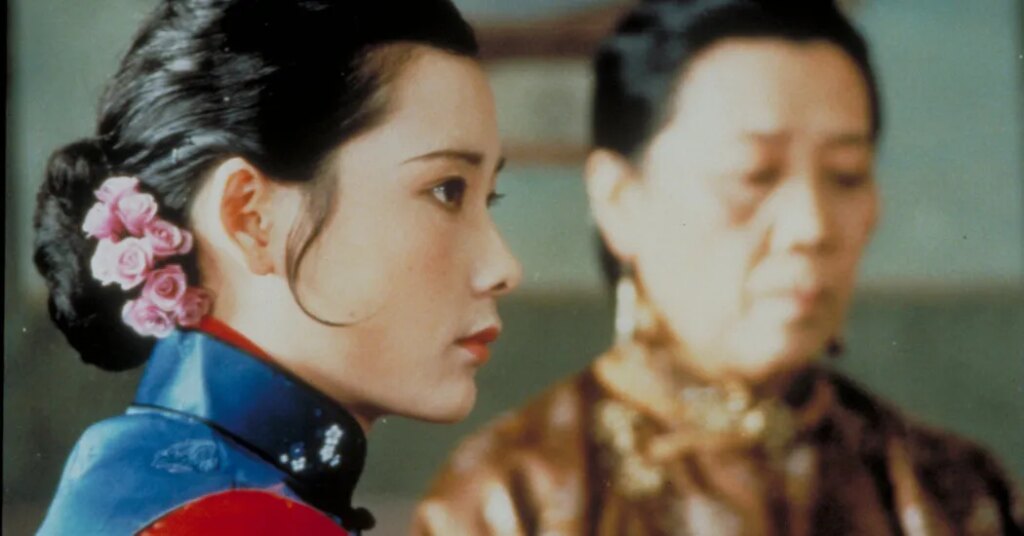
Zhang Yimou’s impeccably fashioned, ferociously anti-patriarchal “Raise the Red Lantern” won the Silver Lion at the 1991 Venice Film Festival, raising the profile of China’s young Fifth Generation filmmakers abroad even as it raised hackles at home.
Opening for two weeks at Film Forum, Zhang’s newly restored fourth feature was also his fourth to star the charismatic Gong Li. It is her quintessential vehicle.
The “Raise the Red Lantern” story is not unlike that of Zhang’s first and third features, “Red Sorghum” (1989) and “Ju Dou” (1990). All three are period pieces in which a beautiful young woman (Gong) is married off to a geriatric representative of pre-revolutionary China with dire results.
In this 1920s-set film, financial hardship compels Songlian, a 19-year-old student, to leave the university and become the fourth wife of a capricious plutocrat more than twice her age. Arriving at his compound with only a suitcase, she finds herself in an enclosed world of stylized rituals based on the master’s nightly choice of concubine. Each woman has her own “house” over which the ceremonial red lanterns are raised should she be chosen. In preparation, the lucky woman receives an elaborate foot massage and the privilege of determining the next day’s menu.
Save for a few rooftop scenes, “Raise the Red Lantern” is shot almost entirely in interiors. Zhang’s studied compositions suggest the influence of the Taiwanese director Hou Hsiao-hsien, one of the movie’s producers, but rather than inspiring contemplation, the symmetry proves confining here. The master’s mansion is an ornate prison.
It is also a nest of vipers. Songlian is slow to appreciate the establishment’s treacherous ways. Taken in by the friendliness of one concubine and repelled by the hostility of another, an opera singer given to shrill nocturnal recitals, Songlian only gradually recognizes the plots around her.
Janet Maslin’s review in The New York Times called the movie a “richly detailed feat of consciousness-raising and a serious drama with the verve of a good soap opera” — to which, one might add, the strategic moves of a high-stakes chess match. Songlian’s attempts to play the game turn the establishment upside down and set loose its ghosts.
The spectacle of women enslaved by a phallocentric order evokes “A Doll’s House” in some ways and “The Handmaid’s Tale” in others. Western critics were accused of over-reading “Raise the Red Lantern” as political criticism, not least by Zhang, the son of a Kuomintang officer, who would transcend an antirevolutionary family background to officially become China’s most lauded 21st-century director. Beginning with “The Story of Qiu Ju” (1992) in which Gong is cast against type as a feisty peasant, his movies have endorsed the status quo.
That cannot be said of “Raise the Red Lantern.” Interviewed in 2005 (after he used the film in sanitized form as the basis for a mixed-media ballet), Zhang linked it to the 1989 Tiananmen Square Massacre. “I was filled with emotion at that time and really wanted to make a statement,” he told the American scholar Michael Berry, adding that the “ceremonies of compulsory behavior” echoed his own youthful experience of the Cultural Revolution. Young and doomed, Songlian is China.
Raise the Red Lantern
Through Nov. 19 at Film Forum in Manhattan; filmforum.org.
The post ‘Raise the Red Lantern’: The Perfect Setting for a Scintillating Star appeared first on New York Times.