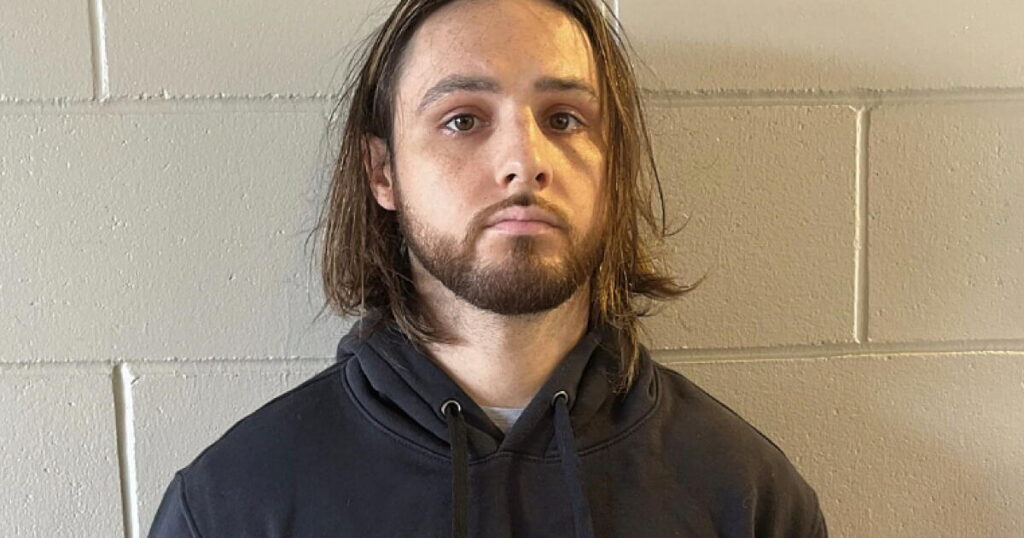
Federal prosecutors on Wednesday again accused a man of using a lighter to deliberately set the blaze that became the devastating Palisades fire, while his attorney argued that investigators settled on their theory months before conducting tests to support it.
The competing accounts opened the retrial of Jonathan Rinderknecht, after his first jury in June deadlocked 10 to 2 in favor of acquittal. Rinderknecht, 30, has pleaded not guilty and U.S. District Judge Anne Hwang ordered that there be no reference to the first trial during the latest proceeding.
Prosecutors have revised the charges against him, narrowing one count to focus solely on damage from the Lachman fire, which began on Jan. 1, 2025. A second count still seeks to hold Rinderknecht responsible for both that blaze and the Palisades fire, which erupted six days later. A third charge of setting timber afire was dropped.
In their second attempt at securing a conviction, prosecutors are putting less emphasis on Rinderknecht’s alleged resentment of the wealthy, instead highlighting laboratory tests they allege prove that a lighter could ignite the hillside vegetation. The defense seized on those tests, conducted after the first trial, to argue that investigators reached their conclusion before testing it.
Rinderknecht’s defense attorney, Steve Haney, said investigators concluded in August 2025 that an open flame started the fire. Rinderknecht was charged that October, but his lawyer noted that authorities did not request the lighter tests until July 2026.
“Decided, charged, tested,” Haney said. “Remember that order.”
Assistant U.S. Atty. Matthew O’Brien told jurors that surveillance images, cellphone location records and fire science would establish that Rinderknecht intentionally ignited brush on a Pacific Palisades hillside in the first minutes of New Year’s Day 2025.
“The evidence will show beyond a reasonable doubt that defendant lit this fire on Jan. 1 and that he did so on purpose,” O’Brien said.
The case turns on two disputed questions: whether Rinderknecht maliciously started the roughly 10-acre Lachman fire on Jan. 1 — and whether that blaze continued smoldering underground before emerging six days later as the deadly Palisades fire, which killed 12 people and destroyed thousands of structures.
O’Brien said investigators determined that the blazes were “actually one continuous fire,” with embers surviving in underground roots before powerful winds brought them back to the surface.
Haney disputed that connection, telling jurors they must evaluate both questions separately.
“The government has never claimed that Jonathan lit a fire on Jan. 7,” he said.
Both sides described Rinderknecht working as an Uber driver on New Year’s Eve before parking and hiking to a clearing known as Hidden Buddha.
O’Brien said cellphone location records placed him in a brush-filled gully about 20 feet from where investigators determined the fire began. Rinderknecht repeatedly tried to call 911, but later falsely told investigators he had first spotted the flames from farther down a hiking trail, the prosecutor said.
Haney challenged that reconstruction, questioning gaps in surveillance images and noting that no witness or camera captured the ignition. He played Rinderknecht’s call to 911, which finally connected around 12:17 a.m.
“There’s a fire, there’s a fire,” Rinderknecht said. It was one of 16 calls Rinderknecht made to 911.
Haney described the calls as efforts to summon help. O’Brien said investigators suspected Rinderknecht made recordings of several attempts to reach 911 in order to create an alibi.
As in the first trial, prosecutors said investigators ruled out fireworks, cigarettes and other potential causes. But Wednesday’s opening also highlighted laboratory tests of an open flame — and gave Haney a new line of attack.
In 67 lighter tests, Haney said, material sometimes caught fire, but the flames went out every time. He played a video showing material briefly burning before the flames died.
“That fire couldn’t even get across a baking pan,” he said.
The defense attorney again raised fireworks as an alternative while stressing that Rinderknecht did not have to establish how the fire started.
“We don’t have to answer that question,” he said. “He doesn’t have to prove how the fire started. The government does.”
Haney renewed his argument that the hillside was not secured after the Jan. 1 fire and had burned a second time before federal investigators examined it, destroying potential evidence. He also questioned investigators’ failure to obtain Verizon cellphone records before they became unavailable.
O’Brien again portrayed Rinderknecht as angry and unusually interested in fire, citing images of burning forests he generated before the blaze. But his opening did not repeat June’s detailed discussion of a French rap video featuring fires or its explicit description of revenge against society as a motive.
Haney urged jurors not to let Rinderknecht’s private messages, searches or personality substitute for proof of arson.
“At the end of the trial, I promise you you’re not going to be asked if you want Jonathan to be your friend,” he said. “You are going to be asked about what happened on Buddha Hill in the first few minutes of Jan. 1.”
The post Palisades arson case: Second trial begins against man accused of sparking wildfire appeared first on Los Angeles Times.