Republicans began picking through their party’s post-midterms wreckage Wednesday to ask about — and argue over — how things went so, so wrong in President Donald Trump’s second term.
Tuesday’s blue tsunami not only washed out Republicans’ House and Senate majorities, it carried Democrats into office even in deep red strongholds like South Carolina, Kansas, and possibly Mississippi. It seemed to be a decisive thumbs down from the electorate on the second Trump administration.
These results also mark the effective start of the battle to determine what the Republican Party will become after Trump — both who the 2028 GOP presidential nominee will be, and what the party will stand for overall.
Within hours of the results, a sort of narrative warfare began to unfold, as different politicians, advocates, and factions tried to advance their preferred accounts of what exactly went wrong, who should get the blame, and what the party should change for the future. Here are three theories of what went wrong that are already starting arguments between big names on the right.
Was the war by far the most important thing – or just one problem among many?
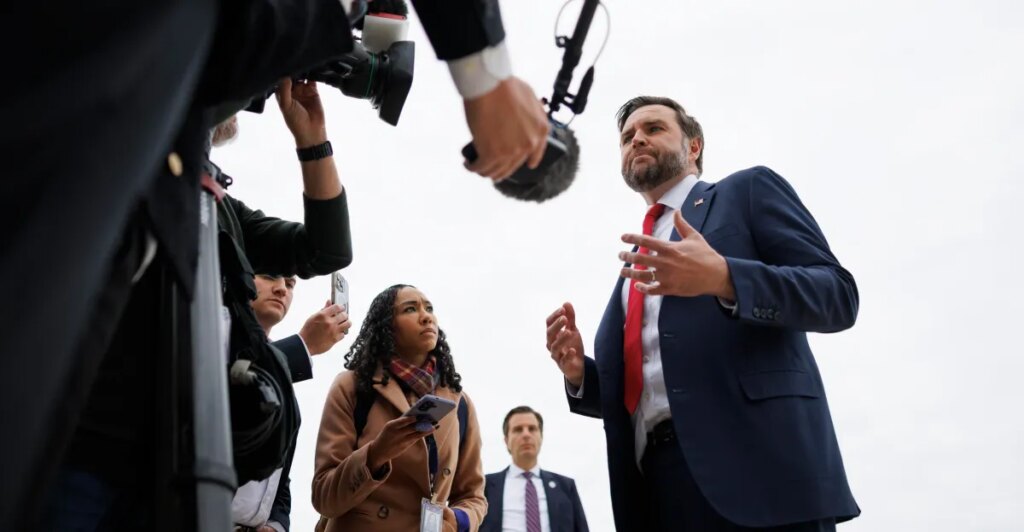
The conversation about what went wrong is especially important for Vice President JD Vance, who remains the frontrunner for the GOP presidential nomination, but is inextricably tied to an administration that increasingly looks like a failure. So it was noteworthy that he offered his own account of what happened.
Vance’s post-mortem glancingly mentioned a few issues, such as “cost of living/inflation,” and floated that he’d be open to changing immigration “enforcement” (though he reiterated he’d never support “amnesty”). He also cited voters’ belief that the United States should “change our relationship to Israel,” perhaps helping explain why Trump announced on Election Day that he’d decided to end aid to Israel after this year.
Yet there was one factor Vance wanted to be sure got most of the blame: the Iran war.
“The reason we lost is the war,” Vance wrote. What’s more, he claimed that “everyone knows” that is the case, and that “any honest conversation about where we go from here must start there.”
That position is no surprise coming from Vance, who has long been a critic of the hawkish GOP foreign policy establishment, and who had hoped to help steer Trump’s second term on a different course.
Vance is associated with an “America First” faction that was deeply skeptical of US involvement in foreign conflicts, particularly in Ukraine and Iran.
But Trump ignored their advice, sided with the hawks, and launched his Iran war early this year. And though Vance stood by that decision publicly, he now wants it known that he was right all along.
Curt Mills, executive director of the American Conservative magazine and a critic of the hawks, told me Wednesday that Vance had a tremendous opportunity to help negotiate an end to the conflict: “He’s in a pole position to get us out of this mistake, and I think if he does do that, he will be associated with ending the war, not starting the war.”
The right’s internal conflict between the hawks and the America Firsters, has long been bitter and personal, and goes beyond Vance. Aspects of it played out publicly among commentators Wednesday, with hawks like talk radio host Mark Levin deriding the idea that the war sank Trump.
“The mid-terms were not lost over a single issue. And anybody with a functioning brain knows that,” Levin posted on X. He added that, to the extent the war harmed Trump politically, it was the fault of the America Firsters’ campaign to “undermine” it.
But right-wing commentator Ryan James Girdusky argued to me that the war hurt Trump’s coalition beyond just driving up energy prices. “In 2024, TikTok was all, ‘Trump is great, Trump is the man,’” he said. “What’s the vibe on TikTok today? It’s, ‘You’re at war for Israel.’ That is a completely different narrative, and that’s a mainstream narrative on TikTok.”
Is this outcome a rejection of Trumpism – that necessitates something very different?
Another narrative some began advancing was that the midterm elections were a repudiation of Trumpism in general — and, particularly, all the ways Trump deviated from the GOP’s pre-Trump conservative principles.
The exact specifics varied, but the conservative commentator Erick Erickson summed up the gist of it by writing:
It was gas prices. It was the war. It was also the corruption. The incompetence. The tariffs. The playing nice with Russia. The impression of cruelty. The overly aggressive deportations. The accidental arrests of American citizens who were Hispanic. The arrogance. The ballroom. The reflecting poll. The golf courses. The arch. The Qatari 747. The aggressive redistricting push. The threats against enemies.
There was also Sen. John Curtis (R-UT), who criticized “a hastily executed war, headline after headline of scandals, a ballooning $40 trillion debt, and unpredictable tariffs” while saying it was “time for Republicans to return to the principled conservative values that once defined us—and that we’ve steadily abandoned over the last decade.”
Florida Gov. Ron DeSantis, a past and perhaps future Republican presidential candidate, had some pointed criticisms for the Trump administration even before the results were in. This week, he said that in addition to failures on affordability and the Iran war being a “big, big drag,” the administration’s aggressive approach to immigration under former Homeland Secretary Kristi Noem had created “unnecessary” conflicts.
But DeSantis also emphasized another issue: corruption.“This swamp here is the worst it’s ever been,” he said. “Look at the amount of money these people are making, who are in the administration,” he went on, specifically calling out Trump lawyer Alina Habba for reportedly getting a $10 million a year contract while advising the Justice Department.
Then on Wednesday, DeSantis gave a lengthy press conference in which he portrayed the results as “close to an extinction-level event for Republicans.” Again, he cited the cost of living and corruption, and said that he himself does not trade any stocks while he’s in elected office.
What can Republicans do about the economy?
There was widespread agreement on the right that Trump had failed to address voters’ concerns about affordability and high prices.
There was much less agreement on why, exactly, Trump had failed on the economy — and what Republicans should do instead.
To the GOP’s free market faction, Trump had blundered with his tariffs, which, in addition to being handled chaotically, helped drive prices up. Curtis, the senator from Utah, mentioned tariffs and a failure to address the debt as major errors from the administration.
Those sympathetic to the populist right were more reluctant to blame the tariffs per se. Gidurksy told me that “the tariffs didn’t do what the anti-tariff audience said they were going to do” — that they did not cause economic catastrophe or raise prices as much as economists had predicted.
Indeed, beyond the tariffs, many on the populist right believe that the Trump administration’s true failure was not delivering on their economic populist rhetoric. For instance, Trump’s biggest legislative accomplishment — the One Big Beautiful Bill Act — was mostly orthodox conservative Republican policy, focused on cutting taxes (particularly for the wealthy) and paying for it by slashing Medicaid and SNAP benefits.
But outside a couple of working-class flourishes, like exempting tips from taxes, it did little to address the broader affordability problem. Gidursky told me that the administration’s most acute problem was that gas prices, interest rates, and health insurance premiums kept getting more expensive, and the administration simply didn’t manage to address that.
“Life is too expensive,” right-wing commentator Benny Johnson posted on X. “Especially for young people. This is a crisis. Communists will win on the ‘affordability’ question if we don’t end the war and fix prices.”
Still, coming up with an agenda that can actually address those voter concerns is more challenging, especially with the deficits and inflation concerns potentially constraining both parties from considering major new tax cuts and benefits. And making major long-term headway on spending cuts would likely require looking at programs like Medicare and Social Security that voters punished Republicans in the past for trying to remake, and that Trump moved the GOP away from considering touching. This tension between offering voters more direct help or retreating to austerity is likely to loom over the 2028 presidential campaign. But for now, Republicans are still struggling to figure out a clear agenda on the economy that resonates with voters.
“Voters are signaling they are unhappy with the economy, the Iran War, and corruption,” the influential right-wing activist Christopher Rufo posted. “It’s about policy.”
The post Whose fault is the GOP’s cataclysmic defeat? 3 theories are gaining steam on the right. appeared first on Vox.