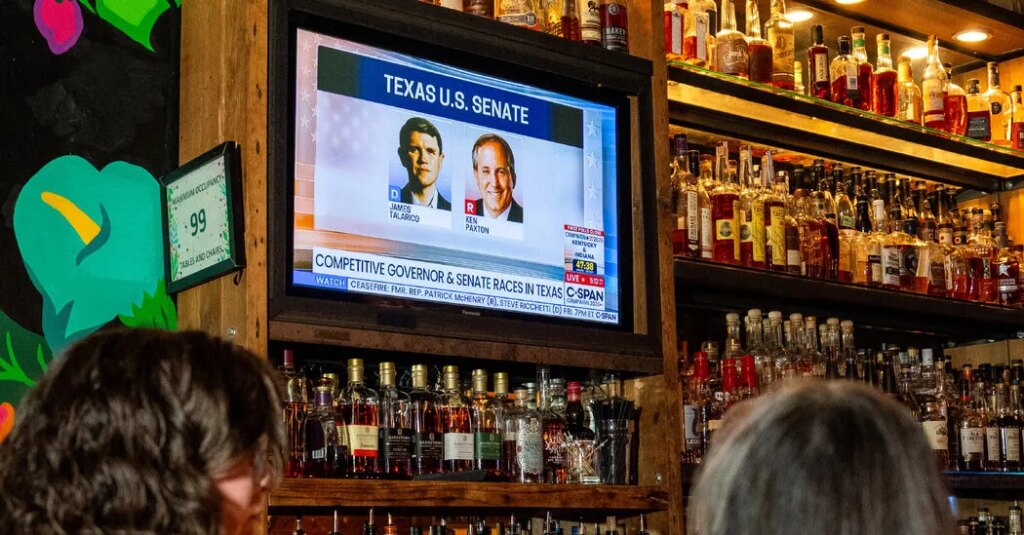
The word of the night was “Wow!”
You started hearing it early in the coverage of the 2026 midterms, as NBC’s analyst Steve Kornacki got the first returns from Indiana and sniffed the salt breeze of a coming Democratic wave.
There was a hushed “Wow” or two in the Fox News studio as the network called both the Texas senate and governor’s races for Democrats. There was a “Wow” and an offscreen chuckle at MS NOW as Rachel Maddow announced the first Democratic Senate win in Kansas since 1932.
“I can’t quite believe it,” she said.
Believe it. We have become used to televised election nights that are as lengthy and unresolved as an overstuffed Netflix serial, counted into the wee hours, resolved days later. In 2018, Donald J. Trump’s first midterm, the newsroom narrative meandered, as what first appeared to be a fizzled Democratic outing eventually turned into something more decisive, if not absolute.
Tuesday night, you couldn’t miss the wave. You were soaking in it. A sane viewer not writing on deadline could have gone to bed at a reasonable hour with a solid sense of the story.
The news came in a rush of percentages and benchmarks and counties flipping from red to blue. Every square inch of the networks’ Jumbotron-sized smart screens was tested as the data nerds were thrown more surprising numbers than they could point at.
But if the magic walls provided the stats, the faces and voices in the studios told the story. There was the electric sense of a big change, even before the networks were able to officially call the Democratic takeover of Congress. “The trend lines appear to be moving in one direction,” said CBS’s Major Garrett early on, “and that is a blue-hued direction.”
A midterm election is a political change, but it’s also a casting change. For years, the serial “America” was dominated by the performative kayfabe of an aging reality TV star, with an interruption by the Democratic elder statesman Joe Biden. Suddenly there was an entirely new roster of protagonists.
One of the most prominent was James Talarico, the 37-year-old senator-elect. Seeming to sense that the Texas decision might serve as the night’s climax, CNN set up the host Erin Burnett near his headquarters, and his acceptance speech, carried live, had a theme of page-turning.
“It has been 10 years of this kind of politics,” he said. “Politics as blood sport. Politics as trolling and owning. Politics as professional wrestling.”
The magnitude of the night was maybe most clear on the Republican home-team clubhouse, Fox News. The network offered red loyalists comfort in a remote report from a celebration at a bar in Florida, a key state where Republican incumbents managed to hold on.
But in the Fox studio itself, the mood was more like Edward Hopper’s “Nighthawks.” The panelists — excepting the occasional guest from the left like Bill de Blasio — were subdued and glum, the feisty Sean Hannity calling the news “brutal.”
At times, the guests searched for a positive spin for the president, the network’s No. 1 guest and viewer. The commentator Larry Kudlow suggested that “Mr. Trump was too successful in the first year.” (The president called in Tuesday night to defend his administration, accept the results — “The end result is what you saw tonight on television” — and complain about the network’s polls, even as reality was bearing them out.)
On most other screens, though, a narrative emerged quickly and clearly: This was a repudiation. There was the price of gas, of course, and the price of everything else; there was the war in Iran and the tariffs and the ICE shootings.
Running through the commentary was a sense that something was happening that was bigger than the price of diesel, something generational. The story of America had been one thing for the last decade or so. Now it was going to become something else, even if we were still figuring out what.
American politics was not quite done with bizarre turns in these midterms. A candidate dropped out in Maine; another was pitted against a doppelgänger in Alaska; in Michigan Haley Stevens, who lost the Democratic primary, became the baffling main character of the final weekend with a chaotic endorsement of the Republican candidate.
And viewers who stuck through to the night’s end were treated to a surprise twist. Shortly after 1 a.m., the long-shot Democratic challenger in the Mississippi senate race pulled ahead by a mere 28 votes. On NBC’s live Kornacki Cam on YouTube, the analyst rifled through papers, typing and muttering to himself, as he tried to sleuth out where the outstanding vote was and whom it would favor.
Let no one ever tell you that math isn’t riveting.
All the night’s excitement, however, could not keep some of the talking heads from looking ahead to the next drama. Well before prime-time was over and the races called, the panel on NBC began speculating how the night’s results would affect the presidential campaign in 2028.
Said the anchor Savannah Guthrie, “I’m fining everyone two dollars!”
The post On TV, the Midterms Offered Drama and a Casting Change appeared first on New York Times.