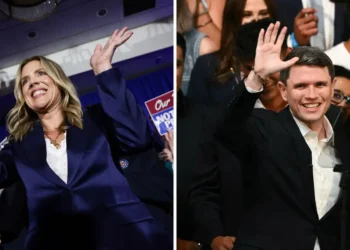
Democrats’ massive wins on election night in Congress — and state races across the country — have opened the door for the party to deliver on one of its biggest campaign promises: making people’s healthcare cheaper.
When Democratic House leader Hakeem Jeffries declared victory on Tuesday night, he promised that his new majority would try to undo the massive Medicaid cuts that the GOP Congress approved in 2025. A new class of Democratic senators — including James Talarico in Texas, Abdul El-Sayed in Michigan and Annie Andrews in South Carolina — are coming to Washington having backed a diverse suite of health policy ideas, from major overhauls like Medicare-for-all to targeted reforms like ending prior authorization for some services.
Change doesn’t come easily, however, and people should keep their expectations in check: President Donald Trump is still in the White House, and that will limit how much policy work gets done in the next two years.
But that doesn’t mean we’re stuck, either. Everybody recognizes US healthcare is a mess, and lawmakers from both parties have expressed interest in smaller-scale changes that could actually pass in the next few years and get Trump’s signature. Given how massive the Democratic wins were, Republicans in Congress and even Trump himself may have a political incentive to cooperate with the new Democratic majorities: By a 19-point margin, voters said they trusted Democrats more than Republicans to address healthcare costs, according to a KFF analysis of exit poll data. And at the state level, Democrats will have freer rein to do what they want in the near term.
Larry Levitt, executive vice president for health policy at KFF, said he expects Democrats to push through ambitious healthcare bills — such as a repeal of the One Big Beautiful Bill Act’s healthcare provisions — that Trump will veto. “Then the game of chess between Democrats and Trump will begin to figure out what on healthcare can actually get enacted,” he said.
The other looming issue for Democrats will be the 2028 presidential campaign, in which candidates will have to figure out how much to promise if they win full control of the federal government. It could be a messy intra-party fight — or they could use this time to find a consensus that allows them to actually pass a bill in a few years. Will the progressive wing push hard for Medicare-for-all? Can Democrats unite around a public option?
These questions won’t be answered definitively before 2029 — but whether Democrats can start to make headway in bridging their differences or not will go a long way toward determining what’s possible.
There are a lot of balls in the air at once, even as Americans are desperate for relief right now. Here is how US healthcare could actually change at the federal and state level in the short term — and a look ahead at the long-term prospects for more far-reaching reforms.
What Congress could do in the short term on healthcare
Donald Trump’s veto pen will dictate how far Democrats can go in the next two years. But there could be room for compromise. Both parties have serious criticisms of the health system, and, on some narrow problems, the two sides are actually pretty aligned on a need to do something. Those issues are the best bets for action in the next two years.
1) Reforms for Medicare payments
One top target would be limited Medicare payment reforms. Medicare is the single biggest healthcare program in the US, and even smaller-scale changes could help reduce premiums and out-of-pocket costs for millions of American seniors, while saving taxpayers money.
Here’s one opportunity for change: Under the current Medicare payment system, the price of a procedure is based in part on where the procedure is being done. So the cost of the exact same service could vary widely based simply on which building it’s performed in: A routine injection for knee pain or inflammation could cost $65 in a doctor’s office — but more than $300 if it’s done at a hospital’s outpatient clinic.
The reason for that huge discrepancy is that Medicare allows hospitals to charge a separate “facility fee” on top of the charge for the service itself. While the exact solution would need to be worked out by lawmakers, both sides have endorsed the idea of ensuring procedures cost the same no matter where they are performed.
That would be a win for patients, because their out-of-pocket costs are based on the total bill. And while the effect may not be enormous, lower hospital spending could also help soften premium hikes in the years to come for all Medicare enrollees.
It’s a policy change that hospitals have long opposed, because they don’t want their payments cut. But DC insiders believe the appetite could be growing to do something about that and other narrow billing issues. Former Democratic healthcare adviser Ezekiel Emanuel and Trump healthcare ally Brian Blase co-authored a Washington Post op-ed endorsing a fix during the week leading up to the midterms.
“Hospitals will always have their friends and allies. They’re the largest employers in a lot of districts. Nobody wants their hospital to close. But I think there’s also a healthy amount of skepticism around, well, wait a minute… What are these billing practices?” Kim Monk, who tracks healthcare policy for the investment research firm Capital Alpha, said. “I think it’s at least something that Congress is willing to take a look at.”
And given how roundly voters rejected AI in the midterms, Democrats could also feel empowered to push for more transparency or even restrictions on how Medicare Advantage plans use AI in ways that lead to patients being denied coverage for medical services.
2) Fixing the No Surprises Act
Of course, fixing healthcare is easier said than done — and sometimes well-intentioned policies don’t work. That’s why the next Congress could also look at remedying an earlier bill that aimed to address hospital billing but has gone awry in practice. The No Surprises Act passed in late 2020 (and was signed by Trump) to try to make sure that Americans didn’t get a massive bill if they were treated by an out-of-network provider when taken to a hospital for an emergency.
But the arbitration process that the legislation had set up to figure out how much the hospital should be paid by the person’s insurer in that scenario has been a mess, with a huge backlog waiting to be cleared. “The No Surprises Act obviously is not working as intended. Maybe they can fix it,” Monk told me. “That’s another one we’re watching.”
Insurers have blamed the law and its alleged favoritism toward providers in the arbitration process for contributing to recent premium hikes, and Democrats argue that creating a simpler system would help rein in rate increases for everyone.
3) Making medications cheaper
Drug costs are a particular point of frustration for most Americans — and it’s another area where both Democrats and Republicans have been circling some of the same policy solutions.
For instance, many Americans with diabetes still struggle to afford insulin, and there is one proposed solution in Congress that already has bipartisan support: a $35 cap for private health insurance plans, matching the cap that already exists in Medicare. Members from both parties have also co-sponsored bills making technical changes to prevent drug companies from using patent law to extend their monopolies and stave off generic competition, which could help bring cheaper versions of breakthrough drugs to the market sooner. One such bill passed the Senate unanimously over the summer, but was never taken up by the GOP-led House.
Democrats could test Trump’s willingness to cut a healthcare deal by pushing legislation based on an idea he himself has endorsed: tying US drug prices to international averages. Democrats could also look to expand Medicare drug negotiations and make more medications eligible for cheaper prices. It’s in theory an issue where they could pick off some Republicans and even win over Trump, who has endorsed negotiations in the past.
4) Reversing the GOP’s Medicaid cuts
One other unlikely change is still worth mentioning: Democrats are going to try to reverse the One Big Beautiful Bill Act’s Medicaid cuts and restore lapsed funding for the ACA marketplaces. They have said that’s their top priority.
Trump probably isn’t going to sign a law repealing a big part of his own signature bill. But the new Democratic majorities are certainly going to press: DC insiders told me they expect Democrats to put together a healthcare-focused budget reconciliation package that can pass the Senate with only 50 votes and make overturning the Medicaid cuts its centerpiece.
This approach will allow them to make the case that they are trying to undo the damage that they accused Trump and the Republicans of inflicting throughout the 2026 campaign. It will force Republicans to take tough votes on an issue that has already cost them dearly at the ballot box. And it sets the stage to make a more serious run at overturning the OBBBA if Democrats win full control of the government in 2029.
“That’s an opportunity for them to drive a wedge right into the Republicans,” Monk said. “Make Trump veto it. It becomes a 2028 issue.”
What states could do on healthcare after the 2026 elections
States have less sway than the federal government in shaping healthcare policy: They can’t touch Medicare, for example, nor the large employer plans that cover tens of millions of people. But they can still take some steps to make healthcare more affordable. In states where Democrats will assume full control of the government, they will have more leeway to pursue whatever agenda they wish and get creative with how they leverage state budgets and expand coverage or control medical costs. The question is whether the new administrations decide to make a major healthcare push a priority.
5) Medicaid expansion
Democratic victories in Georgia and Texas could finally open the door to expanding Medicaid through the ACA in those states. Under the law, states can receive generous federal funding in exchange for expanding Medicaid eligibility to all people making 133 percent of the federal poverty level or less (that’s about $21,000 for an individual or $44,000 for a family of three). But after the Supreme Court decided in 2012 that the expansion had to be optional for states, 10 states have resolutely refused to accept it — with Texas in particular being the biggest holdout.
Democrat Keisha Lance Bottoms, who will be Georgia’s next governor, said she would make expanding Medicaid a priority, and Democrats look likely to win control of the state House there. In Texas, Democrat governor-elect Gina Hinojosa also ran on covering more people through the state’s program; Democrats are likewise leading the race for the state House majority. It looks like a real possibility for the first time since the law passed in 2010. However, their success is not assured: It appears both newly elected Democrats will have to negotiate with a Republican state Senate if they are going to make expansion happen.
If those states did expand Medicaid, it could be one of the biggest impacts of the 2026 election: An estimated 1.1 million people would be covered in Texas and another 144,000 people would get coverage in Georgia.
6) Public health insurance options
The most sweeping policy change proposed across multiple states is the creation of a new public insurance option. Public options were put forward by Democratic gubernatorial candidates in Wisconsin, Maine and New Mexico, and all three candidates prevailed on Tuesday night. In Wisconsin, Democrats actually secured full control of the state legislature for the first time in over a decade.
Colorado and Washington have had public options up and running for a few years now, setting a template that these other states could draw from. That could allow their public options plans to quickly take shape and deliver more coverage options for people in those states in the next few years.
7) Prescription drug prices
Prescription drug prices are another area where states have some limited authority to make changes in the short term. Democrats ran on prescription drug initiatives in the governors’ races in Michigan, Nevada, Maine, and Georgia, and all of those candidates won their races, including Bottoms’s historic triumph in Georgia. Some of their specific proposals included capping Medicaid prices for drugs at Medicare-negotiated rates and establishing state boards to review drug costs.
8) Canceling medical debt
Canceling medical debt was put forward by Democrats in Ohio, Nevada, and Michigan, paired with technical provisions around how healthcare debt is reported for credit scores. Once again, on a very good night for Democrats nationwide, all three candidates — Amy Acton, Aaron Ford, and Jocelyn Benson, respectively — won their elections and will have a chance to try to enact the policy in office.
9) Protecting abortion rights
One healthcare issue where states hold more power than the federal government is abortion access. In Missouri, Nevada, and Virginia, voters backed direct ballot initiatives to protect the right to have an abortion. And the Democratic victories in Wisconsin, North Carolina, Iowa, and Georgia could allow politicians in those states to either restore abortion access (by, for example, reversing an existing six-week ban in Georgia) or at least preserve it (by blocking any new restrictions, as in North Carolina after Dems seized control of the state House there).
10) Serve as an incubator for other unique healthcare policies
States are laboratories for policy innovation. The Massachusetts health reform experiment of the early 2000s turned into the Affordable Care Act for the entire country. The public options currently being test-driven at the state level could be the template for a national program. For any Democratic governors who have national ambitions, making a push in the next two years could pay off in two ways: delivering results for constituents and elevating their political profile.
Several Democrats proposed bespoke healthcare policies that they can now try to pass. In New Mexico, Democratic governor-elect Deb Haaland has pledged to place a limit on private equity’s ownership of healthcare providers and prohibit interference with clinical decision-making. Minnesota Democrats could aim to approve new state assistance for people who purchase insurance on the ACA marketplaces, in order to try to soften their premium increases.
It will be worth watching whether these efforts and others can gain traction and ultimately achieve results. Private equity’s encroachment into healthcare has raised serious concerns about the quest for profits negatively affecting patient care — can states identify effective strategies for pushing back and preventing those adverse outcomes? Can they use state funding to lower healthcare costs for the people they represent? We shall see.
Democrats need to figure out their long-term healthcare agenda
Even with some short-term relief, America’s healthcare crisis isn’t going away. People are fed up: Millions of people are losing their insurance, and millions more are seeing their premiums spike while struggling to afford medical bills. There is going to be pressure for Democrats to think big in the next two years, especially as the presidential race heats up and lawmakers look ahead to 2029.
“That aspirational agenda has no chance of passing the next two years, but it will lay down important markers if Democrats win the presidency and congressional majorities in 2028,” Jonathan Oberlander, professor of social medicine at the University of North Carolina and the former editor of the Journal of Health Politics, Policy and Law, told me.
The pressure could increase if, as expected, Democrats cannot restore funding for Medicaid or the ACA while Trump is president. According to the Commonwealth Fund, the US uninsured rate spiked from 9 percent in 2024 to 11 percent in 2026. Those losses could grow in the next year as costs continue to rise for millions of people. That’s the kind of crisis that demands a policy response.
Congress and the presidential primary will be the forums for figuring out the party’s long-term plans. Candidates will put forward proposals. House and Senate committees will surely hold hearings to explore a variety of ideas; as Monk described it to me, Democrats are currently in an “all ideas are welcome” phase.
A lot of attention will focus on Medicare-for-all or public option proposals. But Democrats have other big ideas they can start working on now, too. They could develop plans to improve Medicare benefits for current enrollees: Sen. Bernie Sanders (I-VT) has signaled he wants to make this a priority by adding vision, dental, and hearing benefits, for example. They could also work on a long-term care plan; Sen. Ron Wyden (D-OR) has been soliciting ideas. This is leftover business from the ACA — a long-term care insurance plan that passed as part of the original bill was dropped before ever taking effect — and the issue is becoming more urgent as the baby boomer generation gets older.
The real push for those policies might have to wait for 2029. But Democrats can start trying to build a consensus now.
And as they begin to identify policies to move on in 2029, they could even start figuring out what is passable via budget reconciliation ahead of the 2028 election. The Senate’s procedural rules create important guardrails for what can pass with less than 60 votes and navigating that byzantine process can be a headache; getting a head start over the next two years would help grease the wheels for quick action if Democrats control the entire government in 2029.
So even though the short-term prospects for change may be limited, this week’s elections and the policy work to come could still prove pivotal in the effort to fix American healthcare.
The post 10 ways Democrats could make healthcare cheaper after their huge election wins appeared first on Vox.