This story appeared in Today, Explained, a daily newsletter that helps you understand the most compelling news and stories of the day. Subscribe here.
Many a pundit spent this morning with his or her thesaurus, seeking aquatic metaphors more portentous than “wave.” Call it a blue deluge. A blue 100-year flood. A blue tsunami — a blunami! — even.
Whatever you call last night’s historic rout, the political class is still working through the flotsam and jetsam today. Democrats won not only the US House and Senate, but governorships, state legislatures, and a slew of other down-ballot offices across the country.
Democrats were favored to take the House, of course — but not to win this dramatically across the board. Over the past several months, voters have expressed mounting frustration with Republicans and the Trump administration on issues including corruption, the war in Iran, and the runaway cost of living.
Last night’s results suggest those issues did get people to the polls: Nearly nine in 10 voters said the cost of living was a major factor in their vote, for instance. But there was also a surprise sleeper issue here — a triumph of mobilization over manipulation, if you will.
In red states across the country, Republicans sought to redraw congressional districts to give themselves a leg up. And that project appears to have backfired, thanks in large part to Black voters.
Go a little deeper
Consider the extraordinary case of Mississippi, a deep-red state that the national Democratic Party all but abandoned this cycle.
The Magnolia State has not elected a Democratic senator since 1982, and the party’s chances since then have not exactly gotten brighter. Republicans control the Mississippi legislature, governor’s mansion, and both US Senate seats, plus three of its four congressional districts.
But as of 5 pm ET on Wednesday, Scott Colom — the Democrat running for Senate — leads the incumbent Republican by fewer than 100 (!) votes. Win or lose, that showing far exceeds what most pundits even thought possible.
“This is all a reaction to voting rights,” explains Vox’s editorial director Benjy Sarlin. “Yes, people are mad about prices. Yes, they’re mad about the Iran war. But voting rights was also a huge motivator.”
Ironically, the GOP seems to have created this particular problem for itself. After the Supreme Court rolled back voting-rights protections this spring, including restrictions on gerrymandering, Republican leaders in Mississippi began the controversial process of drawing new electoral maps. That process threatened to dilute the state’s Black vote across multiple districts and eliminate the seat of its only Black representative.
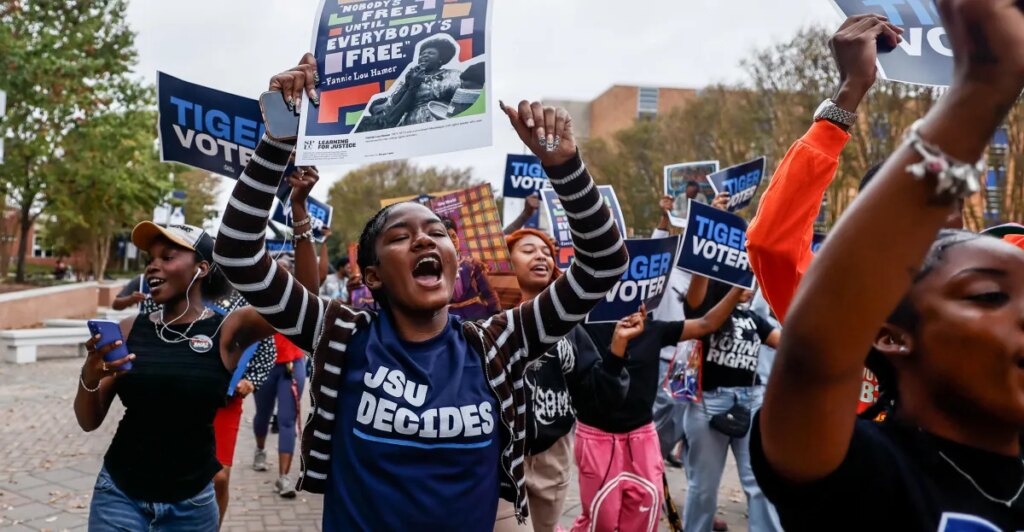
Black voters revolted. “People are fired up. They’re incredibly engaged,” one Mississippi reporter told Vox’s Astead Herndon. Colom, the Democratic Senate candidate, even made voting rights a powerful centerpiece of his campaign’s closing argument.
Early reports suggest that message resonated: One voting rights group said that Black turnout in Mississippi might even rival the group’s turnout in the 2008 presidential election. In parts of the state on Tuesday, Black voters “overwhelmed” the polls.
We can’t say for sure that these voters were reacting to redistricting, of course — but turnout was consistently high in majority-Black counties across Mississippi and the broader Deep South. It was “especially pronounced,” per the NAACP, in states that redrew their maps this year.
Colom was, after all, not the only Democrat to far exceed expectations in a Southern state. In Georgia, Texas, Alabama, and North and South Carolina, Democrats won races they weren’t expected to win or won by vastly larger margins than polls had suggested.
Georgia’s governor-elect, Keisha Lance Bottoms, scored 54.3 percent of the vote in what was supposed to be a neck-and-neck contest. Georgia Sen. Jon Ossoff bested his challenger by a walloping 18-point margin.
In North Carolina, Dems not only picked up a Senate seat with almost 60 percent of the vote, but they also won House races in districts that had been redrawn to favor Republicans. Even Louisiana — Louisiana! — almost elected a Democrat to the Senate.
In the process, these states have opened up what my colleagues dub “a new era of American politics”: one that scrambles old assumptions about which voters, and which states, belong to each party. It’s a pretty heady time for Democrats.
The question now is whether they can hold that coalition even after the proverbial floodwaters recede.
One link for later
➨ You actually can buy happiness. At least for other people! A 2025 report from the Happier Lives Institute, a research organization founded by the Oxford University philosopher Michael Plant, ranks world charities by how much their work increases life satisfaction in the populations they serve. It’s a helpful frame for thinking about your own charitable donations.
Before you go…
- Did you know…that paper currency has existed since the 10th century? China first got that paper, as the kids say, during the Song Dynasty.
- Today’s trivia: Which massive e-commerce website explicitly bars its users from selling their souls? (You can find this and other brain puzzles in Vox’s daily crossword. Look for the answer in tomorrow’s edition.)
- Yesterday’s trivia: Yesterday we asked you for the dog breed beloved by both Rob Zombie and Queen Victoria. That would be the pug, which, as of last year, ranked as the 38th most popular dog in America.
The post How Democrats won the Deep South appeared first on Vox.