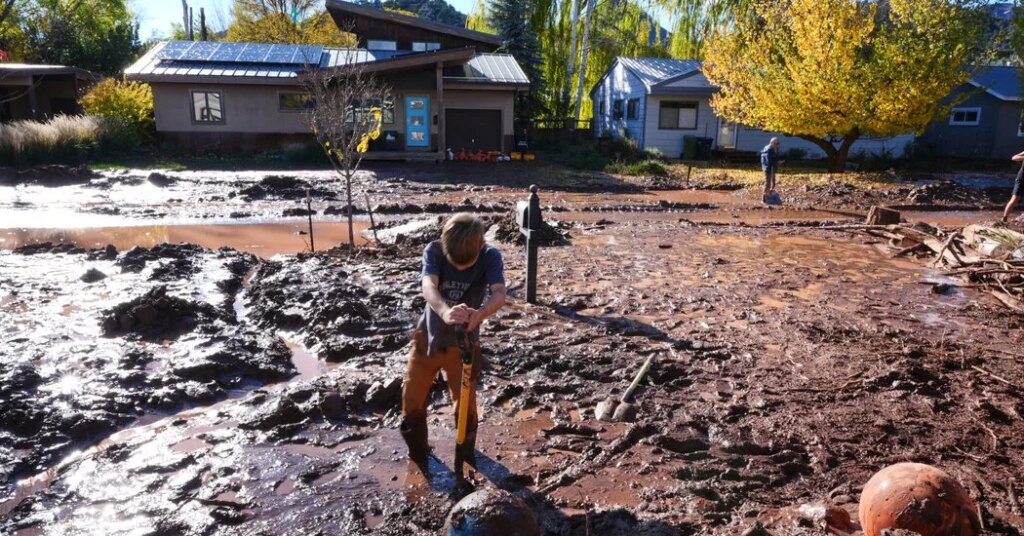
Floods have overwhelmed parts of the parched American Southwest in recent days and weeks, pouring water into critically low reservoirs.
But the deluge did little to ease worries over the water crisis that required significant limits on usage across the Colorado River basin earlier this year.
Instead, it exemplified a sort of weather whiplash that is becoming more common as the climate warms, making it harder to maintain a stable water supply for the West. Right after enduring one of its driest stretches of spring and summer on record, the Southwest is now experiencing one of its wettest autumns.
“It gives us a little bit of breathing room, but we’ve just got to see how much it snows this year,” said Kathryn Sorensen, research director at the Kyl Center for Water Policy at Arizona State University.
Here’s what to know about the floods and what they mean for the Colorado basin, which supplies water to 40 million people and 5.5 million acres of farmland across parts of seven U.S. states, as well as about two dozen Native tribes and two Mexican states.
How much has the rain increased water supplies?
Water levels have risen sharply in Lake Powell, the nation’s second-largest reservoir, which straddles the Utah-Arizona border. The lake’s surface rose by nearly 16 feet from mid-September through the end of October. Lake Powell is expected to continue to rise once floods that hit parts of Colorado and Arizona last weekend flow downstream.
Along with Lake Mead, Lake Powell provides a stable water supply for the Colorado River’s populous and growing lower basin, including parts of Arizona, Nevada and California.
Both reservoirs had hit record lows in August.
Will the rainfall help reverse water shortages?
Lake Powell remains less than 26 percent full, so it would take years of rainy and snowy weather — along with continuing water use cuts — to replenish it. Even with the recent precipitation, on Sunday the lake was only at 41 percent of its average for this time of year, dating to 1963.
The Colorado’s flow has diminished by about 20 percent over the past two decades, as the Southwest has endured a stretch scientists say is its driest in 1,200 years.
Nevertheless, the wet weather could provide some medium-term benefits, Ms. Sorensen said.
The rain has saturated soils across much of the Southwest, causing more precipitation to run off rather than percolate into the ground. While that is making the floods worse, it could also mean that more of any precipitation that falls in the coming months will make it into reservoirs, Ms. Sorensen said.
It may also prevent many farmers from drawing water from the river, she said, easing the strain on reservoirs.
Does the recent wet period suggest a snowy winter could be ahead?
There is no observed link between wet fall weather and the snowy winters needed to ensure a stable year-round water supply, said Cody Moser, a senior hydrologist at the Colorado Basin River Forecast Center.
A year ago, the Southwest received similarly heavy autumn rains, but a record snow drought followed in the winter. That led to drastic water use cuts this summer in states that rely on the Colorado. Melting snowpack is responsible for roughly 80 percent of the river’s flow in a typical year.
Is the ‘super’ El Niño causing the floods?
It’s definitely contributing. The climate pattern that is strengthening in the Pacific Ocean is increasing the amount of moisture reaching the Southwest, Mr. Moser said.
El Niño is tied to unusually warm waters across the central and eastern Pacific, where it has been increasing hurricane activity. That tropical moisture is fueling storms affecting the Southwest.
The phenomenon is known for delivering heavier-than-normal winter precipitation to Southern California and, to a lesser extent, the Southwest.
What about climate change?
Climate change is also adding to the intensity of the rain, as well as the whiplash the region is experiencing between drought and floods.
As temperatures warm, the air can hold more water. That means storms can carry greater amounts of precipitation and deliver more intense rainfall than in the past.
That increased capacity to hold water vapor means the air can also suck more moisture out of the landscape. So during dry seasons, vegetation and soil can become parched more quickly — counterintuitively, exacerbating drought.
“We are seeing a higher frequency of more extreme events on both ends,” Mr. Moser said. “Unfortunately, the drier events have been outweighing the wetter events over the past 25 years.”
Recent water extremes on Lake Powell demonstrate the challenging trend.
The lake received record inflows in October of about 1.6 million acre-feet, Mr. Moser said. One acre-foot of water is enough to supply two or three households for a year.
Compare that to the 1.1 million acre-feet that flowed into the lake during a key stretch from April to July, when winter snowmelt typically refills the reservoir. That was the second-lowest inflow on record for that period.
Such extremes are becoming more common, Mr. Moser said: “They both happened in the same year.”
The post Why Southwestern Floods Won’t Solve a Water Crisis appeared first on New York Times.