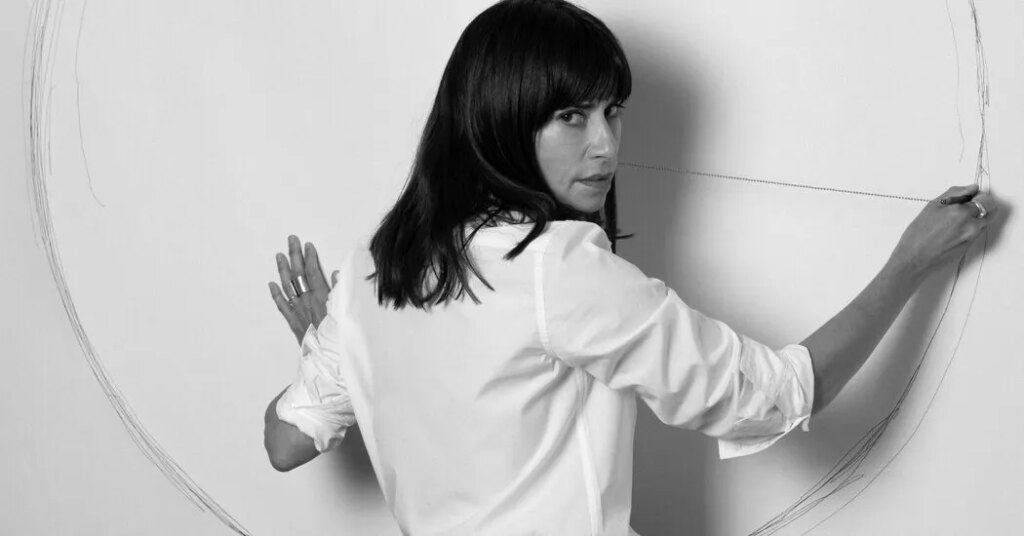
Jill Magid makes impossible things happen.
The New York-based conceptual artist once talked the Amsterdam police into hiring her to decorate its security cameras with rhinestones.
After 9/11, she convinced a New York police officer to let her accompany him on nighttime patrols.
Nearly three decades after the Mexican architect Luis Barragán died, she worked with his family to exhume some of his ashes to be compressed into a 2.02-carat diamond.
“At this point, I never disregard Jill’s ideas that seem impossible to achieve,” said Sandy Rower, the president of the Calder Foundation, which in 2017 awarded her its Calder Prize, which comes with $50,000.
Most people make art with paint or clay. Magid, who is 53, uses the letter of the law and the power of persuasion. She has spent her career meticulously studying seemingly impenetrable systems of authority and control — including the Dutch Secret Service, the New York Police Department and the U.S. Mint — only to poetically insert herself into them. She aims to reveal that the structures that govern our world are more permeable, more human, than we assume. “She’s not trying to dismantle systems,” Rower said. “She’s trying to show you how they work.”
In Magid’s latest artwork, “With Full Consent,” the artist has infiltrated one of the world’s most powerful systems: the U.S. government. More specifically, she sought to have her entire body of work published by the Federal Register. The project is designed to stretch our understanding of where art can be found — not in a museum, gallery, or even a public plaza, but in the public record.
The Federal Register is the government’s daily diary. Every weekday (except holidays), it publishes new regulations, proposed regulations and notices issued by federal agencies. (The register has published more than 65,000 pages so far this year.) Franklin D. Roosevelt authorized its creation in 1935, when the New Deal-era government was expanding and it became nearly impossible to track new rules. Today, any agency that wants to change or implement a rule generally solicits comments from the public through the register.
Magid’s goal was to smuggle a book about her career, known as a monograph, into the register. The book, also titled “With Full Consent,” includes images and descriptions of every major work she’s made; essays by critics and curators; an exhibition history; and, in a fittingly meta twist, her own fictional obituary, which she commissioned a writer to create. To get the book into the register, Magid turned all of its 275 pages into prints that stand as solo artworks.
That was just the beginning. Because only the president and federal agencies can submit material to the register, Magid had to find an agency to act on her behalf. And she had to mold her project to fit an existing legal pathway. “It seemed impossible,” said Cuauhtémoc Medina, a curator in Mexico City who has worked with Magid.
After years of study, negotiation, and trial and error, Magid accomplished her goal. On Sept. 28, the Federal Register published an official notice declaring Magid’s work “of cultural significance.” The notice is part of a relatively routine procedure to protect artworks traveling to the United States from abroad. But now, any member of the public can submit a request to the U.S. State Department for the list of “culturally significant” objects tied to the artist, which in this case is Magid’s monograph, page by page. “Instead of buying the monograph, you can just request it,” she said. In effect, Magid made the government her publisher and her artistic collaborator.
This project, like many others, seeks to tease meaningful connection, even eroticism, out of bureaucratic systems. In “Evidence Locker” (2004), for example, she submitted formal requests for CCTV footage of herself walking through the city of Liverpool in the form of love letters to the authorities. Seduction is at play in “With Full Consent”: “I’m consenting to become vulnerable to the state,” she said. “We’re entangled.”
The State Department has said that Magid’s application was not unusual. The outcome “does not mean the department endorses the objects, their creators, or any views connected to them,” the State Department said in a statement.
The commercial book, published by Dancing Foxes Press and Creative Time, comes out on Nov. 20; that day, a presentation of Magid’s work opens at Calder Gardens in Philadelphia. Through Nov. 23, the prints she made and the Federal Register notice will be on view there, and visitors can pick up a postcard addressed to the State Department to request the monograph.
Coinciding with America’s 250th anniversary, the project can be seen as an absurdist embrace of (and elegy to) government norms at a time when the Trump administration has rejected traditional record-keeping practices. (Magid’s title, “With Full Consent,” echoes language from the Declaration of Independence, which states that governments derive “their just powers from the consent of the governed.”)
On a summer afternoon over iced coffee at her studio in Dumbo, a neighborhood in Brooklyn, Magid explained that she had been obsessed with the Federal Register since she discovered it on a visit to a Brooklyn law library in 2018: “I thought it was the most democratic site I’d ever seen.”
A few years later, Magid began working on her monograph. Perhaps, she thought, she could turn the book into conceptual art by making it public through the Federal Register. For an artist motivated by, as she put it, “an existential need to feel that I exist,” what could be more profound than committing her life’s work to public record?
Many were quick to dismiss the idea. Magid recalled one lawyer telling her that the project was “too radical,” because it could limit her rights to her own work.
But Magid doesn’t consider surrendering her body of work to the state a sacrifice — it’s part of the allure. She was delighted that nesting her copyright-protected artwork in the public domain could blur the lines that govern intellectual property and creative authorship. “I feel like my piece is a public artwork embedded in a public square,” she said.
In the end, she achieved her goal by taking advantage of a 61-year-old law designed to protect valuable art, like a Picasso or ancient Chinese scroll, from seizure while on loan to the United States. (In order to qualify for protection, the State Department must deem the art “of cultural significance” and its display “in the national interest.”)
Crucially for Magid, each notice of immunity is published in the Federal Register. The process is necessary for historic art with murky ownership and is not typically used to import contemporary art — unless, of course, it were part of an elaborate conceptual project.
Next, she needed accomplices: a foreign museum to acquire the prints and an American one to borrow and display them.
The Pompidou Center in Paris, which already owned works by Magid, agreed to acquire the prints along with a blue box and engraved pen modeled on those accompanying bills the president signs into law. “Placing international loan procedures at the heart of a work, and accepting a degree of uncertainty regarding the outcome, strikes us as both deeply poetic and reflective,” said Xavier Rey, the Pompidou’s director. In March, he wrote a letter stating that the Pompidou would lend the works to an American institution only if they received immunity.
The greater challenge was finding an American museum partner at a moment when institutions are reluctant to irk the Trump administration. Eventually, Magid called Rower about showing the work at Calder Gardens, a temple to the sculptor Alexander Calder. The Barnes Foundation, which helps operate Calder Gardens, filed the application in June.
Sometimes, the process verged on Kafkaesque. In an email exchange reviewed by The New York Times, a State Department employee interrogated what gave the art its value. The work would not be deemed significant enough to be recognized in the Federal Register, the employee said, if the only source of its “cultural significance” was being published in that very register. Over email, Magid and the Calder Gardens and Barnes Foundation team argued for the work’s broader importance, clearing up the Catch-22. (Reached for comment after the notice was published, the State Department said: “Determining that an object is ‘of cultural significance’ also does not mean the department takes a position on what that significance is.”)
Channah Norman, a lawyer with the firm Shook, Hardy & Bacon, which advised on the project, considers it “a kind of absurd civic engagement, using day-to-day bureaucracy in a totally unexpected way.”
Back at her studio, Magid summarized her philosophy for infiltrating complex systems as an artist. “Those levers are there to pull,” she said. “The people in power don’t really want you to pull them — or they don’t think you will.”
The post A Conceptual Artist Entwines Her Work With the State appeared first on New York Times.