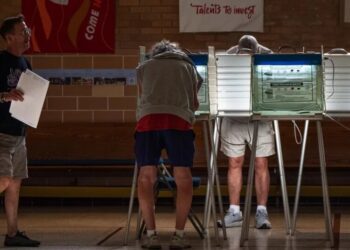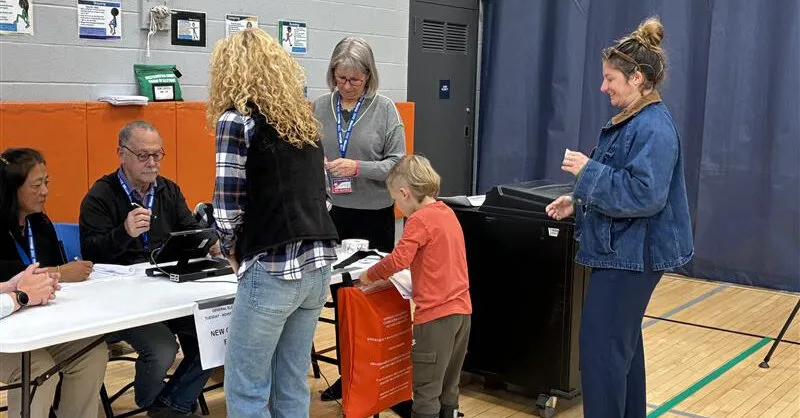
Election officials reported a typical array of glitches at polling places across the country on Tuesday, some serving as provocative fodder for right-wing conspiracy theorists.
Local and state officials described them as the type of unfortunate but innocent hiccups — malfunctioning scanning machines, local power outages, false fire alarms — that commonly emerge on Election Day.
Any potential issues are sure to be under a microscope after attempts by the Trump administration to exert more control over federal elections. With the president continuing to make false claims that the electoral process is rife with fraud, officials across the country have grown increasingly concerned about interference.
State and local officials entered Election Day concerned that minor problems could be seized on by the president and his allies to seek to overturn results. And as expected, false claims quickly circulated as the typical glitches emerged.
Some of the first reported problems were in Westchester County, N.Y., just north of New York City. Voting proceeded despite a malfunction that prevented some scanning machines from accepting ballots, state election officials said. A hand count might be required for some of them.
While the glitches on Tuesday appeared to worry some voters, minor snags with voting machines happen in virtually every election and are usually resolved uneventfully.
In Arizona, two voting centers in Maricopa County closed briefly for “power related issues,” officials said. The news prompted James O’Keefe, the conservative activist and provocateur, to write in an online post: “Time to start investigating this.”
The student union at the University of Texas at Austin, a popular student voting spot, was briefly evacuated when a fire alarm was pulled, according to local media reports. The Travis County clerk’s office told KXAN-TV, the local NBC affiliate, that voting had resumed, and that law enforcement were “reviewing the cause.”
In Broward County, Fla., technical problems delayed the scheduled 7 a.m. poll opening time by 20 minutes, prompting some early arrivals to leave polling sites before casting their ballots. Joe Scott, the county election supervisor, said such problems are “to be expected” on Election Day.
As news of glitches seeped online, conspiratorial messages began bubbling up. Katie Miller, the wife of Stephen Miller, one of President Trump’s most powerful aides, made note of the Westchester problems on social media, declaring, “This is how the Left steals elections.”
Ms. Miller also falsely claimed that officials were turning away voters in the New York suburb.
In another post, Laura Loomer, the far-right activist and informal adviser to Mr. Trump, wrote: “How is it that so many states are all of a sudden having ballot counting issues? Broward County. Of course. Democrats love cheating.”
Mr. Scott, the Broward elections official and a Democrat, lamented the trend. “If anything happens with the election, people immediately go to conspiracy theories,” he said.
In New York, the state’s Board of Elections said in a statement that the issue affecting voting machines in Westchester stemmed from a programming mistake. It appeared to be more widespread than typical glitches, but it was still “well within the world of possibilities that election officials plan for,” said Derek Tisler, a lawyer with the Brennan Center’s Elections and Government Program who specializes in election administration and security.
Voters in Westchester were told that they could still safely fill out and submit their ballots. The note of reassurance came from a statement signed by both a Democratic and a Republican member of the county board of elections.
Instead of feeding ballots into the malfunctioning machines, voters were instructed to place them into separate, secure bags — a standard emergency protocol aimed at ensuring that voting continues without disruption.
Ken Jenkins, the Westchester County executive, said in a video statement that there was no immediate need to extend voting hours amid the issues with voting machines, though he said that candidates and campaigns had made requests to do so.
Kathleen R. McGrath, a spokeswoman for the New York State Board of Elections, said every valid vote would be counted. “Accuracy will never be sacrificed for speed,” she added.
Minor technical issues emerged in other places, including Chester County, Pa. Officials there said they were allowing for 30-minute extensions of voting hours at three polling locations to make up for delays caused by “machine setup issues.”
In Florida, a number of polling places had to be relocated because of flooding from intense autumn storms, with state elections officials posting the substitute voting sites online.
In Fulton County, Ga., officials reported malfunctions of two ballot scanners that occurred in late October, during the early voting period, forcing the county to use an alternative scanning method for roughly 1,000 ballots.
They also warned that some voters had reported receiving bogus messages “regarding polling place changes.”
County officials urged voters to verify their polling place on the state’s voter information page.
Nick Corasaniti contributed reporting.
The post Polling Site Glitches Stir Voter Worries and Unfounded Conspiracies appeared first on New York Times.