Our understanding of Neanderthal life has long been a story told in stone. Because organic matter rarely survives the millenniums, the prehistoric record of any softer innovations has been largely erased by the steady, patient work of chemical decay.
But a geological fluke is helpingupend this history. From 62,000 to 40,000 years ago, the inhabitants of a cliff-side settlement west of Barcelona discarded their wooden tools and housing materials into water that was saturated with calcium carbonate.
Before the wood could rot, minerals coated the objects, hardening into travertine limestone shrouds. Over time, the original plant fibers have vanished, leaving behind hollow, negative impressions, ghostly molds so precise that they preserve tool marks, grain patterns and cellular structures with startling fidelity.
The story that emerges is not of an erratic struggle for survival, but a sophisticated tradition of carpentry and home design.
Still, a separate discovery in a cave in Iraqi Kurdistan offers a stark testament to the dual nature of Paleolithic life: A 75,000-year-old partial Neanderthal skeleton appears to be humankind’s earliest identifiable victim of death by wooden spear.
The mortal blow was a clean, half-inch circular puncture, piercing the left shoulder blade and driving downward through the chest cavity in a targeted strike that researchers describe as a heart shot.
Libby Cowgill, an anthropologist at the University of Missouri who was not involved with the research, speculated that the chest wound was made by a lance that passed through the front of the body and exited through the back.
“If this was a hunting accident, it was a spectacularly bad day on the hunt,” she said.
In Very Cold Blood
Despite the severity of his injury, the Neanderthal with the spear wound also offers a narrative of surprising tenderness.
According to a study published in the journal Scientific Reports, the remains included a nearly intact right hand, a pair of left ribs and six teeth from an individual who died around age 45. Decades of heavy dental wear indicate that this ancient forager endured a catastrophic facial injury about a year before the violent death. The trauma shattered a front incisor and profoundly misaligned the jaw, likely causing prolonged pain. Yet the individual persevered.
Emma Pomeroy, an osteologist and paleoanthropologist at Cambridge and the paper’s lead author, suggested that these healed fractures constitute an early testament to prehistoric empathy. In the grim reality of nomadic foraging, weathering such an injury would have been nearly impossible without a clan committed to securing food and shielding the vulnerable.
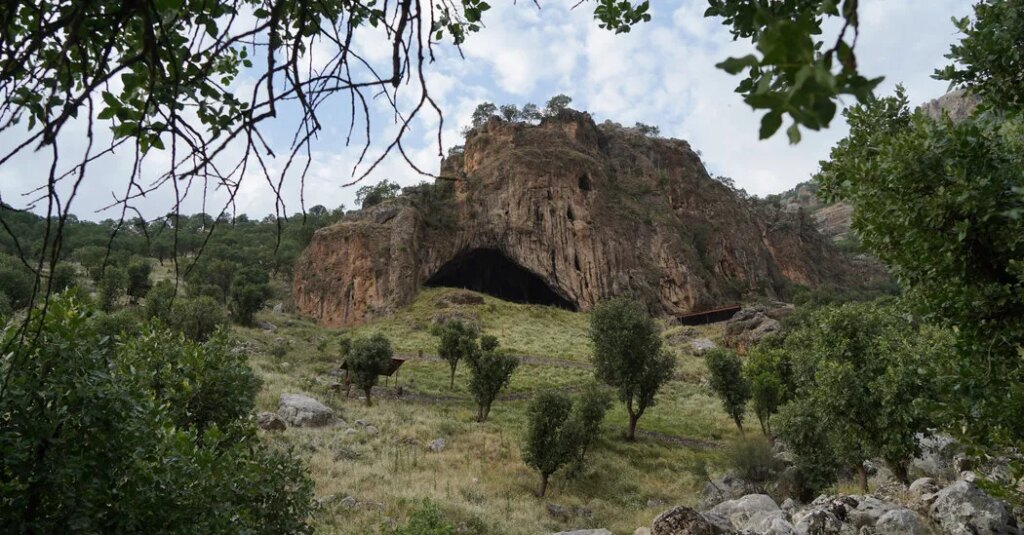
The specimen was recovered from Shanidar Cave, a subterranean site that has long anchored the scientific argument for complex Neanderthal cognition. Since excavations began in the 1950s, the cave has produced several skeletons whose deliberate placement suggested to many the presence of structured funerary rites.
Yet the evidence shows that this profound social care existed alongside the capacity for calculated, face-to-face violence.
Researchers have long known that Neanderthals led perilous lives; their remains frequently bear fractures that have healed. Such damage was traditionally characterized as a hunting mishap or an environmental hazard.
Still, evidence of ancient conflict runs deep. The earliest suspected homicide in the fossil record comes from northern Spain, where researchers at the Sima de los Huesos ossuary uncovered a 430,000-year-old skull that had sustained two distinct, penetrating fractures above the left eye. The wounds indicate that the victim, a proto-Neanderthal, was struck repeatedly during a direct confrontation.
The lethal event at Shanidar represents another rare instance of injury inflicted by a hominin-made tool. The absence of shattered bone fragments around the hole in the shoulder blade led Dr. Pomeroy and her colleagues to hypothesize that the victim was assaulted at close range with a thrusting spear, rather than a projectile.
Bruno Maureille, a paleoanthropologist at the University of Bordeaux in France, agreed that the wound is consistent with the impact of a sharpened wooden shaft. Dr. Pomeroy added that there are no signs that Homo sapiens were present in the region at that time, so the evidence strongly points to a Neanderthal assailant.
This stands in contrast to a separate Neanderthal trauma victim found at the site, from roughly 25,000 years later. Researchers believe that this injury, a nonlethal rib puncture, was inflicted with a hafted stone point. The technological shift occurred at a time when Homo sapiens were expanding into the area, raising the possibility that the attacker was a modern human using a weapon made to be used at a distance.
The more recent narrative of a prehistoric homicide has been met with caution among some experts. Rebecca Wragg Sykes, an archaeologist at Cambridge, noted that while the analysis of skeletal damage is convincing, the interpretation remains debatable.
“We can’t be certain whether the spear wound was accidental or due to intentional violence,” Dr. Wragg Sykes said. The fatal injury could have been sustained during a big-game hunt, delivered by an oryx horn or a deer antler. Dr. Pomeroy countered that the hole is round, whereas antlers and horns tend to be asymmetrical or off-center.
Other critics point out that shifting sediment and tumbling rocks can carve lines into brittle bone that may mimic a weapon strike. Furthermore, it’s not easy to deduce a kill shot from a single, fractured shoulder bone.
Ghosts of an Ancient Workshop
Modern commentators on prehistoric life often find themselves caught between two romanticized extremes: mourning a lost, peaceful idyll inhabited by ancient foragers or endorsing what Dr. Pomeroy called “a Hobbesian caricature of a brutal, primitive existence.”
“Things were not so simple,” Dr. Pomeroy said.
Indeed, the Abric Romani rock shelter, nestled 30 miles west of Barcelona, provides a window into a more hospitable and tactile Neanderthal world.
In a study published this month in Science Advances, researchers led by Palmira Saladie, an archaeologist at the Catalan Institute of Human Paleoecology and Social Evolution in Tarragona, Spain, documented 597 traces of wooden artifacts across 16 archaeological levels.
The discoveries show that these hominins were discerning consumers of the forest, selecting distinct timbers with a craftsman’s eye. Pliable juniper bark was fashioned into trays and storage containers, while dense Scots pine was carved into sturdy thrusting spears.
One of the most striking discoveries is a mace-like implement with no known parallel in the Paleolithic record. The wooden club features a clearly-defined handle and a bulky, flared head that hints at a capacity for bespoke engineering.
The artifacts also show that residents of Abric Romani did not merely endure the elements; they curated their environment. They erected 16-foot-long wooden windbreaks to shield their living quarters from alpine drafts and organized their space into distinct domestic zones. In the sleeping quarters, they maintained small, intentional hearths that functioned as personal braziers, keeping the night chills at bay.
To Francesco D’Errico, a paleoanthropologist at the University of Bordeaux, peering into the rocky molds means realizing that the grand arc of human domesticity — the urge to soften the elements, to organize a room, to choose just the right wood for the job — did not begin with modern humans.
We have long comforted ourselves, he believes, with the notion of our unique refinement, casting our evolutionary cousins as clumsy actors who knew only the blunt violence of a chipped rock. But, Dr. D’Errico said, these finds present a bygone world of historical tradition and social intimacy that today we “could only imagine.”
The post Neanderthals Used Wood for Tools, Housing — and Murder? appeared first on New York Times.