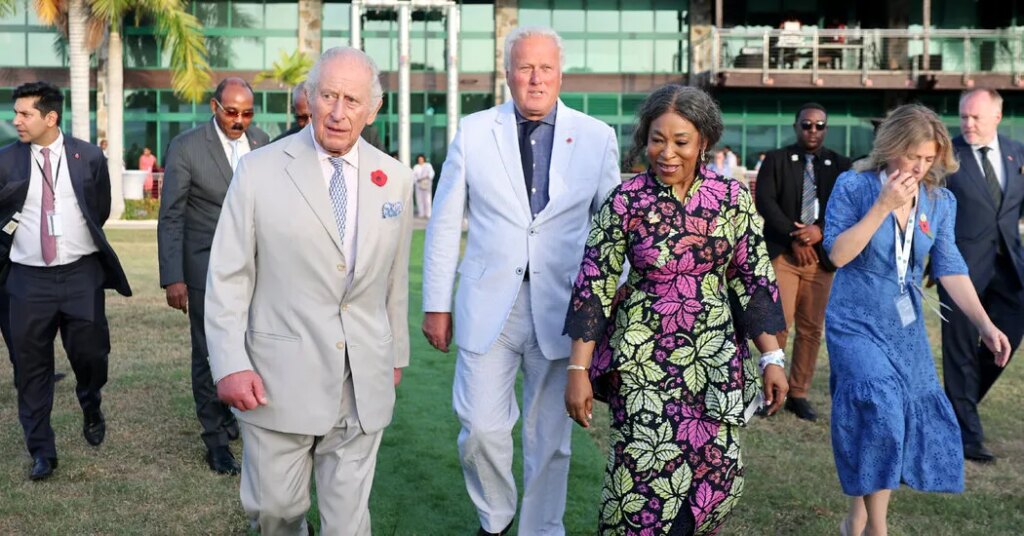
King Charles III and Prime Minister Andy Burnham are both expected to confront the legacy of Britain’s role in the slave trade in speeches at a gathering in Antigua that includes the leaders of many former British colonies.
Their planned remarks follow years of pressure from members of the Commonwealth, a voluntary organization that includes 56 nations, most of which were once part of the sprawling British Empire, for Britain to apologize and pay reparations.
Mr. Burnham wrote in an essay last week that his government was open to a structured conversation with countries affected by the trans-Atlantic slave trade, which he called “a brutal and barbaric violation.” Britain trafficked millions of slaves from Africa in the 1700s and 1800s. Mr. Burnham wrote: “Listening to calls for a formal apology on behalf of the British state will form an important part of this process, and I am open to them.”
However, he rejected calls for reparations, saying that British people should not be “held liable for historical wrongs, however heinous, that happened in a different age under different laws and in which they played no personal part.”
The king has previously said that slavery “forever stains” British history and he asserted last week that the country should directly “acknowledge the great suffering of the past.”
Buckingham Palace said the king’s 15-minute address would address Britain’s colonial connection to the trans-Atlantic slave trade with “unflinching honesty.” The king, as the country’s ceremonial head of state, is constitutionally unable to issue a formal apology unless he is directed to by the government.
Neither the king nor the prime minister is expected to deliver an apology at Tuesday’s opening meeting of the Commonwealth. Government officials said a formal apology could emerge after a “structured dialogue with Commonwealth nations.” The BBC reported that could be within the next year, perhaps when Britain holds the rotating presidency of the G20 group of countries.
“Britain is bringing a new approach to this meeting as we look to reshape a new era for the Commonwealth, as well as being open to discussions about the past,” Mr. Burnham will say in his speech, according to excerpts released by his office.
The prime minister is expected to announce an effort to help Commonwealth nations restructure their debt, allowing them to pay over a longer period of time and at lower interest rates. In his essay last week, he said that he had asked Gordon Brown, a former prime minister and a long-serving chancellor of the Exchequer under Tony Blair’s premiership, to attend the meeting on Tuesday and lead the debt talks.
Mr. Burnham will also announce a task force to encourage development of critical minerals, his office said. And he will promise that Britain will invest 40 million pounds (about $53 million) over the next three years to accelerate critical infrastructure investment in the Caribbean.
King Charles will focus most of his speech Tuesday morning on opportunities for the Commonwealth nations, according to the palace.
“His majesty’s most significant contribution,” the palace said in a statement, “has been helping to connect leaders, institutions and investors — many of whom he knows personally from his many years of international diplomacy — around shared areas of interest and concern, creating the conditions in which ambitious Commonwealth-led initiatives can emerge and succeed.”
The king will mention a nature initiative intended to help protect biodiversity and increase conservation. He will talk about plans for an insurance mechanism to help countries become more climate-resilient and to deal with natural disasters. And he will endorse efforts to bring heads of governments, investors and business leaders together to increase development in small economies.
The post King Charles to Give ‘Unflinching’ Speech on U.K. Role in Slave Trade appeared first on New York Times.