Switzerland held a special place in Sergei Rachmaninoff’s heart. The Russian composer came to the country on honeymoon and once said he would like to be buried in the alpine-fringed city of Lucerne (although he ended up in Kensico Cemetery in Valhalla, N.Y.).
In the early 1930s, he bought a plot of land on the shores of Lake Lucerne on which he eventually built a Bauhaus-style villa, and there may have been another sentimental reason for choosing that particular spot: A short boat ride away is the house where Richard Wagner and his family lived from 1866 to 1872. Another stop on the Rachmaninoffs’ 1902 honeymoon was Bayreuth, Germany, where Wagner built an opera house against all odds to stage his works.
Rachmaninoff had already emerged from a creative slump, supposedly alleviated by a bout of hypnotherapy. But it seems that his encounter with Wagner’s work spurred the young Rachmaninoff, more readily associated with the concert hall as both composer and pianist, to finish two one-act operas, “Francesca da Rimini” and “The Miserly Knight.”
Premiered back to back in 1906, the operas have been reunited in Switzerland this season at the Zurich Opera House. They are preceded by “Aleko,” the one-act opera Rachmaninoff wrote at age 19 for his graduation from the Moscow Conservatory. It is adapted from Pushkin’s poem “The Gypsies,” and the setting recalls Bizet’s “Carmen,” but musically, “Aleko” displays influences much closer to home: Borodin, Rimsky-Korsakov, Tchaikovsky.
Zurich Opera House’s general music director, Gianandrea Noseda, seems particularly well suited to the task of presenting these operatic rarities. Noseda — who also helms the National Symphony Orchestra, newly peripatetic after the Kennedy Center’s closure — has dedicated himself to Russian repertoire for decades and first established himself in his new role at Zurich with a Wagner “Ring” cycle. Next year, he will perform the “Ring” in concert with the Zurich Opera House orchestra at Carnegie Hall, the first time the whole work has been played there.
Noseda seems so comfortable with both Wagnerian and Russian idioms now that he can play with them. He lightened the serpentine phrases of the long, lugubrious preludes of “Francesca da Rimini” and “The Miserly Knight” so that they almost skipped rather than slid, capturing a sense of mirth on the verge of tragic despair. Conversely, lighter balletic textures galloped flat-footedly or roiled impatiently.
There were also moments that seemed to hint at more modernist styles. Toward the end of “Aleko,” as the title character laments his banishment from a travelers’ camp where he has murdered his lover and rival, he is accompanied in the orchestra by a mournful trumpet. In this performance, the trumpet’s tone wobbled on the edge of woe-is-me, looking ahead to the sardonic manner of Shostakovich.
Those exchanges and moments of irony helped support the directorial style of Dmitri Tcherniakov — an émigré from Russia since 2022. Tcherniakov’s work shows not quite disdain for, but at least a distrust of, grand Romantic plots: their jealous men, their honor killings, their chivalric revivals, their declarations of love.
These are the substance of these Rachmaninoff’s operas, which means this triple bill is not the best introduction — and is maybe even a bad one — to these rarely seen works. But the production is intriguing in its own right.
In fact, to call it a triple bill is misleading. Tcherniakov is fond of ripe and rare parings — he has staged Tchaikovsky’s “Iolanta” and “The Nutcracker” (which originally premiered on the same night) in Paris and twinned Gluck’s “Iphigénie” operas at the Aix-en-Provence Festival. In Wagnerian fashion, Tcherniakov combines Rachmaninoff’s distinct operas into a single sweeping drama (with an intermission halfway through “The Miserly Knight”) about a man’s lonely descent into fantasy, megalomania and ultimately madness. Tcherniakov further underlines his auteurish reputation by borrowing from himself.
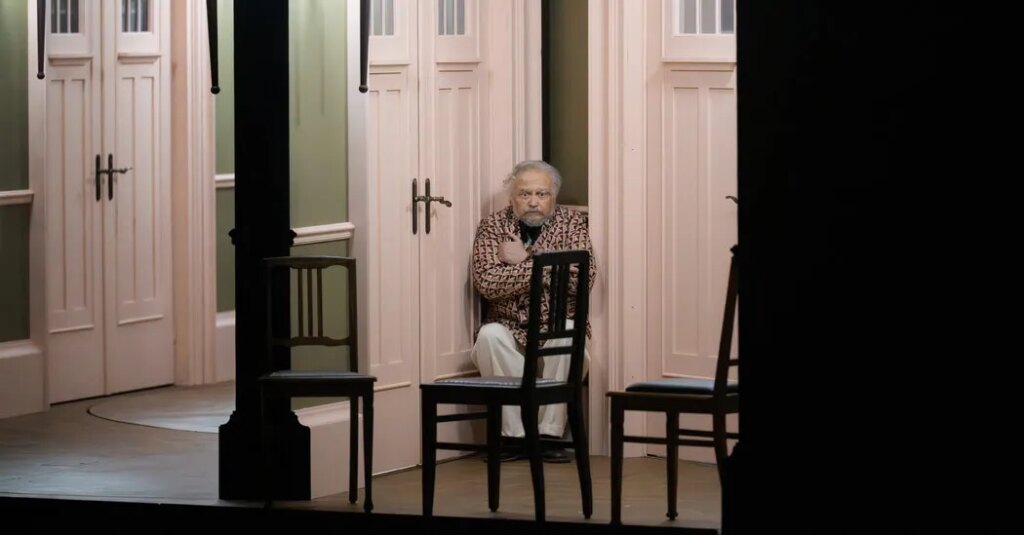
As in his 2023 “Così Fan Tutte,” Tcherniakov ages all of his characters. A projected title tells us that we are in a retirement home, where residents dance conga lines through the armchair-filled rooms. (The costume designer Elena Zaytseva and the makeup team deserve special recognition for transforming the cast.) The main event of these unspecified festivities is a game of improvised role play, with names drawn out of a hat, that just happens to follow the plot of “Aleko.”
Like the depressed businessman in Tcherniakov’s 2017 “Carmen,” who takes part in an immersive theater therapy session of Bizet’s opera but becomes too invested in it for his own good, the character who picks the role of jealous lover Aleko can’t muster the winking detachment of his fellow players. The Baritone Vladislav Sulimsky takes on this part with startling conviction, blasting with Noseda’s aid through Tcherniakov’s layers of irony.
In the next opera, Sulimsky plays the Baron — the miserly knight of the opera’s title — whose profligate son, Albert (the lively, clarion tenor Dmytro Popov), raves about perceived insults to his knighthood. The production’s naturalistic setting, with Albert in a baggy cardigan, makes his claims seem particularly inane, and his deliriousness takes some of the weight out of the sometimes antisemitic abuse that Albert doles out to a moneylender he has turned to in desperation. (Perhaps Rachmaninoff borrowed more from Wagner than we thought.)
Eventually, though, the Baron seems to suffer worse and more ridiculous delusions of grandeur than his son.
In the evening’s final opera, “Francesca da Rimini,” the Baron’s madness becomes all-consuming. Tcherniakov’s treatment of this work about the pair of adulterous lovers in Dante’s “Inferno” redeems one of his least successful ideas from “Aleko,” where the chorus sings from a balcony while the retirees mime.
Now, the chorus — rich and ringing — warbles the wordless laments of the souls in hell in a kind of surround sound. The set comes apart at the seams and revolves in multiple directions, but once it has reassembled, the production runs out of steam.
Back in the retirement home, in a sadder version of the opening game, Tcherniakov has the Baron become a kind of director, forcing a score of “Francesca da Rimini” on the retirees who also took on the lovers in “Aleko.”
As earlier, the tenor Bekhzod Davronov and soprano Elena Stikhina act with a clearly conveyed double consciousness and sing their demanding roles handsomely — especially Stikhina, admirably contained in her upper register. But with static blocking and the singers looking into their sheet music, this stretch resembles a rehearsal, undercutting the lovers’ central duet — which was one of the first things Rachmaninoff wrote after coming out of from under his cloud of depression.
Despite its occasional moments of levity, Tcherniakov’s production seems to move in the shadow of that cloud. You end up feeling a little like the businessman in Tcherniakov’s “Carmen,” somewhat detached and desensitized. What this production perhaps aims for is pity, which is a theatrical emotion — one that relies on certain distance, a view from afar or above. That’s fine as far as it goes. But we still can make a little room for love.
Rachmaninoff: The Three Operas Through Nov. 28 at the Zurich Opera House; opernhaus.ch.
The post In a Rare Evening of Rachmaninoff Operas, Megalomania and Madness appeared first on New York Times.