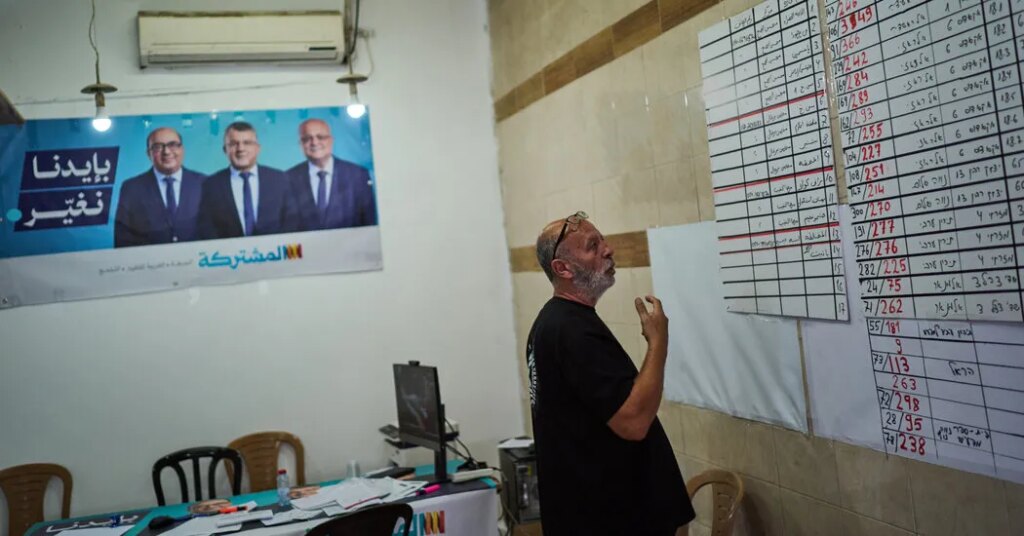
Israel’s democracy is facing a huge test after Arab political parties made historic gains in last week’s election.
And opponents of Prime Minister Benjamin Netanyahu are facing an enormous dilemma over whether Arab lawmakers should now be given a share of power in a new government.
Mr. Netanyahu’s opponents secured a clear majority in the Parliament by winning 67 out of 120 seats. But 19 of these were won by the Arab parties, and their inclusion in a governing coalition is seen as so problematic by many Israeli Jews that opposition leaders are putting themselves through contortions looking for ways to form a government that would not rely on Arab lawmakers.
The aversion to building a government with the two main Arab factions — the United Arab List, or Raam, and the Joint List, which comprises three smaller parties — is enormously frustrating to political activists who helped drive Arab turnout to a near-record high of 77 percent last week.
“Why is it so complicated? A vote of an Arab citizen of Israel should equal no less than the vote of a Jewish citizen,” said Alon-Lee Green, a founder of the Jewish-Arab organization Standing Together.
The efforts to sideline the Arab parties also fuel complaints among many Arab citizens, who represent about 20 percent of the country’s population, that Israeli Jews welcome their participation in the political process only up to the point where they might wield real power.
“This is the problem with Israeli democracy,” said Thabet Abu Rass, a longtime advocate for Arab-Jewish partnership. “It’s a democracy for Jews, but it’s a Jewish state for Arab citizens like me. We Arab citizens are entitled to the same rights, and would like to use them to dictate who’s going to lead the country.”
“But some Jews say no, democracy is for Jews only,” he said. This has become especially true since the Oct. 7, 2023, Hamas-led attack on southern Israel, he said.
Indeed, welcoming the Arab parties into a new government, particularly at a time of conflict, is dismissed by many Jewish Israelis as unworkable, overly risky, and even unconscionable.
Few would deny that racism plays a part. But Israeli Jews also view the particular Arab parties — Raam, headed by Mansour Abbas, and the Joint List, led by Yousef Jabareen — with varying degrees of skepticism.
Mr. Abbas’s party has its roots in the Muslim Brotherhood movement, as does Hamas, a history that right-wing critics often highlight in denouncing him.
But Mr. Abbas was once the first lawmaker from an independent Arab party to join an Israeli governing coalition, and he has won many Jewish admirers by working with Jewish lawmakers. He has focused on domestic issues affecting Arab citizens, like violent crime and discriminatory housing policies, and devoted little attention to Israel’s policies in the West Bank and the Gaza Strip.
The Joint List’s members, by contrast, have focused more on Israel’s treatment of Palestinians in the occupied territories and have generally preferred to criticize government policy from the opposition. Some have denounced Israeli military actions, assailed Israel’s war in Gaza as genocide or referred to slain Palestinian militants as “martyrs.”
“Abbas managed to make himself more legitimate because he made it very clear he’s in politics to look after the domestic affairs of his own community,” said Yohanan Plesner, president of the Israel Democracy Institute, a nonpartisan research group. “But you don’t hear the same music from the members of the Joint List.”
Mr. Plesner noted that even Mr. Abbas, when asked whether he supports toppling Hamas, deflects the question. “Any Zionist Israeli expects that any government would work toward toppling Hamas, because of what Hamas did and wants to do to Israel,” Mr. Plesner said.
Mr. Abbas and Mr. Jabareen bristle at such questions as demeaning and tantamount to demanding loyalty oaths. Both men have condemned the Oct. 7 attack, and Mr. Abbas has said that such violence has only harmed the Palestinian cause.
Before last week’s election, Arab parties never held more than 15 seats in Parliament. Until Mr. Abbas joined the governing coalition in 2021, Arab party leaders generally resisted taking part in governments and thus sharing in responsibility for Israel’s occupation and military actions.
But discriminatory policies, like the demolition of Arab citizens’ homes built without official permits, and soaring crime in Arab towns that Arab Israelis attribute to police negligence, have prodded lawmakers like Mr. Jabareen and others in the Joint List to vow to do all they can to drive Mr. Netanyahu’s government from power.
Discrimination against Arab citizens also undercuts Israel when it trumpets its democratic credentials beyond its borders.
For the anti-Netanyahu opposition, led by the former military chief Gadi Eisenkot, the options for assembling a governing coalition are all uncomfortable.
He could try forming a minority government of fewer than 61 seats in which one or both of the Arab parties would be left outside the coalition but would cooperate to some degree, opposing no-confidence votes in Parliament. Or he could agree to a unity government, if Mr. Netanyahu or some of his allies were to accept the opposition’s terms to share power.
Mr. Eisenkot could also accept a new round of elections in hopes of a better result, though many in the opposition fear this would benefit Mr. Netanyahu, whose alliance netted only 53 seats in the balloting last week.
Rula Daood, another leader of Standing Together, said that by shying away from including Arab parties in a new government, Mr. Eisenkot was playing into Mr. Netanyahu’s hands. She accused the prime minister of seeking to delegitimize the Arab vote by claiming, without evidence, that Arab parties stole the election.
Zvi Hauser, a former center-right lawmaker, warned in the newspaper Israel Hayom that bringing the Arab parties into government could cause a catastrophe. Coalition members, he said, would hold “worldviews that disagree even on basic questions of national security.”
Mr. Hauser wrote that every vote on policies affecting Palestinians in the West Bank and Gaza, enforcement of housing rules in Arab communities or the demolition of the homes of those who attack Israelis could become “a test of coalition survival.”
Yossi Klein Halevi, an author and senior fellow at the Shalom Hartman Institute in Jerusalem, said that he was crestfallen last week when Mr. Abbas, whom he admired, sidestepped a television interviewer’s challenge that he label Hamas a terrorist organization.
Mr. Halevi has denounced Mr. Netanyahu for dividing the Israeli mainstream into his coalition — which puts a priority on Israel’s Jewish nature — and an opposition that prioritizes Israel’s democratic values. But Mr. Halevi said he feared that if Mr. Eisenkot formed a government relying on the two Arab parties, it would destroy the possibility of repairing that rupture for a generation.
“We will be seen as preferring anti-Zionists to our fellow Jews,” he said. “And that will be seen very widely by Jews on the right, and even some in the center, as a betrayal of the most basic Jewish solidarity.”
Among Mr. Eisenkot’s allies, Yair Golan of the left-wing Democrats party has spoken most enthusiastically of Arab party support. In an interview, he said Israel needed to cure itself of the “psychosis” of treating Arab citizens as potential traitors or second-class citizens, arguing that the Arab public had overwhelmingly proved its loyalty and solidarity since Oct. 7.
“They are a part of us,” he said. “We are on the same team.”
Mr. Golan, a former deputy chief of staff in the Israeli military, also dismissed the idea that it was risky to national security to include Arab lawmakers in the cabinet, saying that they would be excluded from the smaller security cabinet where operational decisions are made.
Mr. Golan said he envisioned a government including Raam and relying on outside support from the Joint List. He compared this to the government of Prime Minister Yitzhak Rabin in the 1990s, which led effectively with just 56 seats in Parliament and outside Arab backing.
Some Israelis say the election results have presented Israel with a golden opportunity. By making common cause with Arab lawmakers, they say, the opposition could finally establish a national commission of inquiry into the security failures that led up to the Oct. 7 attacks and adopt military conscription of ultra-Orthodox Jews, who have long been exempt.
“It’s the most delicious moment,” said Yosef Abramowitz, a Jewish renewable-energy entrepreneur who said he had voted for Raam.
“Everybody has to grow up — now,” he said. “The Arabs have to break free of the Palestinian narrative as their organizing thesis. And Israeli Jewish society has to say that a national commission of inquiry and a full military draft are more important than the mythology that all Arabs are terrorists and terror supporters.”
The post A Test for Israeli Democracy: Should Jews Ask Arabs to Join the Government? appeared first on New York Times.