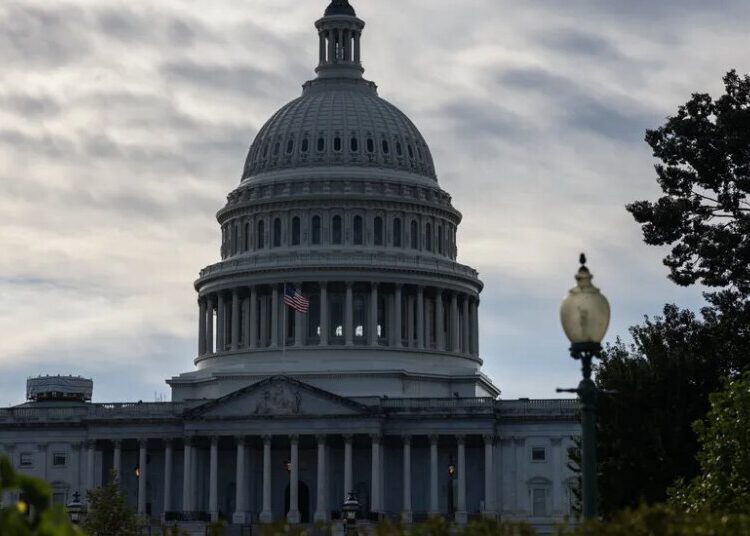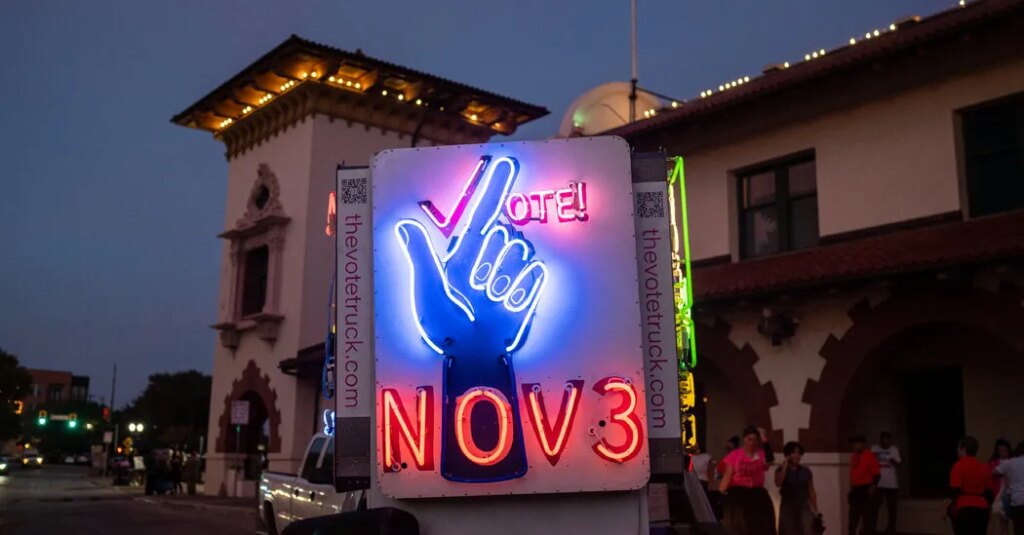
The tumultuous midterm campaign is barreling into its final full day, with both parties offering their closing arguments in a contest defined by economic anxiety, a backlash to the Iran war and disapproval of President Trump’s second-term agenda.
Republicans, fearing deep losses across the country, have unleashed a flurry of attacks, casting their Democratic challengers as radical, dangerous and even anti-American. In Michigan, Republicans seized on a surprising last-minute endorsement of their nominee for the Senate, former Representative Mike Rogers, by Representative Haley Stevens, a moderate Democrat who lost during the primary race.
While Democrats erupted over Ms. Stevens’s decision, the party’s candidates have tried to keep their focus on the three issues that have animated their campaigns for months: affordability, corruption and what they describe as the chaos of the Trump administration.
As Democrats campaigned at tailgate parties, town-hall meetings and church services, they have centered their final arguments on Mr. Trump and his allies, arguing that Republican incumbents were enriching themselves while ordinary Americans struggled to make ends meet.
In Houston on Saturday, James Talarico, the Democratic nominee for the Senate, railed against Ken Paxton, his Republican opponent, accusing him of being controlled by Elon Musk, the world’s richest person, who has injected more than $158 million into the race.
“We have an affordability crisis because we have a corruption crisis,” Mr. Talarico told hundreds of supporters. “It’s why we can’t afford the basics in this economy, because the system has been rigged by billionaires and corrupt politicians like Ken Paxton.”
Mr. Paxton, for his part, has cast Mr. Talarico, who is trying to become the first Democrat to win a statewide race in Texas in more than three decades, as a “radical” who wants to transform the state into a liberal haven.
“This isn’t just red versus blue,” Mr. Paxton said on Friday at his own event in Houston. “It’s the America our founders gave us versus something they would never recognize.”
Strategists in both parties say they believe Democrats will win control of the House, although they differ on how deep into Republican terrain the party’s victories might extend. Democrats have also grown more optimistic, though cautiously, about their chances of winning a Senate majority, even as their party must flip four Republican-held seats and keep all of its own to take control.
The Senate map of contested races has significantly expanded since the start of the year, with traditionally conservative states including Kansas, Texas, Iowa, Alaska, Ohio and even South Carolina in play. All are states that Mr. Trump won by double digits just two years ago.
Polls released on Sunday night from The New York Times and Siena University found Democratic candidates ahead in five states that now have Republican senators and effectively tied in a sixth. They hold leads in Kansas, Maine, Ohio and Texas and a narrow edge in Alaska. They are effectively tied in Iowa. Dr. Abdul El-Sayed, the Democratic nominee in Michigan, was leading by double digits in the state, the lone top Senate battleground already held by Democrats.
Republicans have all but ceded the Senate races in North Carolina and Georgia, dropping their spending in those states and shifting resources to Kansas, Michigan, Ohio and South Carolina, according to data from AdImpact, a media tracking firm.
Early voting across the country reflected the intensity of the election: More than 54 million voters had already cast ballots by Sunday afternoon, with some states that have competitive Senate races showing large increases, according to the University of Florida Election Lab.
In the final weeks, Democrats have tried to capitalize on the discontent of constituencies that tilted toward Mr. Trump in 2024, including Latinos, young men, white working-class voters and rural Americans. Polling, focus groups and interviews indicate that those voters increasingly disapprove of Mr. Trump’s handling of the economy and are skeptical that his administration can bring the cost of living under control.
“I’ve gone out there and said to Republicans, ‘Look, I understand why you voted for Trump, because he accurately identified the status quo was not working for the average person,” Josh Turek, the Democratic nominee for the Senate in Iowa, said as he campaigned at a tailgate party at Iowa State University in Ames. “Now they’re ready for a true common-sense prairie populist that’s actually going to make their lives better.”
Republicans believe that their path to success — or, at least, staving off the worst — depends on driving their core supporters to the polls.
Despite his low approval ratings, many in the party believe that the president remains their strongest surrogate. Mr. Trump announced plans to deliver a closing midterm election message on Monday at the Lincoln Memorial Reflecting Pool in Washington.
On Sunday, Mr. Trump took his whirlwind rally tour to Dubuque, Iowa, and Salina, Kan., and reiterated his calls for supporters to pretend that he is on the ballot.
In Dubuque, he spoke for more than two hours, spending much of the time talking about himself — his electoral margins, his intelligence and his stamina. He defended his stewardship of the economy, pointing to stock-market growth during his presidency, blaming his predecessor for high prices and calling the focus on affordability in the midterms a “hoax.”
As he has for weeks, Mr. Trump “weaved” through his campaign pitch, oscillating between personal and nasty attacks on Democrats, commentary on his renovations of the White House and now-familiar digressions on the physiques of Republican candidates. In Iowa, he praised Representative Ashley Hinson, the party’s Senate nominee, for having lost weight.
Earlier, the president celebrated Ms. Stevens’s endorsement of Mr. Rogers, calling it “fantastic.”
“Nobody expected that, but it’s a smart thing to do because El-Sayed would destroy our country,” he told reporters.
Ms. Stevens’s decision ignited a firestorm within her party, as Democratic leaders spanning the ideological spectrum condemned her move.
“A despicable betrayal,” said Senator Chuck Schumer of New York, the minority leader, who privately backed Ms. Stevens in the primary. “The stakes are too high,” Representative Alexandria Ocasio-Cortez, who endorsed Dr. El-Sayed in the primary, said as she campaigned at a bar in Queens.
For his part, Dr. El-Sayed downplayed the endorsement’s significance. “None of this matters,” he told reporters before quickly turning back to attacks on Mr. Rogers and Mr. Trump.
The focus on Mr. Trump marks a shift from 2018, when Democrats won a significant number of seats during his first term. Then, the party’s candidates largely avoided putting the president at the center of their message in the closing days of the election, instead focusing on issues where they had more popular support, like health care.
Now, many Republican and Democratic candidates are delivering closing pitches that cast their rivals as emblematic of the most unpopular parts of each party.
In Ohio, where advertising spending has exceeded half a billion dollars, Senator Jon Husted, a Republican, focused on socialism, and former Senator Sherrod Brown, a Democrat, accused his opponent of corruption — a charge Mr. Husted denies.
Mr. Husted has painted a picture of a state under Mr. Brown where borders are open to immigrants, sports are welcoming to transgender athletes, and language is policed to the point that Ohioans have to say “birthing person” instead of “woman.”
“It’s common sense versus crazy,” Mr. Husted said at events last week across the Buckeye State.
Mr. Brown, for his part, has depicted Mr. Husted as a tech shill beholden to special interests instead of the people of Ohio.
“Ohio doesn’t have to accept this corruption,” Mr. Brown said at rally on Thursday. “Tell them we’re going to end this war. Tell them we’re going to end these tariffs. Tell them we’re going to clean up the corruption that’s all over our federal and state governments.”
Republican candidates broadly found themselves on the defensive in the final weekend, with polls showing Democrats gaining ground in key races.
In Kansas, Senator Roger Marshall, who is facing an unexpectedly close re-election race, closed his campaign with a video defending his treatment of patients as an obstetrician-gynecologist. His Democratic opponent, Adam Hamilton, has attacked the senator over a New York Times report that found Mr. Marshall had sued more than 700 patients over unpaid medical bills, with 81 later arrested for missing court dates.
Mr. Marshall’s top advisers had urged him not to run such an ad, to avoid refocusing attention on a potential vulnerability in the final days of the race. Mr. Marshall, however, went rogue, The Times reported, arranging for his own film crew to shoot the spot and sending it to people outside the campaign. On Saturday evening, the video emerged on social media.
“I never had anyone arrested,” he says in the video. “Not once.”
In Michigan, Speaker Mike Johnson spoke at length about his distrust of the polls, expressing optimism that Republicans could defy expectations on Tuesday evening.
“I can’t find a Republican anywhere who’s responding to polls right now,” he said as he campaigned for Mr. Rogers. “I’m telling you, we are going to shock them on Tuesday.”
Reporting was contributed by Tyler Pager from Dubuque, Iowa, Emily Davies from Geneva, Ohio, Benjamin Oreskes from New York City, Reid J. Epstein from Sterling Heights, Mich., and Leah McBride Mensching from Ames, Iowa.
The post The Parties Make Their Closing Arguments: ‘This Isn’t Just Red Versus Blue’ appeared first on New York Times.