Even in a city whose school system is among the most segregated in the United States, Hunter College High School stands out.
Black and Latino students make up 61 percent of public schoolchildren in New York City. At Hunter, a prestigious and highly selective school in Manhattan that includes grades seven to 12, their share is 16 percent. Roughly the same proportion comes from low-income families, the lowest representation in any of the city’s more than 400 public high schools.
Despite years of efforts, schools in New York have made little progress toward reflecting the economic and racial composition of one of the most diverse cities in the world. Change has been especially halting at Hunter, which is often overlooked in the debate over stark admissions disparities at the city’s elite high schools.
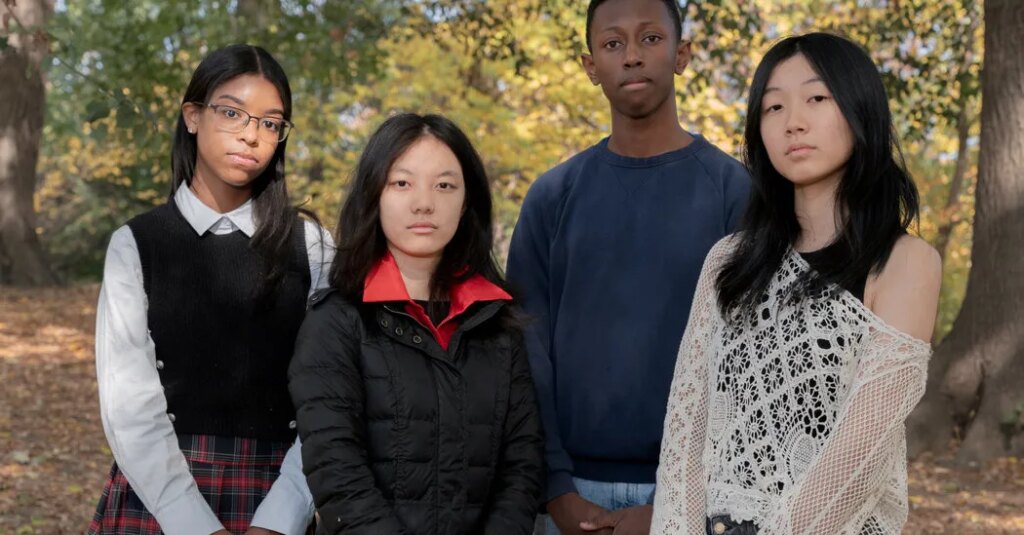
But now, amid renewed dialogue in the city about what Mayor Zohran Mamdani and the schools chancellor, Kamar Samuels, can and should do about integration in public schools, students at Hunter are taking matters into their own hands.
“It doesn’t really make sense that we’re living in this world of New York City and the students that we see around us every day aren’t of the demographic makeup,” said Kassidy Khuu, 17, a senior and a member of the student group leading the effort, HCHS4Equity. “There’s a real social problem and social mishap when students who are from these underrepresented groups go to a place where there’s barely any people who look like them.”
In recent months, students with HCHS4Equity have strategized over weekend Zoom calls, consulted education activists and experts, and rallied alumni, parents, fellow students and teachers behind a petition demanding immediate and systemic change. They plan to deliver a letter with their demands to school leaders on Monday.
Their core concern is an admissions policy that has left Hunter predominantly Asian, white and wealthy. Entry for most students hinges on a three-hour exam taken in the sixth grade, for which many applicants prepare with months of private tutoring, parents and students say. The remaining seats go to children from Hunter College Elementary School, which admits kindergartners based on a $375 IQ test.
Housed in a former armory on the Upper East Side, Hunter attracts driven students who routinely go on to top universities. Among its nearly 1,300 students, many come from affluent families who choose Hunter over top private academies, parents say, and fuel a parent-teacher association that raises roughly $1 million a year.
In interviews, Black and Latino students described their experience at Hunter as academically rewarding but isolating. None said they had encountered overt racism. But several recalled feeling singled out, particularly during lessons on slavery or discussions of Richard Wright’s memoir, “Black Boy,” about growing up in the Jim Crow South.
Nnamdi Umelo-James, 16, a junior from the Bronx, said he was sometimes the only Black student in his classroom. Of the 210 students in his class last year, eight were Black, according to school records.
“It can be very jarring to see there’s almost no one like me in the school,” he said.
After its founding in 1869, Hunter remained almost exclusively white for decades — among both students and faculty members. A century later, a city board ordered the high school to change its admissions so that its student body reflected the racial and socioeconomic diversity of the city’s children. In 1974, boys were admitted to the school, which previously was only for girls, but the diversity goal has never been achieved.
Large urban school districts across the country have grappled for years with selective schools that diverge sharply from the communities they serve. Attempts to overhaul high-stakes admissions policies have encountered fierce pushback from opponents who argue that any change will water down academic standards.
Barred by the Supreme Court from using race in integration plans, school leaders in Boston, Chicago and other districts have turned to socioeconomic factors as a race-neutral alternative to boost diversity. After admission changes in Boston, Black enrollment at the acclaimed Boston Latin School doubled.
Such approaches are coming under legal scrutiny. The Supreme Court has agreed to hear a case challenging a diversity plan at some selective middle schools in Montgomery County, Md., which plaintiffs argue discriminates against Asian Americans.
Lisa Siegmann, the director of Hunter College Campus Schools, which encompasses both the high school and the elementary school, said the former had tried in recent years to diversify the student body, incorporating socioeconomic factors into some admission decisions. The changes have not been widely publicized, nor mentioned on the school’s admissions website.
For candidates not admitted in the initial rounds of offers, Ms. Siegmann said, Hunter now factors in the “economic need index” of an applicant’s school — a city Department of Education formula measuring the poverty and homelessness levels of the students, as well as their eligibility for public assistance.
She said the index was a “significant factor” in those admissions decisions. In their letter, the Hunter students demand that the index be used for a larger share of applicants.
Ms. Siegmann pointed to signs that the student body was shifting: The proportion of students from low-income families had nearly quadrupled over the past decade. But she cautioned that it was too early to credit the school’s initiatives alone, noting that more families of enrolled students had also recently qualified for financial assistance to cover some school-related costs.
“We are pushing at the edges, and I know incremental change is not sexy,” said Ms. Siegmann, adding that Hunter had also hired more teachers of color in recent years. “If there was a magic wand to wave to make it happen, people would have waved it before.”
Home to the nation’s largest school system, New York City essentially has a two-tier educational system. A cluster of coveted, highly selective schools serves mostly Asian and white students. The remaining schools are largely filled with Black and Latino students, many with shrinking enrollments and fewer course offerings.
Mr. Samuels and Mr. Mamdani have both vowed to make school integration a top priority. Past city leaders have made similar promises, only for their plans to stall after resistance and other obstacles.
One hurdle is the state’s 1971 Hecht-Calandra Act, which dictates the entrance criteria at some of the city’s specialized schools, including the prestigious Stuyvesant High School. Only three Black students were offered seats in Stuyvesant’s freshman class this year. Still, about 50 percent of its students come from low-income families.
The students behind HCHS4Equity argue that Hunter administrators could overhaul its admissions policy with relative ease, noting that it operates outside the city’s Department of Education. The school is run by Hunter College, a branch of the City University of New York.
“It is really a political-will problem at Hunter,” said Paul Sonn, whose daughter graduated from Hunter in 2024.
Mr. Sonn and others have called on Hunter to reserve a percentage of seats for students from low-income families, as some other selective schools do. Bard High School Early College in Manhattan, for instance, sets aside 50 percent of its seats.
But Ms. Siegmann called a set-aside policy a nonstarter, saying that the concept had been “a point of very strong contention” among alumni, parents and school leaders. “We haven’t made progress,” she said.
Another major hurdle is the entrance exam: It is open only to students who score in the top 10 percent on fifth-grade standardized tests. In that qualifying pool, about 30 percent are Black and Latino, according to 2019 and 2020 testing records obtained by The New York Times.
“It’s just a great shame,” said Andy McCord, a parent of a Hunter graduate who started a free tutoring program for the entrance exam for students from the Bronx and Upper Manhattan.
The HCHS4Equity students at Hunter, who are also starting a tutoring program, are just the latest students at the school to demand diversity changes. In 2020, a group delivered a letter with similar demands and more than 2,000 signatures to school leaders. A decade earlier, a senior named Justin Hudson criticized the school’s lack of diversity in a graduation speech that drew a standing ovation.
In his class of 2010, six students were Black. Last year’s senior class had five.
“Not to be a cynic,” Mr. Hudson said in a recent interview, “but I can’t say that I’m that surprised.”
Jennifer Jenkins and Sheelagh McNeill contributed research.
The post N.Y.C. Schools Are Deeply Segregated. These Students Demand Change. appeared first on New York Times.