More than 100 residents of the South American nation of Guyana lined up outside an Indigenous cultural site on Friday, eager for a glimpse of King Charles III, the figurehead of a British state that ruled here until independence almost 60 years ago. Some brought their small children.
Standing nearby in the searing sun, about two dozen protesters waved signs demanding that Britain pay reparations and apologize for the millions of enslaved Africans who were trafficked across the Atlantic in the 1700s and 1800s. They chanted loudly: “Not our king!”
As Charles makes a seven-day visit to three of Britain’s former colonies, his country’s history of slavery — and what he and the British government should say or do about it — continues to divide opinion across the once-sprawling empire.
“They bought slaves, sold slaves and made money from slavery and then paid the slave owners millions of dollars and the slaves and their descendants got nothing,” said Elton Campbell, referring to British legislation passed in the 1830s that compensated slave owners for the freeing of slaves after the country outlawed the practice.
Mr. Campbell, a 76-year-old insurance agent in Guyana’s capital, added, “Let the king explain that to the nation and our Black people around the world.”
For the first time on Friday, Prime Minister Andy Burnham of Britain said the government was open to offering a formal apology for the country’s role in the slave trade, which he described as “brutal and barbaric.”
But he rejected demands to pay reparations to the descendants of slaves, writing in an opinion article: “I do not think that British people today can be held liable for historical wrongs, however heinous, that happened in a different age under different laws and in which they played no personal part.”
Mr. Burnham and the king are both scheduled to address leaders of the Commonwealth at a gathering in Antigua on Tuesday, though it is not clear what they will say. At the start of his Caribbean tour, Charles said that “it is only right that we should acknowledge the great suffering of the past, in these islands and beyond.”
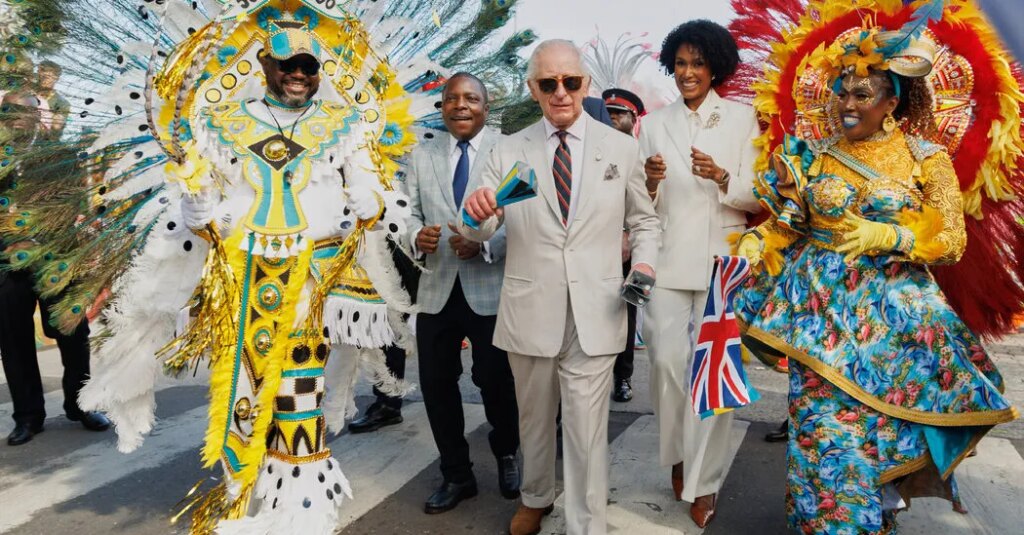
In the Bahamas, where the king’s events included dancing in a carnival parade known as the Junkanoo, some residents warmly welcomed his role as their country’s official head of state.
“Whatever you feel about the royals personally, we are still members of the Commonwealth,” said Margaret Ramsingh, 52, referring to the voluntary organization of 56 nations, most of which were former British colonies.
“I understand what people are saying about reparations,” Ms. Ramsingh said in an interview last week, “but at some point in time we have to move forward.”
During his trip, the king has not tried to dodge the issue of what he has called a “dark stain” on Britain’s past. In Guyana on Friday, he visited the site of the Demerara Slave Rebellion of 1823, where colonial forces brutally crushed a rebellion by thousands of enslaved men and women, killing hundreds.
If Buckingham Palace officials had hoped that some of his seven-day trip could also be focused on issues like climate change and nature conservation — issues that have long been priorities for the king — they may have been disappointed by the persistent conversations about reparations.
Just hours before Charles met with Mohammed Ifraan Ali, the president of Guyana, on Thursday, Mr. Ali said in an interview that an apology for slavery would be “the next step” to be taken. Mia Mottley, the prime minister of Barbados, said Saturday that Mr. Burnham’s openness to an apology was welcomed. But she did not back away from demands for reparations.
“On reparations in particular, our views differ, and we will say so plainly and respectfully,” she wrote in a statement.
Interviews with residents of the Bahamas, Guyana and Antigua revealed an eagerness to discuss the topic of the British slave trade, the monarchy and the government’s role in making amends for Britain’s history.
Daren Matthew Ward, 51, an insurance manager in Antigua, said the king’s visit to the island was a positive thing and could help bring much-needed investment to the country. But he said the discussions about the legacy of slavery are important.
“Nobody present is, you know, guilty of or complicit in the crime that took place many years ago,” Mr. Ward said. “On our end, we’re saying there are certain historical disadvantages that are inherent in our societies as a result of what happened during the slave trade. And those injustices and imbalances need to be addressed in some way.”
Others in the country of just under 100,000 people were more blunt about what they expect from their monarch.
“At the end of the day, why are we trying to impress our former slave masters?” asked St. Claire Henry, 39, an IT technician in Antigua. “These are not people that genuinely cared for us. He acknowledged that grave things were done in the past. OK, acknowledge it. Say sorry, do something. Pay us something.”
At the king’s first stop in the Bahamas, the king delivered a speech at a youth rally, in front of bleachers filled with young schoolchildren cheering wildly for the monarch.
And at Parliament Square in Nassau, the streets were lined with more than 1,000 people, many of them holding their iPhones up high to snap a royal photo. The mood at the event was joyous and excited, with little evidence of protesters demanding an apology or reparations from the king.
But such carefully produced events rarely capture the full range of opinions, especially on sensitive topics like slavery.
Endal Adderley, 56, a retired secondary school principal on Long Island in the Bahamas, said it is the British government that should take responsibility for slavery.
“The Black people who were disenfranchised, who had lost all they had, even lost their names, their languages, they came over, they survived, they built communities, they built societies, they now are building nations,” Mr. Adderley said. “All they’re asking for is some justice and some economic reparations in cash or in kind, and I fully endorse that.”
He added: “In the Caribbean, I don’t see any reason for us to be bowing down to a king anymore.”
Joy Burrows, 70, is a part of the generation in the Bahamas that remembers a time when the Union Jack flew over the archipelago and schoolchildren sang “God Save the Queen.” She said she believes the Bahamas has moved on and there is no need to address what has already happened.
“I think that this is a part of history,” she said, “and we can’t change history or what has happened.”
The post King Charles Meets Both Joy and Criticism on Caribbean Tour appeared first on New York Times.