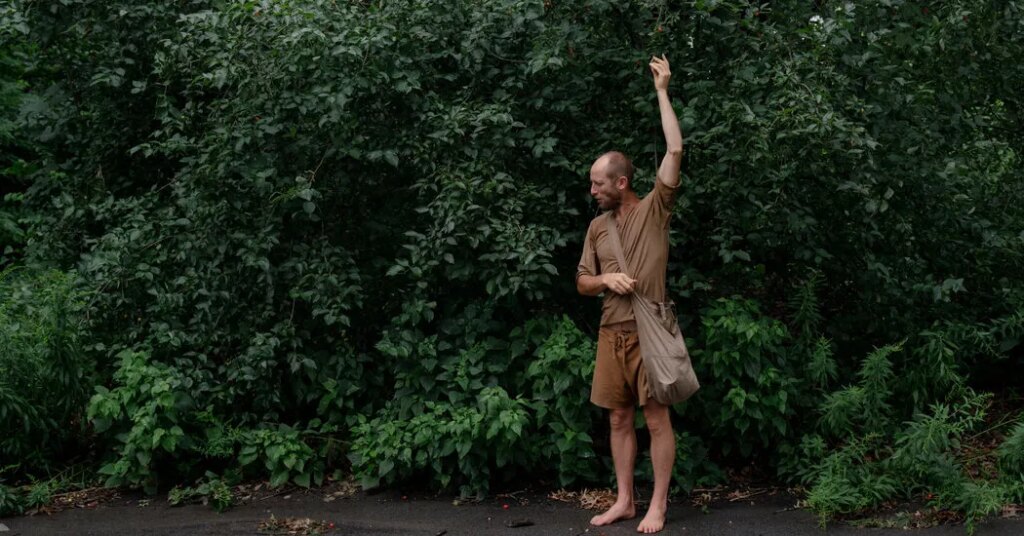
About 80 New Yorkers gathered in Prospect Park, Brooklyn, to watch a gaunt, barefoot man hug an oak tree during a foraging walk.
“This tree produces in the realm of millions of calories of food,” said Robin Greenfield, a social media influencer known for his outlandish and risky stunts to reduce food waste.
Greenfield’s gambit this year was to survive only from foods he had found in the wild. He would not rely on grocery stores, garden produce, farm products, cooking staples like butter or olive oil, or foraged foods others might share with him. The Brooklyn gathering, in late July, was day No. 292.
Reduced to a sinewy waif, running low on carbs and fats, Greenfield had calories on the brain. He had used up all of his wild rice and was down to half a gallon of hickory oil and about four pounds (7,000 calories) of acorn flour.
He was also struggling with energy levels and a low social battery. After a three-hour interview with me in Prospect Park, he stumbled into a thicket of trees, drained from talking. He’d had enough of the media-friendly facade.
Once a poster boy for capitalism who was determined to become a millionaire by his 30th birthday, Greenfield remade himself more than 10 years ago into an environmental stuntman, dumpster diving and stuffing bags full of trash and affixing them to his body to raise awareness about our ravaged planet.
“Food is the central way we’re impacting the earth,” said Greenfield, a 40-year-old who presents like a millennial Mr. Rogers (if he had a California surfer’s drawl).
At first, he kept his apartment and a few changes of clothes. But gradually and methodically, Greenfield embraced asceticism and dedicated himself to it full-time. He let go of his possessions, as well as his connections to the government and commercial society.
He has no phone, car, driver’s license, passport, health insurance, property, bank accounts or credit cards. He wears biodegradable clothing and has not paid taxes or taken pharmaceuticals for more than a decade. He lives under the poverty level, and said he has no romantic or sexual attachments. He brushes his teeth with a twig.
And he carries his poop around in a bucket, refusing to rely on the flush toilet system, which he calls destructive and ineffective (composting toilets can be difficult to find on the road). He brought the bucket with him that afternoon in Brooklyn.
“OK, this is too much,” murmured one woman in the crowd.
Social media is his one remaining vice. It is both the megaphone for his earth-friendly messaging and his Achilles’ heel. It’s hard, after all, to be a purist or an anti-corporate stalwart when counting “likes.”
He still owns a laptop and digital camera, necessary for his chronicling and communication. He and those who volunteer in the effort shoot his videos, which get edited by workers at a nonprofit he started. He doesn’t make money from his social media accounts, he said.
He no longer flies. So when he travels, he hitches a ride with someone he knows or takes a bus or train.
Pinpointing what drove a once-aspiring rich guy to a now-aspiring nature monk is a murky undertaking. According to Greenfield and those closest to him, his transformation arose from a combination of family history, personal compulsion and the way his brain works.
“All data leads to me losing my mind,” Greenfield said. He likens his practices to those of wandering sadhus, holy men who take vows of poverty and celibacy to pursue spiritual freedom in India.
But as the sadhus know, the path to spiritual freedom is often uneven. Few things are more natural than interpersonal conflict, and Greenfield has seen his share. He has posted videos in which he describes — and says he regrets — behavior as a young adult involving what he believes were sexual and financial misdeeds. Even he acknowledges that sometimes his most formidable opponent is not the food industrial complex, but his own complex nature.
“I have a tone,” he said.
Greenfield’s parents, part of the Hare Krishna movement, moved from Oregon to Northern Wisconsin in the 1980s, with back-to-the-land aspirations. But they split up, and Greenfield grew up on welfare in a cluttered duplex “with paint chipping off the walls,” he said.
“I was not into my lifestyle growing up,” he said. “I Febrezed everything. I had the American Eagle clothes.”
He developed a keen interest in money and structure, working in fast food and as a lifeguard and becoming an Eagle Scout. He saw financial independence and goal-setting as ways to gain social acceptance and love.
“I shined the wheels of my car every Sunday,” he said. “My food came from Walmart. I went to McDonald’s.”
Though he partied while at the University of Wisconsin–La Crosse, sometimes getting blackout drunk, he said, he remained focused on success, selling educational books door to door over summer breaks, working up to 90 hours a week.
After graduating, Greenfield traveled through Southeast Asia and Africa. It was a turning point, according to several friends. He was exposed to global poverty and off-the-grid living that made his childhood look comfy by comparison, they said.
Greenfield moved to San Diego and started a business, selling advertising in grocery stores. The year he was 25, the business pulled in $250,000 in revenue, he said.
But he also began to read books and watch documentaries about the same commercial food system that was making him rich. “The Story of Stuff,” a short film by the anti-consumerism activist Annie Leonard, left a particularly strong impact.
“I learned that the reason I was doing most of what I was doing was because corporations had large advertising budgets, and they had convinced me that I needed to do these things in order to be a loved member of society,” Greenfield said.
“The way that I was living was basically a lie.”
He wrote a list of 100 changes he wanted to make in his life — some of them the sorts of shifts many people aspire to, like shopping with reusable bags and switching to LED lightbulbs — and hung it up in his kitchen, with plans to incorporate one each week.
Around this time, Greenfield met Cheryl Davies, a student of Eastern medicine who would figure prominently in his evolution. The guy was goofy, Davies said, but his curiosity and sense of play charmed her.
“He had this big story about how he was in Africa by himself, and he was wearing these colorful bracelets,” Davies recalled. Once, she and her roommates were cooking herbs and he grabbed a mouthful.
“And we’re like, ‘You’re not supposed to eat that,’” Davies said. “And he’s like, ‘I’m going to try everything.’”
By then, Greenfield had accomplished the 100 goals on his list, including the more exteme ones, like getting rid of his credit cards and cellphone and undergoing a vasectomy. But he’d also kept going, not showering for a year (bathing instead in natural bodies of water and the occasional leaky fire hydrant), starting to run barefoot and finishing a 4,700-mile sustainable bike ride across the United States.
“I managed to use just 160 gallons of water, create a mere two pounds of trash, plug into only five outlets, not turn on a single light switch and consume 280 pounds of food from grocery store dumpsters,” he wrote on his website.
Soon, he was living in a 50-square-foot, solar-powered home, having dissolved his company and buried his earnings, in the form of gold and silver, in his yard. He would dig up the treasure to finance his early eco-adventures, which Davies gamely joined.
But as Davies reached her mid-30s, she grew tired of the physically demanding lifestyle, and of being a sidekick to Greenfield’s agenda. Plus, her friends and family had wearied of his uncompromising nature.
“They didn’t want to deal with Robin composting in the kitchen, or not flushing the toilet,” she said. “I was always the person in the middle.”
During a yearlong challenge in which Greenfield was living from a garden he’d started in Florida, Davies left for Italy, and is married there, with two children. Greenfield dated a few more people before committing to celibacy.
They are still friends. “She was one of my greatest teachers,” Greenfield said. As for Davies: “Robin taught me how to be free.”
After Davies left, Greenfield tried to expand his fledgling nonprofit, which focused on planting fruit trees and helping gardeners. But he found that working with people and managing their expectations was not his strong suit.
“He’s always had intense determination,” said Myrna Greenfield, his aunt. Ryan Sandberg, who sits on the board of the nonprofit, said Greenfield would sometimes drive away co-workers who lacked his priorities.
Tanja Vidovic, a public radio producer and host in Florida at the time, thought Greenfield’s involvement with community gardens dovetailed perfectly with the ethos of the show “Sustainable Living.” When she reached out for an interview, one of Greenfield’s colleagues told her that a local program wasn’t worth his time. “It kind of put a sour taste in my mouth,” she said.
Increasingly, Greenfield felt compelled to retreat and reconnect with himself. Loud music bothered him. So did too much chatter. In 2020, when he moved his operations to Asheville, N.C., he began to believe he was probably on the autism spectrum, like other close family members, Greenfield said.
“I read the description of Asperger’s, and I was like, wow, this is such a clear description of my own mind and how I function,” he said. He never got an official diagnosis.
His focus and discipline had supercharged his naturalist agenda, winning him more than two million followers on social media. But in the real world, he struggled to work with others.
Greenfield hired an expert in nonviolent communication, a practice that helps people relate to each other through compassion.
The practice, which encourages self-repair and transparency, inspired him to post videos about his past transgressions. In one, he spoke of taking advantage of women sexually while in college and in his early 20s, including what he described as nonconsensual touching, having sex blackout drunk and letting his friends watch him with a woman through a peephole. Two women working on a documentary about him stepped away from the project when they learned about his past.
“I am a product of a sexist, broken society,” Greenfield said. The raunchy 1999 movie “American Pie” was his playbook as a young man, he said. An important way to heal from this culture, he stressed, was to talk truthfully about these issues, something he aims to do with young people, perhaps on college campuses, in the future.
Vidovic, the journalist in Florida, had already deleted Greenfield from her social media feed after watching a video he’d posted in 2024 about walking down a closed road naked. She thought it was an affront to women and it made her uncomfortable. When the confessional videos emerged, she was not surprised, she said.
“He just loves the attention,” she said. “I think he’s a covert narcissist.”
Greenfield said that his truth-telling videos and his naked jaunts — there was more than one — were simply part of his “strategy to have nothing to hide.”
Awkward communications remain an issue for Greenfield, who spent his foraging year teaching the skills to others across the country.
In June, he offended a group of women in California who had picked him up in a car to look for mushrooms. He was expecting just one person, he told them curtly, announcing that he did not like surprises, recalled a woman who spoke on the condition of anonymity because she is part of a tight-knit foraging community where Greenfield is revered. The difference between the mild-mannered online persona — an amalgam of Henry David Thoreau and the Dude — and the aggravated guy in the back seat was upsetting, she said.
New York’s screeching car alarms, fast-talking pedestrians and Bluetooth speakers blasting reggaeton can be a lot for anyone, but especially for a nature monk who has a hard time with people. Greenfield kept a smile this summer, but one could sometimes glimpse how hard he worked at managing the stress and exhaustion behind it. The self-negotiating seemed like a part of who he was, like yoga teachers fighting their own anxiety to summon a spirited “namaste.”
The day before Greenfield’s Brooklyn event, he met a group of foragers inside the New York Botanical Garden in the Bronx. When a security guard kicked the group out, Greenfield’s smile shifted to a grimace. I watched him struggle to keep the peace and control his irritation.
As the group left, the guard told Greenfield he could not be barefoot. He took a deep breath and his shoulders tensed. But he reached into his bag, took out his moccasins, slipped them on and pointed out a sassafras tree to the foragers while they walked.
Later, crouching by a sewer grate, he said, “Within 10 feet of this spot, I count about eight plants that are edible.” Greenfield the sadhu was back. Soon the group was chewing on wood sorrel. One woman said it tasted like Sour Patch Kids.
During Greenfield’s week in New York, he had to balance his foraging guru status with a growing desperation for some peace. The journalist Kiri Blakeley, who put him up in her home, caught a glimpse of his moodiness while trying to vacuum his room. When the noise annoyed Greenfield, he sharply asked her to leave.
“I was thinking, I am not your mate, you are not in a hotel,” she said. She told Greenfield that if he spoke to her again like that, she would kick him out. He apologized.
Sophia Moskalenko, a psychologist who studies extreme behavior, said: “There’s so much effort that goes into an extreme lifestyle that it encompasses absolutely everything. You want the persona to be true, but you’re doing performance art, and it’s exhausting.”
At Blakeley’s apartment, Greenfield made stew for lunch. It had acorn flour, hen of the woods mushrooms, lambsquarters (a wild green he had found in Brooklyn the day before), elderberries, applesauce, a little hickory oil and maple syrup, and some green powder made from the leaves of a basswood tree.
It was hearty and nutty, sweet and salty. You could taste the berries.
“Six different trees are in this meal,” he said. “I will say that eating from the trees changes you at a core level.”
After a fortunate stop in Minnesota, where Greenfield gathered 25 pounds of nuts (about 13,000 calories) from an oak tree prematurely dropping acorns, he returned in the early fall to the woods of Wisconsin, where he lives in a sauna with a wood-burning stove, which a friend is letting him use for now, rent-free. There, he was able to harvest wild rice, fruit and fish, more than enough to see him through his wild food challenge, which ended in October.
These days, Greenfield is reconsidering his online presence. This winter will be a trial run: He will log off for three months while he canoes around Florida.
But that doesn’t mean he will quit technology, and the social friction it can bring, for good. “One day I will get there,” he said.
But not quite yet.
Susan C. Beachy contributed research.
The post He Wants to Be One With Nature. But He Can’t Quit Instagram. appeared first on New York Times.