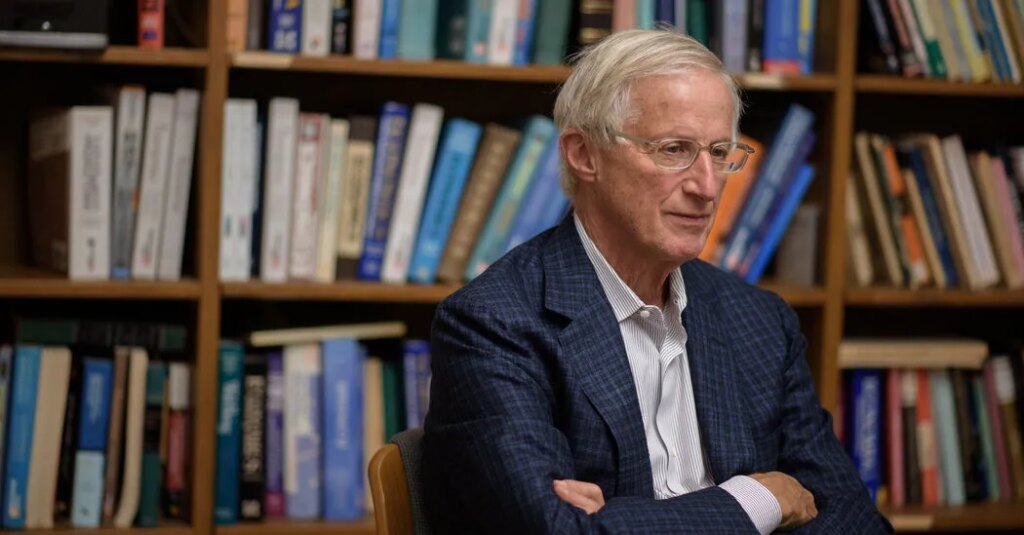
Long before climate change entered the vernacular, the economist William D. Nordhaus had seized on the idea of taxing pollution as the most effective way to combat man-made global warming.
Dr. Nordhaus, who died Friday at 85, spent his career championing the idea of a tax on carbon dioxide. Putting a price on planet-warming pollution, he contended, would slow down climate change and could be achieved without severe harm to the economy.
His work helped inform government policies around the world, and in 2018 he shared the Nobel Prize in economics.
But Dr. Nordhaus faced powerful adversaries who ultimately curtailed the influence of his ideas. The fossil fuel industry, which would have absorbed the costs that Dr. Nordhaus proposed, vigorously opposed his work and commissioned reports that attacked carbon taxes.
“What economists did not take account for a long time was the enormous political interests that were lined up to fight any kind of climate policy,” said Gilbert E. Metcalf, emeritus professor of economics at Tufts University. “Basically, the fossil fuel industry had a lot of money and they spent it wisely to block any progress in this area.”
Dr. Nordhaus, who joined the faculty of Yale University in 1967, began thinking about the effects of a warming world on economic growth in the 1970s, when the subject drew comparatively little attention.
He understood that increased heat, more severe weather and rising sea levels would ultimately ripple throughout the economy, with profound effects on everything from agriculture to industry.
His work built on that of British economist Arthur Pigou, who popularized the concept of negative externalities, a term that describes when private industry imposes costs on society without paying for them. Dr. Nordhaus applied this concept to climate change, and homed in on the idea of taxing polluters as a way to reduce planet warming emissions.
“He started working in this area much before the topic became trendy,” said Pinelopi Koujianou Goldberg, the William Nordhaus professor of economics and global affairs at Yale. “He was a pioneer.”
Dr. Nordhaus developed several ways of understanding the interplay between emissions, economic growth and damages from global warming. His best-known model was DICE, short for Dynamic Integrated Climate-Economy. The model was intended to let researchers project how different emissions policies would affect warming and economic growth.
Climate change, he said in his Nobel banquet speech in 2018, was “a harmful unintended side effect of economic growth.” Polluters are essentially permitted to burn fossil fuels and add carbon dioxide to the atmosphere without any penalty, shifting the costs to society, he said.
“The result is too much burning of fossil fuels, too much climate change, and too many harms to humans, wildlife, ecosystems, and more,” Dr. Nordhaus said. “Economic theory suggests that the best remedy for such externalities is a pollution charge — a charge on carbon emissions, or what is now called a carbon tax.”
His ideas were embraced by some conservative economists like Martin Feldstein and leading Republicans including Henry Paulson, James Baker III and George Shultz, all former Treasury secretaries.
But the idea that pollution could be reduced by putting a price on carbon dioxide clashed with oil and gas companies that rejected the additional costs or controls. By the early 1990s, those companies were fighting Dr. Nordhaus’ ideas with research of their own.
The American Petroleum institute and Exxon Mobil commissioned work that argued that a tax on carbon would have catastrophic effects on the economy. In 1991, during the presidency of George H.W. Bush, a report from the Energy Department that came out against a carbon tax cited some of this research.
The campaign continued for decades and came to target Dr. Nordhaus directly. In 2008, the Institute for Energy Research, a think tank funded by Exxon Mobil, the American Petroleum Institute and Peabody Energy, published a paper titled “Rolling the DICE: Nordhaus’ Dubious Case for a Carbon Tax.”
Fossil fuel companies also spent heavily to downplay the public about the risks of global warming and lobby against all manner of regulations that would have reduced harmful pollutants.
Dr. Nordhaus’s efforts to promote a carbon tax also coincided with the arrival of a powerful anti-taxation movement in the United States.
“The other current that’s really important, and this goes back to Ronald Reagan, is this extreme antipathy to taxation at all,” Dr. Metcalf said. “We’ve seen an incredible erosion of federal tax revenues as a share of GDP and just the decimation of all kinds of taxes, the estate tax. So I think in some sense, the carbon tax idea came along at just the wrong time.”
Congress has considered bills that would have put a price on carbon in 1993, and then in 2009 and 2010, but no laws were passed.
In 2018, the Republican-controlled House of Representatives passed a resolution denouncing the idea of an American carbon tax as detrimental to the economy. Months later, Dr. Nordhaus shared the Nobel Prize with the New York University economist Paul M. Romer, and acknowledged that efforts to promote a carbon tax had been stymied by industry.
“It’s been caught up in the politics, and it just happens that this particular policy is one that has faced the wrath of a whole group of thinkers,” he told The New York Times. “Grover Norquist, energy companies, it’s the Koch brothers and their foundations, it’s people using fair tactics and foul tactics — it’s been caught up as one of the issues in the Great Divide. This anti-tax movement has been so powerful and so harmful in the United States. There have been a large number of conservative economists in the United States who have endorsed the idea of a carbon tax.”
Exxon Mobil, the American Petroleum Institute, Mr. Norquist and Koch Industries did not immediately reply to requests for comment.
Several states, including California and Washington, have implemented cap and trade systems that attempt to limit pollution by placing a declining limit on carbon dioxide pollution and then allowing companies to pay for, and trade, credits that permit them to pollute.
Around the world, the European Union and several countries in South America and Asia have different versions of cap and trade systems and carbon taxes.
But federal efforts to impose a tax on carbon have failed.
In 2016, after a news report suggested Donald J. Trump was considering such a move if he won the presidency, he dismissed the idea on Twitter, “I will not support or endorse a carbon tax!”
Though many environmentalists remain skeptical of their sincerity, some fossil fuel companies now say they support some version of a carbon tax. “Establishing a market price on carbon dioxide is an important element of building the business case for capturing it,” Exxon Mobil says on its website.
Yet on the whole, Dr. Nordhaus’s signature idea has yet to gain traction worldwide.
“It feels like we’re going to have to have even more in the way of climate catastrophes before we finally focus political attention on this problem,” Dr. Metcalf said, “which is a very sad state of affairs.”
The post He Pioneered a Groundbreaking Idea and Was Met With Corporate Wrath appeared first on New York Times.