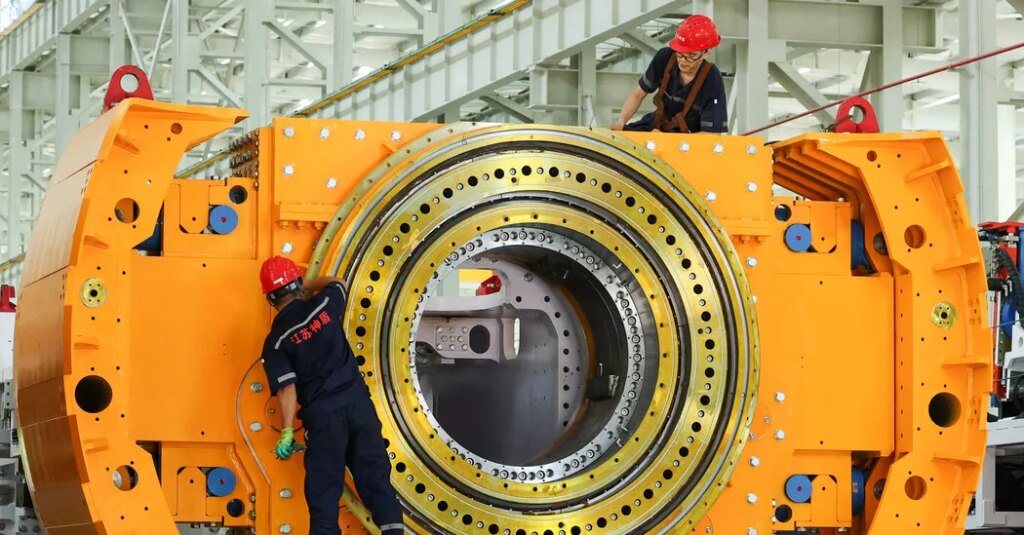
They are among the biggest machines in the world: steel cylinders, some as long as a football field, armed with rotating discs that can chew through rock to clear the way for roads and railways. Known as tunnel boring machines, they are made by only a handful of companies, mostly in factories in China.
India uses them to dig tunnels, including in the Himalayas, to improve its ability to send troops to defend its contested border with China. But starting next month, Beijing is likely to be able to control whether India gets to buy them.
The machines are part of a broader effort by China to control what leaves Chinese factories and laboratories for foreign lands. In the past month, Beijing has moved to control the exports of dozens of technologies, including drones, artificial intelligence models and agents, and certain processes used to develop advanced medicines and to make solar panels.
The overall push could make it much harder for companies in the United States and elsewhere to set up solar energy equipment factories that would compete against Chinese manufacturers. And it could soon make it more difficult for anyone outside China to gain access to the latest and most powerful Chinese A.I. models.
The planned restrictions show that Beijing is doubling down on its strategy of making Chinese factories indispensable to the world, even as many governments are alarmed by their countries’ dependence on China and are pushing to be less reliant.
In the United States, concern over China’s grip on rare earths has spurred the government to revive the country’s own mining and processing industry for the minerals. In Europe, Japan and elsewhere, governments are trying to reclaim their ability to make antibiotics and active ingredients of medicines, many of which now come from China. In India, the transport minister has urged companies to make tunnel boring machines locally.
For Xi Jinping, the Chinese leader, the controls are the realization of a plan he laid out years ago, when the pandemic exposed China’s dependence on foreign countries for advanced medical equipment like ventilators and life-support systems, as well as for raw materials and specialized parts.
He declared that China would develop “trump card” technologies in industries such as high-speed trains, renewable energy and telecommunications. That would make China not only more self-sufficient, but deter countries from trying to cut China off.
Digging In for a ‘Great Struggle’ With the West
Mr. Xi has depicted China as locked in a long struggle with the West, which he sees as trying to contain China’s rise.
Beijing needs leverage to ensure that China can still get what it needs from other countries — namely their customers and advanced technologies like jet engines and high-end chips, said Kirsten Asdal, a founder of Asdal Advisory, a consultancy that focuses on Chinese political research.
“Xi and the party see themselves as naturally embattled” against the West, she said, and have been “angling for a confrontation sooner or later, whenever the opportunity and capability present itself.”
At home, the Communist Party has framed China’s push for industrial and technological might as a fight for survival, echoing the struggles of the party’s revolutionary past.
In recent days, the party has repeatedly invoked the Long March, the Red Army’s epic 6,000-mile strategic retreat that cemented Mao Zedong’s leadership and became its defining myth of triumph over impossible odds. By drawing on that history, the party may be trying to reassure ordinary Chinese that endurance under its leadership will carry China through a time of slower economic growth, a prolonged housing crisis and growing hostility abroad.
In a recent front-page editorial commemorating the 90th anniversary of the Long March, People’s Daily, the party’s mouthpiece, called for the country to “focus on the ‘chokehold’ key core technologies” and “stiffen the Chinese backbone” of self-reliance.
In a clear reference to the United States, the editorial praised China for weathering tariffs and trade wars and urged readers to prepare for a “great struggle.” The call to secure technological choke points was also likened to the way the Red Army took the “strategic initiative” on the battlefield to ultimately defeat the Nationalists.
China has said that the recent flurry of export controls and proposed rules are needed to protect Chinese business interests. The country has spent decades and billions of dollars developing its dominance of the manufacturing of solar equipment, for instance, and it argues that it must restrict the export of core equipment to prevent competitors from trying to replicate China’s supply chain domestically.
China has also said that more controls are needed to guard against threats to national security.
“China is beginning to more systematically consider which technologies and equipment can be exported, to whom they should be sold and what their ultimate applications will be,” said Sun Chenghao, a foreign relations expert at Tsinghua University in Beijing.
He said, for instance, that the risks that A.I. could be used for cyberattacks or that machines that bore tunnels and that dredge mud could be used by militaries against China are legitimate reasons for Beijing to vet where these technologies go.
Learning From the United States
The proposed controls may also be a part of tit-for-tat actions that China and the United States have traded in recent months, despite a broader trade truce. The Trump administration added BGI, a major Chinese genomics company to a trade blacklist aimed at barring products made with forced labor in China. Earlier, the Treasury Department proposed regulations prohibiting U.S. companies and investors from taking investment stakes in Chinese biotechnology firms.
President Trump and Mr. Xi are expected to meet in China later this month and next month in Miami.
American restrictions and sanctions on China helped teach Beijing that great powers need economic weapons as much as they need aircraft carriers and long-range missiles, some analysts have said. Washington first cut two of China’s largest technology companies, Huawei and ZTE, off from American chips and software, then restricted exports of advanced chips to China broadly, curbs that continue to hurt China’s A.I. ambitions.
During its trade war with the second Trump administration, Beijing choked off exports to the United States of rare earths, the minerals needed to make fighter jets, cars and everyday technologies. That pressured Washington into a truce.
Some Chinese analysts worry that Beijing’s rare earths strategy has been too successful. The United States and many of its allies and partners are now scrambling to develop alternative sources.
Part of this month’s flood of Chinese controls was aimed at establishing new points of leverage.
“China is concerned that it might lose its ‘rare earths card,’” said Zhao Minghao, an international relations scholar at Fudan University in Shanghai. “So, what other cards does China still hold? How can China effectively counter U.S. sanctions or tariff measures? I believe Beijing is prioritizing this highly at the present.”
A Costly Bet
China’s single-minded focus on technological self-sufficiency carries risks for Beijing.
Economists have long urged Beijing to invest in pensions, health care and unemployment benefits so that residents feel secure enough to spend.
“That obsession with developing technology and protecting it is leading to a massive misallocation of resources in China that is generating slower growth and higher debt,” said Scott Kennedy, a researcher on the Chinese economy at the Center for Strategic and International Studies in Washington.
The new controls could also alarm other trading partners like Europe, which is already uneasy about a flood of cheap Chinese exports.
“That kind of business by threat is not going to be something that is sustainable,” Mr. Kennedy said.
Even some Chinese analysts acknowledge the danger.
“If uncertainty becomes too high, customers may seek alternatives,” Mr. Sun of Tsinghua said.
That is already happening in India. Experts say that China had been holding up exports of tunnel boring machines as early as 2024, before it added them to its list of export controls. As a result, India has had to seek out other suppliers.
Yet New Delhi had few ways to retaliate because its economic ties with China were so thin, said Pranay Kotasthane, chair of the High Tech Geopolitics Program at the Takshashila Institution in Bengaluru, India.
“China is indiscriminately expanding the scope of their export controls to include basic equipment that aren’t even strategic,” he added. “They are demonstrating that in any political conflict, they can counter with industrial leverage.”
The post China’s Message to Its Rivals: You Need What We Make appeared first on New York Times.