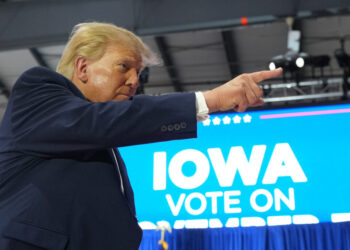
As he opened his speech at a recent campaign rally in Greenville, N.C., President Trump told the story of the Willie Horton crime case that helped sink the presidential campaign of the Democrat Michael S. Dukakis in 1988.
And then, 30 minutes later, still speaking at the same rally to the same audience from the same lectern, Mr. Trump told the same Willie Horton story all over again, using some of the same language (and getting the facts wrong both times).
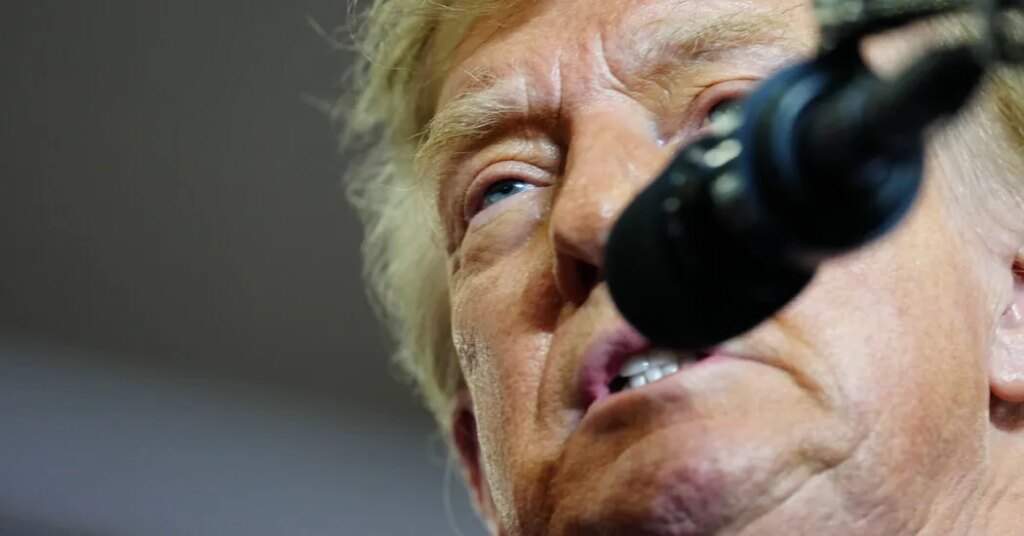
Mr. Trump, who last year became the oldest person ever inaugurated as president and turned 80 in June, has demonstrated physical stamina as he barnstorms the country in advance of midterm elections. But his performances on the road and at the White House this fall have produced many head-scratching moments that have revived questions about his age and stability.
He can be forgetful and repetitive. He is more long-winded, more profane and more absolutist than when he ran for president a decade ago. His rambling speeches seem even more garbled at times. He makes comments that leave people wondering what he is talking about or that sound like he is saying something he is not. And even for a president who has never fully observed the norms of the office, he seems more willing to say things no other president would say.
He declared that at an unfenced construction site “only a Hispanic could survive that fall.” He wants to ban immigrants from Norway “because I didn’t get the Nobel Prize.” He says “I don’t give a damn” if he is seen as caring more about oil company profits than struggling workers. He mispronounces the Strait of Hormuz as the “Hormone Strait.” He has told supporters to “cheat like hell” in the Nov. 3 elections. He says military leakers “should be shot.” And then there is his baffling fixation with admiring men’s posteriors.
Even Mr. Trump seems astonished at times by what comes out of his mouth — and by how much his supporters embrace him nonetheless. “I could say the stupidest things and you’d clap. ‘Oh, I love you so,’” he marveled at a recent rally in Clarksville, Tenn. “But we don’t say the stupidest things,” he quickly added. “We say things of common sense. We say things that make sense.”
For Mr. Trump, making sense often places second to having fun at rallies, and some outrageous remarks appear aimed at generating a laugh. His allies say too much is made of comments that are really just jokes. He has always been a provocative speaker, willing to outrage for the sake of outrage. Mr. Trump defends his stream-of-consciousness rambling as a “brilliant” speaking style that he calls “the weave.”
But the weave seems to be getting weavier. An A.I.-assisted New York Times review of Mr. Trump’s comments from speeches, rallies, social media, interviews and public meetings found significant changes since he began a run for president at age 69 in 2015, although not as much of a notable shift since 2024 when a similar review was conducted. Broadly speaking, the review concluded, Mr. Trump’s public communication is more vulgar, more uninhibited and less coherent than it was a decade ago.
“He’s saying so many stupid things, even for him, so many outrageous and aggressive things,” said former Representative Francis Rooney, a Republican from Florida. “This aggressive kind of attack language, that’s something I’ve never heard from a president.”
The White House denied that Mr. Trump has lost a step. Davis Ingle, a White House spokesman, hailed his “sharpness, unmatched energy, relentless work ethic and historic accessibility” and dismissed concerns about his provocative comments.
“The president doesn’t care about being politically correct, he cares about making America great again,” Mr. Ingle said. “The American people love how authentic, transparent and effective the president is.”
The ‘Freaking Genius’
Measuring the effects of age can be difficult without a medical exam, although that has not stopped many physicians, political commentators and everyday Americans from drawing conclusions about Mr. Trump based on what they see on television.
The Times review from 2015 through Thursday found that the president in his second term has used 19 percent more all-or-nothing words like “always,” “never,” “everything” and “totally” at rallies than he did a decade ago and 5 percent more than in 2024, a sign of black-and-white thinking that experts say often accompanies advancing age or cognitive decline. He is cruder than he used to be, using nearly 15 swear words per 10,000 words compared with 14 two years ago and six a decade ago, a change consistent with age-related disinhibition.
The review, relying on an A.I.-assisted metric, found that he makes rambling or confusing digressions in his rallies and speeches two and a half times as often in his second term as in the 2016 campaign, although roughly the same as in 2024. His vocabulary remains about the same, as does the reading level of his speaking, which hovers between fourth and fifth grade. (The average modern president speaks at an eighth-grade level.)
Mr. Trump’s public schedule is thinner, down to 1.3 events per weekday versus 2.1 in the first term. But he is posting online an average of 21 times a day, up from 13 a day in 2016 although down from 34 a day two years ago. The night owl president has posted messages between midnight and 5 a.m. on 30 percent of his nights in his second term and has had 240 bursts of 10 or more posts an hour.
The president’s doctor has said that Mr. Trump is mentally sharp. In a three-page summary released in May, Dr. Sean P. Barbabella, the White House physician, noted that Mr. Trump had scored 30 out of 30 on the Montreal Cognitive Assessment. “Cognitive and physical performance are excellent,” he wrote.
The Montreal assessment is a quick test to screen for Alzheimer’s disease or other cognitive impairment and includes basic questions like identifying a lion, camel and rhinoceros; drawing a clock; repeating words or numbers in order; and naming as many words as possible in one minute that start with the letter F. “Nobody can do this,” Mr. Trump insisted a couple weeks ago, adding: “But I can. You know why? Because I’m a freaking genius!”
Mr. Trump appears sensitive to the perception that he is slipping, bringing up his cognitive tests without being asked at a half-dozen recent rallies. In Chillicothe, Ohio, on Wednesday night, he called himself “a very high-IQ person,” offered an extended description of the tests and compared his brainpower to that of former Presidents Barack Obama and Joseph R. Biden Jr.
“Don’t forget I’m the only president to pass without exception — I passed three cognitive tests,” he said. “I’m the only president that agreed to take them. And they’re hard, you know? Obama couldn’t have passed it. Biden we don’t even talk about.”
‘I Don’t Give a Damn’
While Mr. Trump has been known to nod off during White House meetings, he draws energy from crowds when he is on the road. He speaks and speaks and speaks — twice as long as in 2016, according to the Times review, for an average of 85 minutes per rally compared with 42 minutes a decade ago.
He is profoundly and proudly undisciplined. He says things that are manifestly unhelpful to him. Even as many Americans are upset about the cost of filling their gas tank, he said in Perry, Ga., the other day that high oil prices were good because the fossil fuel industry was making hundreds of billions of dollars. Even as he said it, he acknowledged it would produce bad headlines. “I don’t give a damn,” he said. “I’m going to say it. We’re making a freaking fortune.”
He wanders from thought to thought, often without finishing a sentence, embedding one off-the-cuff story within another. In Pendleton, S.C., he started talking about transgender athletes, interrupted to tell a story about someone he met in Israel, referred to a poll without explaining its results and then riffed on climate change:
“You have a lot of records that are not exactly going to be shattered by women. They’re going to say, ‘Who the hell broke it?’ Or the swimmer who was a great swimmer, and then she looked to her left, she looked to her right, and she saw this massive human being next to her.
You’ve seen him — her on television. And she had to compete. And my wife said, ‘Please don’t tell those stories. They’re terrible stories to tell as president. Can you imagine George Washington telling these stories?’ No, because George Washington lived in sanity. He didn’t have men playing in women’s sports.
I promise you this. I didn’t know George Washington personally, but they did not have the mutilization of your children for transgender purposes. Do you think George ever had any of the things that we have to go through, Tim? I don’t think so.
Abraham Lincoln — I met a young man from Israel. I said, ‘Who’s your favorite president?’ He said, ‘Abraham Lincoln.’ I said, ‘Oh.’ I said, ‘That’s nice.’ We love Abraham Lincoln. But you’re going to see something later, because they have a poll — they took a poll recently. You’re going to see it. But I also declared a national emergency on energy and terminated the Green New Scam, one of the greatest hoaxes in the history of our country.”
‘He’s All Man’
Like many people in their ninth decade, he is prone to say things that seem inappropriate. His focus on the male anatomy, for instance, has become remarkably pronounced lately.
“I don’t do this with men very often,” Mr. Trump said at a rally with Senator Jon Husted, Republican of Ohio, on Oct. 12. “I started examining his body because I didn’t know he was a great athlete. And I looked and I watched up and down. I looked at his ass.”
Five days later, he repeated his appreciation of Mr. Husted’s backside. “I examined his ass,” Mr. Trump said at a rally in Kentucky. “I never did that with, no, I never did that with a man before.” Three days later in North Carolina, he praised Mr. Husted’s derrière again. “His ass is, it’s like a pile of muscle,” he said. In Chillicothe, he did it again: “I started by looking at his ass, and it was strong as hell.”
Mr. Husted is not the only object of Mr. Trump’s manly approval. Among the others:
Senator Tim Scott, Republican of South Carolina: “As much as I can fall in love with a man, which isn’t that much, I fall in love with him, and his name happens to be Tim Scott.”
The spouse of Senator Darline Graham, the other South Carolina Republican: “He’s a good-looking husband.”
Robert F. Kennedy Jr., the health and human services secretary: “He’s got the body of a 30-year-old.”
Representative Mike Collins, Republican of Georgia: “Mike Collins is a good-looking man. And he’s all man.”
In Michigan on Sunday, Mr. Trump made a point of praising a woman’s backside for a change. “I looked at one hell of a beautiful ass before — Nicki Minaj,” he told the crowd. “That’s hard to miss.”
A Quick Temper
Mr. Trump has always displayed fits of public anger in ways that other presidents have not. But he seems even more prone to pounce these days.
He snaps at reporters so often now that he barely waits for their questions before calling them “sick” and ordering, “Quiet!” When a reporter asked on Thursday if he was canceling a trip to Kansas because he was tired of traveling, Mr. Trump accosted his physical appearance. “You are disgusting! Put yourself in shape. You look like hell.”
His exhortations to supporters to vote have grown more vulgar and violent as well. “If you do that,” he said in Vandalia, Ohio, “we’re going to win and we’re going to win big. And we’re going to shove it up their ass, OK?”
He depicts himself as all-powerful. “I can do whatever I want,” he told reporters in the Oval Office recently. As if to prove it, he regularly tries to rename bodies of water after America or himself. He demanded that tech companies stop using the term artificial intelligence, preferring instead “super intelligence”; those that disobey, he wrote online, are “THE ENEMY!”
He has never been burdened with excessive self-awareness, but even so, some of his recent comments have been jarring. The man who dispenses disparaging nicknames like “Talafreako” for James Talarico and “Annie Trannie” for Dr. Annie Andrews insisted with a straight face the other day that “I don’t go around mocking people.”
Likewise, the commander in chief who recently threatened to “annihilate” Iran complained bitterly that he did not win the Nobel Peace Prize. Even so, one night last month he could not remember the name of the prize he covets. “Does anybody know the name of that peace prize?” he asked in Pendleton, then came up with another: “the Pulitzer Prize.”
When he summoned the name of the Nobel Prize last week in Port Huron, Mich., he declared that he would like to ban all immigrants from Norway, where the award committee is based, because he did not win. “I don’t want anybody from Norway,” he said. “Frankly, Norway sucks. Norway has become a shithouse country, actually.”
These days, even Mr. Trump seems aware that eyes are on him, watching and waiting. “I love the weave,” he told the midterm Republican convention in Dallas in September. “You know what the weave is? You talk about something, then you bring in a ballroom or you bring in an airplane or you bring in Air Force One. But you notice I always get right back to the same topic.”
And yet, he went on, “when someday, there’ll be a time when I do the weave is weave, weave. Someday, there’ll be a time when I don’t get back to the original subject, and then you can say he’s had it. OK? You can say then he’s had it.”
Methodology
The Times collected thousands of Mr. Trump’s speeches, interviews, social media posts and schedules using data from Roll Call’s Factba.se from 2015 through late October this year. To quantify Mr. Trump’s use of all-or-nothing language and swearwords, we measured basic word frequency statistics across Mr. Trump’s presidential terms and campaign periods. To identify confusing and rambling passages of text, we used the A.I. model Claude Opus 5.5 to score more than 6,500 passages of Mr. Trump’s speeches with detailed instructions based on our previous reporting analyzing Mr. Trump’s use of rambling and profane language. We counted a speech passage as incoherent if it scored at least a seven out of 10 with this rubric, which was informed by manual review of hundreds of passages and an evaluation to ensure a high bar of accuracy.
The post Threats, Gaffes and Men’s Posteriors: Trump’s Talk Gets Wilder appeared first on New York Times.