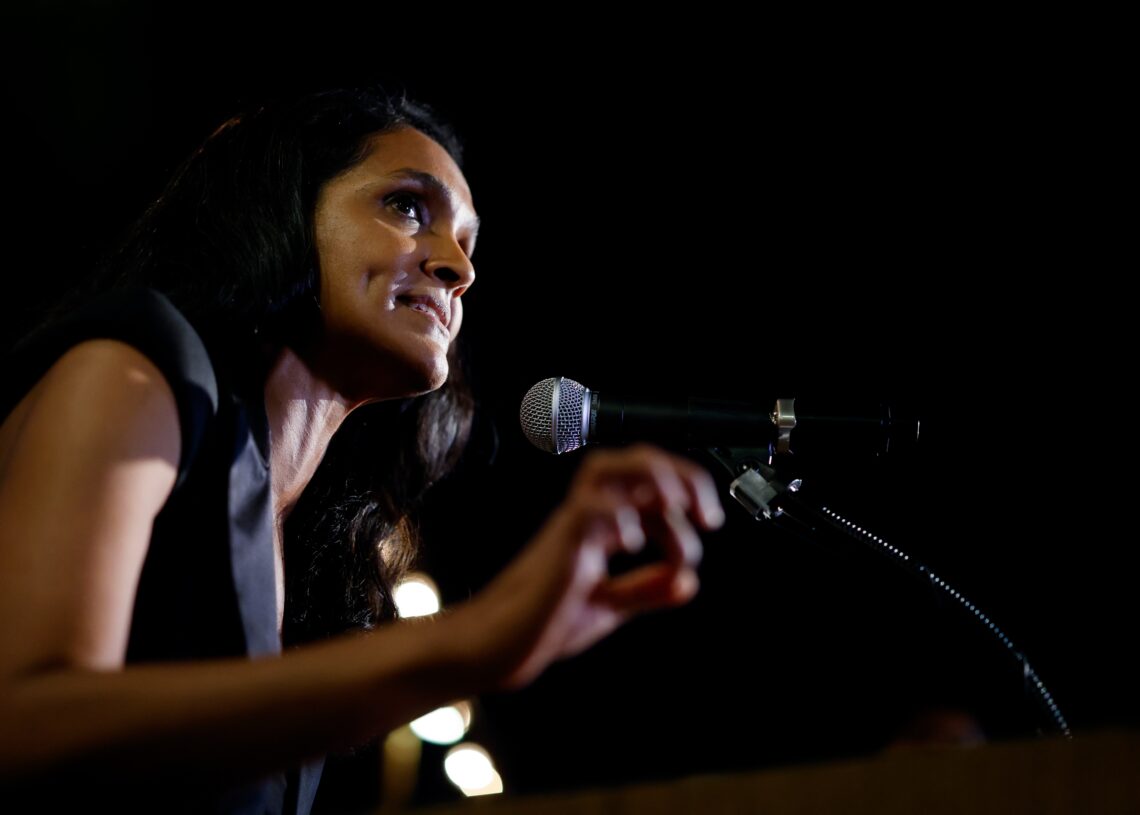
LOS ANGELES — With 21 days to go before an election that could make her the first democratic socialist mayor of the nation’s second-largest city, Nithya Raman was trying to take the fight to incumbent Karen Bass, her deeply unpopular opponent, during their final debate.
Raman, a second-term City Council member, stared into the camera from a television studio in Universal City as she calmly criticized Bass’s police department for what she said was its cooperation with federal immigration agents. She didn’t stumble over a name that few in Los Angeles expected to ever hear again, at least in a positive context, on the campaign trail.
“This city used to be the gold standard, in terms of noncooperation with immigration enforcement, years ago — under the era of Daryl Gates,” Raman said. “And now, under this mayor, we’ve actually lost trust from our immigrant community.”
To younger voters, who polls indicate are overwhelmingly supporting Raman’s mayoral bid, the mention of Gates, who led the Los Angeles Police Department from 1978 to 1992, might not mean much. But for older Angelenos, particularly Black and Latino residents who experienced the racist policing and civil unrest that scarred this city in the 1980s and 1990s, the favorable invocation of the former chief’s tenure was as offensive as it was shocking.
Gates resigned after the riots that followed his officers’ acquittal for the vicious beating of a Black motorist, Rodney King. For many in the historically African American neighborhoods of South Los Angeles, the attack on King was a moment when the world witnessed a videotaped example of the treatment they had endured for years from Gates’s police force.
“The idea that she would mention Daryl Gates as the golden age of policing just shows that she has no knowledge of L.A. history,” Bass — a Black woman who rose to prominence as an activist in the parts of the city where Gates was most reviled — said after the debate. Raman apologized but said the mayor was twisting her remarks to avoid scrutiny of her own failures.
With many Americans tuned into the midterm races that will decide control of Congress, Los Angeles’s mayoral election has evolved into one of the most closely fought and potentially revealing battles over the direction of the American left. From a distance, the race resembles others that played out earlier this year across the country through a tumultuous primary season: an established Democrat facing a challenger backed by the more left-leaning Democratic Socialists of America.
But the resemblance is superficial — and not only because of this sprawling city’s distinctive and frequently misunderstood political culture. In Bass and Raman, Angelenos have a choice of two candidates who both occupy the far left of the political spectrum. (They were the top two vote-getters in June’s open primary, easily beating the former reality television star Spencer Pratt, who drew favorable coverage from right-wing media outlets but came in third.)
The battle line in Los Angeles has been drawn not between centrist and progressive visions of Democratic politics. Rather, on one side is a heterodox assembly of disgruntled left-of-center constituencies — from wealthy housing developers to young socialists in neckerchiefs — who have rallied behind Raman. In Bass, they are seeking to topple the leader of an “establishment” that is not a country-club oligarchy but the governing structure created by a coalition of Black, Latino and labor activists who worked for decades to gain political clout in a city that for much of its history ignored their voices.
The struggle could be a preview of the intramural fights that await the Democrats in the 2028 presidential primary and beyond, as various factions of a disorganized left seek to define the party’s identity and agenda. And the Los Angeles race’s results, in a general election held in a racially and economically diverse city of nearly 4 million people, could offer some clues as to how those clashes will play out on the national stage.
The electorate’s unsettled mood was evident on a warm October weeknight at the Black Cat, a famous LGBTQ+ bar on Sunset Boulevard in Silver Lake, where Raman’s supporters gathered on the patio for a fundraiser headlined by the gay comedian Joel Kim Booster and a drag queen in a dazzling silver dress named Pickle.
Trim men in shirtsleeves mingled beneath olive trees and a decorative string of bare lightbulbs, some sipping $17 cocktails. It was not exactly a scene of insurgent desperation, but the crowd cheered loudly when Raman addressed them, denouncing “a city hall that has gotten comfortable and an establishment politics that keeps telling us that we don’t deserve better.”
Jiao Chen, one of the event’s co-hosts, said he was one of many Raman supporters frustrated with the well-documented shortcomings of Los Angeles’s government, from cratered streets to high rents.
“I’m tired of nothing getting done in the city of Los Angeles. We’re supposed to be one of the greatest cities in the world,” said Chen, who is 40 and has lived in the city for 13 years. “Right now, everyone around the country, I think we’re wanting our representatives not to be part of the establishment, because the establishment isn’t working.”
‘More radical politics’
Los Angeles spans roughly 500 square miles. Its more remote reaches are served by dirt roads and prowled by mountain lions. At the same time, it struggles with all the problems of a megalopolis, including the country’s largest unsheltered homeless population. Even on its best days, the city can strike some as ungovernable, and none of its modern mayors has ever advanced to higher elected office. (Bass’s predecessor, Eric Garcetti, briefly served as ambassador to India in the Biden administration.)
Even when judged against that standard, Bass is a strongly disliked incumbent. The recent UC Berkeley-Los Angeles Times survey found that 65 percent of likely Los Angeles voters view her unfavorably.
Many turned against the mayor after last year’s Palisades Fire, which killed 12 people and destroyed more than 6,800 structures in one of the wealthiest sections of the city. Bass was abroad attending the inauguration of Ghana’s president when the disaster began, despite advance warnings of extreme fire risk from the National Weather Service. Upon her return, she began publicly sparring with the city’s fire chief, who claimed firefighters’ response was hampered by insufficient funding and whom Bass eventually fired.
But Raman’s supporters say the mayor is also emblematic of Democratic leaders who — in Los Angeles as elsewhere — have ceased to serve the interests of those who elect them.
“What Nithya represents is an effort to replace a Democratic Party that’s not producing for Democratic voters,” said Rick Cole, a City Council member in Pasadena, California, who is advising Raman’s campaign. “The sidewalks are broken. The streets are potholed. The streetlights take a year to fix. You have to wait for somebody to answer 911. We’re paying out tens of millions of dollars in settlements for police abuse. And people are saying, ‘How come we’re in charge and none of this is changing?’”
Some of the mayor’s allies say Bass has been judged unfairly for failing to solve the same long-standing problems that bedeviled her predecessors. Angelica Salas, executive director at the Coalition for Humane Immigrant Rights of Los Angeles, lauded the energy of Raman’s supporters but said some of them don’t appreciate the long-festering and intractable nature of the city’s troubles.
“There’s an absolute impatience,” Salas said.
The mayor who emerged from a black SUV in an aquamarine pantsuit to confront mounted Border Patrol agents beneath the palm trees of MacArthur Park last year — “They need to leave, and they need to leave right now,” Bass said, to the lasting gratification of many of the city’s immigrant-rights activists — did not evolve overnight. Salas, who first met Bass when the mayor was a young activist helping to calm and rebuild the neighborhoods ravaged by the 1992 riots, said it can be easy to forget how much progress has been made.
“It took decades of work to have representation, from South Los Angeles, by an African American woman, in a city that has disregarded and in many instances abused African Americans and Black and Brown people,” Salas said.
It’s hard to deny the historical irony in perceptions of Bass as an avatar of establishment politics. The daughter of a mail carrier, Bass was raised in central Los Angeles. At the age of 14, she said, she impersonated her mother to serve as a precinct captain for Robert F. Kennedy’s 1968 presidential campaign, riding her bicycle to and from the campaign’s California headquarters at the now-demolished Ambassador Hotel.
Bass was forced by her parents to stay home on the night of Kennedy’s assassination — it was a school night — but the trauma nevertheless “led to a complete change in my life’s trajectory,” she said in recent interview with The Washington Post at Getty House, the Tudor Revival mansion off Wilshire Boulevard that is the official mayor’s residence. “I was done with the system and then became way more interested in more radical politics.”
Bass attended San Diego State University, where she became involved with the Venceremos Brigade, a group that organized trips for left-wing activists to Fidel Castro’s Cuba. Bass herself spent two months in the communist dictatorship in 1973, the first of repeated trips she would make in the coming decades, including as a U.S. congressional representative.
“I thought that here was a poor country that was able to provide for its people, and that fascinated me,” Bass told The Post.
Back in Los Angeles, Bass was put under surveillance by Gates’s Public Disorder Intelligence Division — a since-disbanded LAPD unit that spied on political activists — which accused her in the 1980s of bringing propaganda back from her trips. The unit’s activity was one of many scandals that dogged Gates, who said Latinos were not promoted in his department because they were lazy and that Black men were disproportionately killed in police chokeholds because their “veins and arteries do not open as fast as they do in normal people.” (Gates claimed he meant to refer to normally functioning arteries and that his “lazy” comment was a joke.)
In 1990, Bass’s experience working as a physician assistant with victims of the crack cocaine epidemic led her to found the Community Coalition, a nonprofit that advocated for more effective public health responses to a crisis that was largely being met with aggressive police raids and long prison sentences. With Bass at its helm, “CoCo,” as it came to be known, was one of the foremost organizations urging investment in South Los Angeles after the 1992 riots.
At the age of 50, Bass re-embraced electoral politics, running for and winning a seat in the California Assembly in 2004. Four years later, she became assembly speaker — the first Black woman to lead a state legislature in American history. Bass was elected to Congress in 2010, where she served six terms, and in 2022, she ran to succeed a term-limited Garcetti as mayor.
Despite being heavily outspent, she handily beat Rick Caruso, a billionaire real estate developer. But she took office in a city whose electorate was quietly transforming.
‘The city feels rudderless’
In 2015, Los Angeles voters amended the city charter to move municipal elections from odd- to even-numbered years, a measure intended to boost anemic turnout by aligning the calendar with presidential and congressional races. It worked: In 2020, when the new calendar went into effect for City Council races, about 38 percent of registered voters cast ballots, compared with 11 percent in 2015, according to Common Cause, a nonprofit good-government group.
This expanded pool of voters was younger and included more renters, according to Zev Yaroslavsky, a former member of the Los Angeles County Board of Supervisors who now directs the Los Angeles Initiative at the UCLA Luskin School of Public Affairs. The remade electorate represented “a significant change in the political architecture of Los Angeles,” Yaroslavsky said.
One of the first candidates it propelled into office was Raman.
Raman was born in India in 1981 and moved to the United States as a child with her family, who eventually settled outside Boston. She attended Harvard University, then the Massachusetts Institute of Technology, where she obtained a master’s degree in urban planning.
Raman moved to Los Angeles in 2013 from New York, where her husband, the television writer and producer Vali Chandrasekaran, had worked on the iconic sitcom “30 Rock.” They eventually bought a home in the sought-after Silver Lake neighborhood and had two children.
Raman co-founded a nonprofit that works to help the homeless in northeast Los Angeles and worked at another nonprofit, Time’s Up, that advocated on behalf of women in the entertainment industry after the beginning of the #MeToo movement. With her toppling of incumbent council member David Ryu in 2020, Raman became the first member of the DSA to hold elected office in Los Angeles.
During a recent interview with The Post at a cafe in her council district, Raman said DSA was one of the few organizations attentive to Los Angeles renters whose needs have been neglected in local politics.
“They are one of the strongest voices in the city around renter’s rights,” Raman said. “I ran against an incumbent. I’m running against an incumbent again. And you have to build up the biggest possible coalition to push back against the power of establishment politics here in Los Angeles.”
Raman’s sometimes awkward attempts to manage that coalition demonstrate independence to her supporters — and opportunism to her critics.
As the Los Angeles Times recently reported, Raman has reversed her positions on central questions facing the city: calling to defund the police during her 2020 council campaign, then voting two years later to boost spending for the LAPD; opposing efforts to clear homeless encampments, then saying that as mayor she would allow them to move forward; advocating a new transfer tax on real estate worth more than $5.4 million (Los Angeles’s “mansion tax,” as it’s called), then arguing to change the policy, saying it had slowed housing construction.
“It’s disingenuous,” said Monica Rodriguez, a council member who argued that Raman tailors her opinions to her audiences. “I find her not to be earnest and authentic.” None of Raman’s 14 fellow council members has endorsed her, and 13 of them — including three other Democratic socialists elected after 2020 — have endorsed Bass.
Raman herself had endorsed the mayor’s reelection effort before her surprise entry into the primary earlier this year.
“She is now — even now — the most progressive mayor in L.A. history,” Raman said during her interview with The Post. But while she stated that she has “an immense amount of respect for Karen Bass’s contributions to Los Angeles,” she said the mayor “has not met the urgency of L.A., that it needs right now.”
On the campaign trail, Raman has highlighted not only the mayor’s handling of the Palisades Fire but the disrepair of streets and sidewalks and the disappointing results of Bass’s flagship homelessness program, Inside Safe, which initially helped thousands of people off the street only to see many of them return. She has also put the cost of housing at the center of her campaign, saying she would strengthen tenant protections while simultaneously speeding up the construction of apartment complexes.
“The city feels rudderless, and that rudderlessness is palpable for communities. I hear it every day,” Raman said. “Angelenos distrust that our establishment cares about them. Voters feel like they’re being taken for granted.”
Socialists and Saul Goodman
Raman has been unable to take her own antiestablishment backers for granted, even in the midst of such a tight election. Despite her vaunted status inside DSA as Los Angeles’s first “socialist in office,” she has repeatedly tussled with the organization, most notably over Israel and on the best approach to solving the city’s housing crisis.
Raman has denounced the invasion of Gaza as a genocide and did a friendly interview in May with the controversial anti-Israel Twitch streamer Hasan Piker, who among other things has downplayed the rapes of Israeli women during the Hamas-led terrorist attack of Oct. 7, 2023. (Raman told The Post she does not agree with Piker’s statement that “it doesn’t matter if … rapes happened on Oct. 7.” Piker has denied that he is antisemitic.)
But in the days after Oct. 7, she also criticized the national DSA for putting out a statement that she said “failed to reckon with the horrors committed by Hamas and was unacceptably devoid of empathy for communities in Israel and at home who are living in fear and mourning.” She was reprimanded by the DSA’s Los Angeles chapter for seeking the endorsement of Los Angeles’s Democrats for Israel during her 2024 reelection bid.
“This most recent action continues a pattern in which the Councilmember has avoided embracing and organizing alongside the movement, while accepting support from its enemies,” the chapter’s steering committee stated in a letter of censure. “It demonstrates a willingness to benefit from the chapter’s endorsement and resources without being bound by the accompanying responsibility to stand with the workers of the world.”
Raman’s philosophical allegiance to the Democrats’ “YIMBY” flank of urbanists who urge a dramatic ramp-up in densely clustered apartment buildings has also put her at odds with the DSA-LA platform, which calls for the expropriation of privately owned housing and states that focusing on the construction of affordable housing by developers perpetuates “the primacy of the private sector in the provision of what should be public goods.”
On the council, Raman voted against a resolution that opposed California Senate Bill 79, a controversial law that overrides zoning restrictions to permit multifamily housing near transportation hubs. However, Raman told The Post she does not unequivocally support the bill as it was signed into law by Gov. Gavin Newsom, calling it “a very blunt instrument” that “I don’t think … was designed perfectly for L.A.”
Members of DSA’s chapter in the city argued internally over whether to endorse the woman within striking distance of becoming the city’s first democratic socialist mayor, ultimately voting in September to support her candidacy. But the organization’s national political committee is now considering rescinding that endorsement, asserting that Raman has not adequately affirmed her commitment to targeting Israel with boycotts, divestment and sanctions. Raman recently said such moves are a “legitimate form of peaceful protest” but stopped short of advocating them.
Many DSA members remain committed to Raman, saying she is a pragmatist whose views reflect a desire to advance socialist ideals in an imperfect world.
“One of the things that Lenin said was that we cannot lie,” said Noah Suárez-Sikes, a DSA organizer in Los Angeles who helped persuade the chapter to endorse Raman. “We have to tell the truth to the broader working class, right? And I cannot look somebody in the face and say to them there will be no difference between Nithya and Karen Bass, because, frankly, the difference between Nithya and Karen Bass is night and day.”
Raman is supported not just by DSA but by the election’s largest individual donor, Aaron Sosnick, a billionaire hedge fund owner who supports efforts to build more bike lanes and has given $7 million to committees backing Raman, according to city campaign finance records. Some real estate developers are supporting Raman’s campaign, as well as celebrities such as actor Bob Odenkirk, who in his gravelly baritone — known to viewers from TV shows like “Breaking Bad” and “Better Call Saul” — urged Angelenos to vote for Raman during an ad that aired before the Emmy Awards.
Raman has also garnered support from several of the unions that have traditionally played powerful roles in Los Angeles elections, including the Western States Regional Council of Carpenters; Unite Here Local 11, the city’s primary hotel workers union; and United Auto Workers Local 4811, which represents 60,000 employees of the University of California system.
But most public employee unions have sided with Bass, including the Los Angeles Police Protective League, which has spent more than $5 million opposing Raman. Bass has also benefited from hefty spending on her behalf by Airbnb. And Caruso, her opponent in the 2022 election, said he plans to vote for Bass.
Bass’s ongoing support for her police department and its chief, Jim McDonnell, whom she appointed in 2024, has become one of the campaign’s main flash points. A few weeks ago, Raman appeared in a video with a young influencer, stating, “Only you can stop fascist liars.” Bass’s face flashed on the screen. “Los Angeles has become extremely fascist, especially because Karen Bass appointed Jim McDonnell as the chief of police,” the influencer said. Raman responded by saying she would replace the chief.
Raman and her campaign later disavowed the video, saying she believed she was referring to the Trump administration and Immigration and Customs Enforcement agents when she joined in the chant about “fascist liars.” But the incident drew sharp rebukes from Bass, who said it showed that Raman and some of her supporters are out of touch with both the actual authoritarian excesses of the past and the public safety needs of the present.
“They clearly have no idea what fascism is,” Bass told The Post. “When I was growing up, a key part of our activism was study. We studied history. We studied revolutions in other countries. I think this” — Bass held up her cellphone — “has really dumbed people down.”
Nevertheless, Bass said she not only understands but admires the enthusiasm of many of the young activists now arrayed against her. If she wins, she said, she hopes to try to build deeper connections with Raman’s supporters and to channel some of their energy into her administration’s still-hypothetical second term.
“I was them,” she said. “I identify with them way more than you would think.”
Scott Clement contributed to this report.
The post The biggest fight over the future of the Democratic Party is playing out in L.A. appeared first on Washington Post.