This article is part of the Fine Arts & Exhibits special section on how the world of art and museums is pushing boundaries.
Every fall, tens of millions of monarch butterflies from southern Canada and the United States descend on the forests of Michoacán, Mexico. Branches sag and even break under their weight. The sheer number of twitching bodies covering the trees can be unnerving, even for insect lovers.
“I’m really glad they’re not cockroaches or flying monkeys,” the cartoonist Peter Kuper remembers thinking when he visited the roosting monarchs in 2007. It was the wonder of the scene, however, the butterflies rising through the air “like sparks from a fire,” that has lingered with him. “It’s one of nature’s grandest things,” he said.
Monarchs have served as metaphors for transformation and resilience in Kuper’s work ever since. They’re part of the ensemble cast of “Diario de Oaxaca,” his 2009 illustrated account of the two years he spent living with his family in Oaxaca; “Ruins,” his 2015 graphic novel loosely based on those experiences; and “Insectopolis,” his 2025 homage to insects and their human champions.
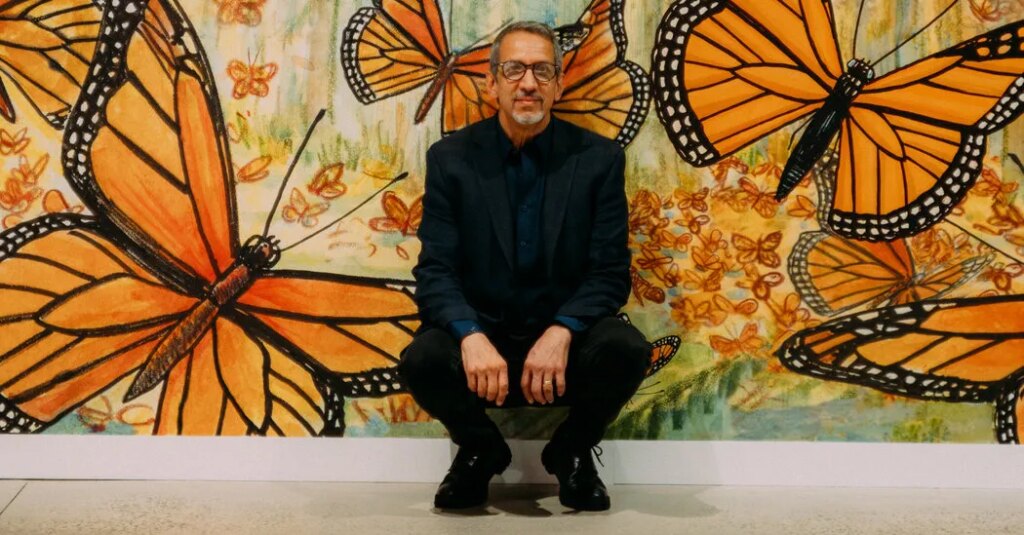
Now, Kuper’s fascination with the black-and-orange butterflies is on full display in “Monarch’s Journey,” a new exhibition at the American Museum of Natural History in New York.
By scaling up drawings into wall-size graphics, Kuper has transformed a corridor in the museum’s Richard Gilder Center for Science, Education, and Innovation into an immersive version of the monarch migration. Fans of “Ruins” will recognize drawings of a lone butterfly traversing hazardous landscapes — power plants, strip mines, the New Jersey Turnpike — rendered in steely shades of blue.
These panels lead to an exhilarating, full-color scene of hundreds of monarchs flocking within a Mexican forest that spans an entire wall. Parts of the image flutter and stir, thanks to projected footage of monarchs in flight. “You’ll see the drawing, and it’ll seem to be moving,” said Kuper, who spent weeks meticulously sketching the butterflies one by one.
Kuper and his museum collaborators view monarchs as charismatic ambassadors of the 10 quintillion insects who collectively support life on Earth. Their hope is that an exhibit devoted to the intrepid butterflies might open minds to the unsung flies, gnats, roaches and dung beetles who perform vital roles pollinating plants, decomposing waste, aerating soil and sustaining food webs. The monarchs’ journey, said Kuper, is a natural “way in.”
Monarchs weigh less than a paper clip and yet, over the course of two months, some cover 3,000 miles. In March, one butterfly flew 320 miles in a single day.
The dangers these delicate insects face are largely human made. For Kuper, whose cartoons critiquing the fossil fuel industry and other drivers of climate change earned him a Pulitzer Prize nomination this year, illustrating the migration is a more subtle means of raising urgent environmental issues.
“Pretty much everything I do is much more of the punch in the face,” said Kuper. “But this is really about bringing people in. You don’t want to have somebody stop at the door.”
Plans for the exhibit took off when Kuper approached Jessica Ware, the museum’s division chair of invertebrate zoology, who had granted him access to the entomology collections when he was working on “Insectopolis.” His original pitch was a show covering the entire 400-million-year history of insect life on Earth. Ware helped him to refine the focus, select images and hone the conservation message.
“I hope the show endears the monarchs to people, because there’s actually a lot of people who don’t realize that monarchs aren’t doing well,” said Ware.
“We think of monarchs as a staple, something that will always be there,” she said. “But the idea that our grandchildren could live in a world without monarchs is on the table.”
Eastern monarch populations have dropped by 80 percent since the 1990s, when 700 million monarchs overwintered in Mexico. Drought, extreme weather and wildfires caused by climate change have driven these declines in combination with pesticide use and deforestation, according to Ware.
In her own life, Ware said, she struggles to find the middle ground between “freaking people out” with grim statistics and managing her own “existential dread.” Insects around the world are disappearing at alarming rates, according to Ware, who studies these declines.
People sometimes give up when they’re confronted with bleak news, she said, but there’s encouraging evidence that insects rebound quickly when given a chance. “If there’s a wet spring, we have more fireflies,” said Ware. “If there’s less drought, the monarch numbers are a little higher.”
According to data published in March, the monarch population overwintering in Mexico showed a 64 percent increase over last year. “So what that tells us is that we actually can make a difference,” said Ware. “It’s not too late. But we have to act fast. We have to act now.”
Monarch caterpillars have evolved to eat a single plant: milkweed. To help populations bounce back, Ware recommends planting native milkweed (not generic “monarch food” sold online). Plant more than you think, advised Kuper, who’s raised generations of caterpillars. “You can’t just have two milkweed plants because, when they hatch, they eat. They’re voracious,” he said.
When monarchs thrive, so do the plants they pollinate. With the exhibition, Kuper and Ware tried to convey that it isn’t just the migration that makes monarchs spectacular, it’s the extent to which butterflies and other pollinators sustain larger ecologies and economies. When people mow milkweed in a park or highway meridian, there’s a cost.
“They’re basically cutting down money,” said Kuper.
According to a 2021 study published in the Journal of Environmental Science & Technology, pollinators contribute $34 billion annually to the U.S. economy alone. Without pollinators, crops like chocolate and coffee would disappear. Without insects in general, the human species wouldn’t last three months. “This has been a wonderful experiment for 4.5 billion years or so,” said Ware. “If we want it to keep going, if we want life to continue, it doesn’t happen without insects.”
“We’re basically promoting being selfish,” said Kuper with a laugh. “It’s very self-serving to want to protect insects.”
The post Swarms of Butterflies Land at the American Museum of Natural History appeared first on New York Times.