At a glance, the portrait depicts a teenage Black boy posing in front of a brick wall. But upon a closer look, the structure appears to be consuming the boy’s body, his arms and torso partially blocked out by masonry, all constructed of soft quilting fabric and other materials.
It is an image of the artist, Gary Tyler, “being immersed into that wall of captivity” as a young boy, Mr. Tyler said in a video call from his home in Pasadena, Calif.
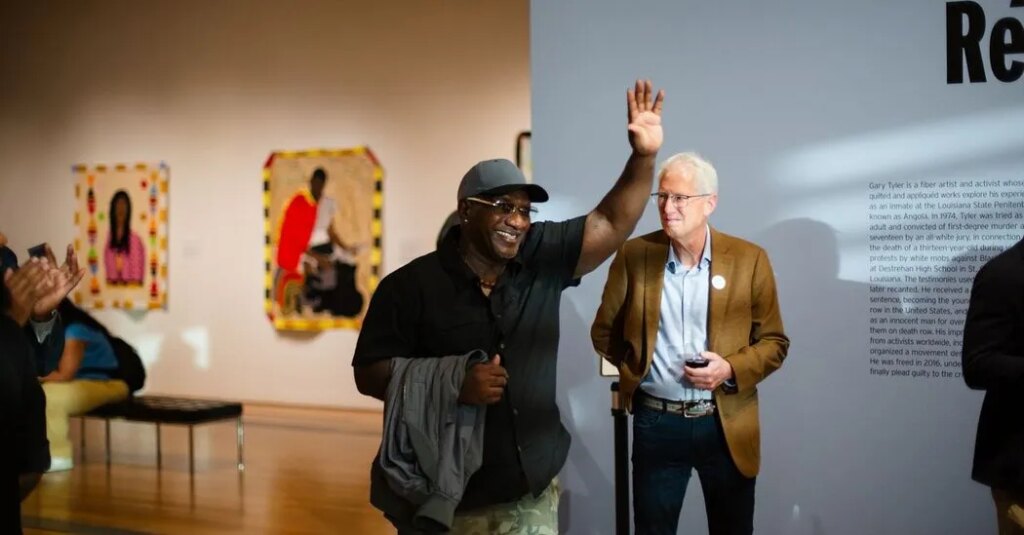
Stitched in 2023, the self-portrait nods to the interrupted life of Mr. Tyler, 68, who spent four decades in prison despite a flawed trial and repeated recommendations for a pardon. Now, a decade after his release, it is hanging at the Grand Rapids Art Museum in Michigan, part of Mr. Tyler’s first solo museum art show.
The quilt is based on a photo taken by his brother in 1974, right after Mr. Tyler was charged with murder at age 16. That year, Mr. Tyler had been sitting in a bus with other students near his recently desegregated high school in Destrehan, La., when a skirmish erupted outside, and a bullet struck and killed a 13-year-old white boy named Timothy Weber.
Mr. Tyler was sent to death row the next year — convicted by an all-white jury in a town seething with racial tension — largely based on flimsy evidence. His sentence was reduced to life imprisonment in 1976 after the United States Supreme Court deemed Louisiana’s mandatory death penalty unconstitutional.
Behind the bars of the Louisiana State Penitentiary, the country’s largest maximum-security prison, Mr. Tyler sought a semblance of normal life. He completed his G.E.D. despite guards at first dismissing his request for schooling, then earned a trade degree in art. He became the leader of the prison’s drama club, using theater “as a means of education, as a means of individual development, as a means of therapy,” both for himself and other inmates, he said.
It was in the early 2000s, the third decade of his incarceration, when he stumbled into quilt making. He had volunteered to serve as a counselor in the prison’s hospice program, and there, with a dozen others, created his first patchwork quilt to sell to support patients with AIDS.
“But it wasn’t my intention to make quilts,” he said.
He had been nudged into it by other inmates because he repaired wheelchairs in a workshop, which was a rare space in the prison to devote time to sewing.
At first, he resisted. “I kept turning them down,” he said. But he soon embraced the art form.
Sitting behind a sewing machine, he found, conjured memories of his mother, who worked as a seamstress, and his grandmother, who fashioned blankets for the family.
“I love the craft,” he said, adding that it’s “in my DNA.”
Efforts to free him continued.
New evidence and revelations had inspired hope for a new trial. Witnesses recanted their testimony, and a bus driver said no shots had been fired from inside the vehicle Mr. Tyler was in. A federal appellate court in 1980 deemed Mr. Tyler’s trial — in which he was represented by a divorce attorney — “fundamentally unfair.”
On three occasions, the Louisiana Board of Pardons and Committee on Parole recommended freeing him. But the two governors who had the power to do so did not.
In 2016, another Supreme Court decision altered his life. It deemed juvenile life imprisonment unconstitutional, offering Mr. Tyler a way out of prison.
He was not pardoned. Though he had maintained his innocence for four decades, he was required to plead guilty to manslaughter, with a sentence of 21 years, to enable his immediate release because he had already served 41 years.
After he was freed on April 29, 2016, he joined relatives in the Los Angeles area and made a living for several years as a counselor for at-risk youth before embracing life as an artist. He is represented by Library Street Collective, a gallery in Detroit.
Many of Mr. Tyler’s works have been acquired by private collectors and were lent to the Grand Rapids Art Museum for the current show, said Jennifer Wcisel and Terra Warren, curators at the museum.
His quilted appliqués — crafted from a blend of textiles, jewelry and charcoal — lean into motifs from his incarceration, signposts for some of the most crushing moments of his life.
As a teenager on death row, Mr. Tyler saw butterflies every morning among the hills outside his cell.
“I used to say to myself: ‘I wish I was a butterfly,’” he said, so that he could slip out of his bars and “just be free.”
Only after his release did he consider butterflies as an emblem of his rebirth, a process that also inspired the name of his exhibition, which runs through Jan. 3, and a work titled “Hope,” featuring a purple butterfly.
A semi-raised fist in chains, which appears in multiple pieces, he explained, recalls the gesture he made one day outside a courthouse in response to chants from a gathered crowd: “Free Gary Tyler! Free Gary Tyler!”
His mother, Juanita, who died in 2012, campaigned for his release. She was joined at various points by Rosa Parks and Amnesty International.
“I wasn’t able to raise my hands all the way up,” he said. So he lifted them partway and gave a power sign.
It was a show of “defiance,” he added, in the face of decades of legal disappointments, including the court’s dismissal of a motion that day.
Angola, as the prison is known, sits on 18,000 acres of a former 19th-century slave plantation. In one of Mr. Tyler’s quilts, it appears as two darkened watch towers, one of which he and other inmates had been tasked to demolish as free prison labor. That tower, now reconstructed, is in the collection of the Smithsonian’s National Museum of African American History and Culture.
In another design, the prison is embodied as a slave girl, shackled and hunched. It’s meant to “put a face on Angola itself,” Mr. Tyler said, and to condemn the use of “Black bodies as a means of currency, merchandise.”
One of the most elaborate pieces in his collection, newly sewn for the exhibit, is “Suffering of Humanity,” where a man with a full beard and dreadlocks carries the weight of the world, like Atlas, on his back as he trudges through a river of fire.
It serves as a remonstration to global man-made catastrophes — “wars and famine,” Mr. Tyler said — but also to more personal tumults.
“I saw myself in that struggle,” he said.
For the sake of his own well-being, though, he said he doesn’t dwell on the “anger, hate.”
“If I succumb to that poison,” he continued, “then I will basically be condemned by my environment, by the way things are.”
The post Imprisoned on Flimsy Evidence, He Began Quilting. Now His Work Is in Museums. appeared first on New York Times.