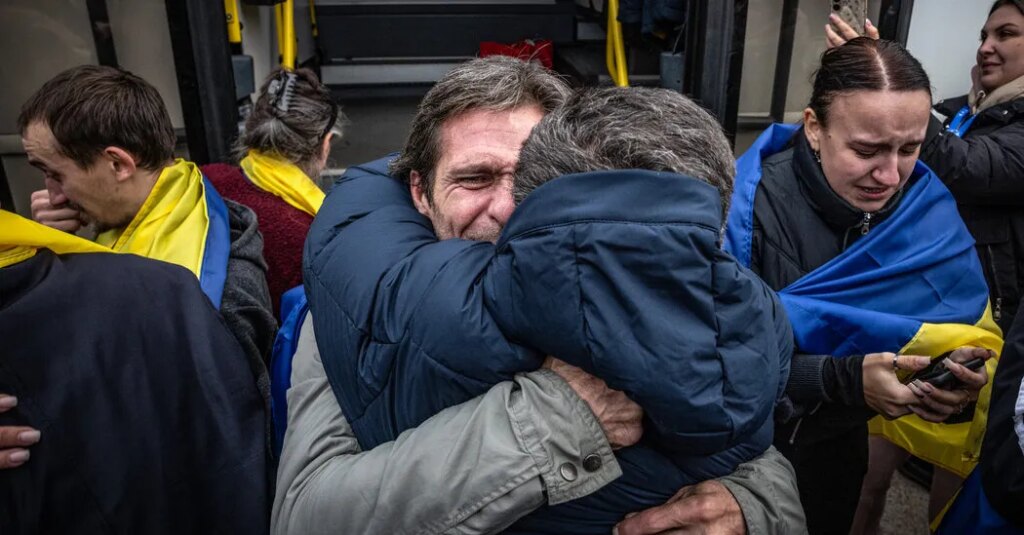
A rasping scream rang out as a teenager recognized her father. He was one of the hundreds of people who had escaped: years of Russian occupation, months of hunger under a deadly drone war, and then a truce backed by a first lady and the pope and an odyssey back to their loved ones.
A fleet of buses brought the evacuees from the embattled Ukrainian city of Oleshky out of the war zone on Saturday, the passengers waving and wiping tears as they swung into the parking lot and ended their journey back.
Draped in Ukrainian flags, the evacuees stepped down gingerly from the buses, weary after a 24-hour journey, which took them from the front line and through Russia and Belarus before returning to Ukraine. Many were gaunt from living months with little food, dark rings round their eyes from lack of sleep.
“We are coming from hell,” said Oleksandr Styopin, 75, lighting a cigarette. “It’s a kill zone there.”
Trapped close to the front line, with Russian soldiers living among them, the residents of Oleshky have been living under occupation for more than four years since Russia invaded Ukraine in 2022.
Their predicament worsened this year, when Ukraine drastically increased its drone attacks on Russian forces in the area, said Mr. Styopin, a retired electrical engineer.
The roads came under fire and supplies dried up as fewer and fewer drivers dared to risk the trip. Some residents tried to drive to the nearby town of Radensk to buy provisions, but many were killed on the road when drones struck their vehicles, he said.
Bodies of Russian soldiers were left lying in the road, he said, since no one would risk collecting them.
Mr. Styopin would push his bike to a local store once in a while and stock up on as much food as he could carry. Once he passed the burned body of a girl beside her own bicycle, he said. “That was from a mine, I think,” he said.
Some drones hovered close as if to look at him, and then let him be, he said.
But they hunted down the Russian soldiers relentlessly, he said.
“They pinned them down so hard, they could not step out of the building,” he said of the Russian soldiers. A group of soldiers had moved into an apartment in his building, he said.
Some of the evacuees described the hardships they endured with a lightness that verged on humor as they recalled destruction and loss.
“There was no electricity and no water. Then the house got bombed. Then the food ran out,” said Halyna Lohvynovska, 65.
“We got used to everything,” her husband, Ivan Lohvynosky, said with a smile. Their house was hit several times, he said. “When something fell on your head, you moved to another room. When the house was destroyed more, you moved house.”
There were some young families and even young children among those evacuated.
Vladyslav, 24, came out with his sister and mother. Thin and watchful, he declined to give his surname for security, he said.
The family had stayed in Oleshky because they had been scared that the Russian authorities would prevent him from leaving; he was of the age to be drafted into the military in Ukraine.
They survived by growing vegetables in their garden and raising a few animals, he said.
To some of their fellow evacuees, that was good fortune.
“The past two years were terrible. We had nothing to eat,” said Anatolii Honcharov, 53. His 61-year-old brother, Valerii, had not heard from him for three years because communications were so bad. Only families who lived close to the river could pick up a Ukrainian cellphone signal.
Things became so dangerous in recent months, Mr. Styopin said, that he did not dare leave his apartment. He sat listening to the radio, a cigarette permanently clamped between his teeth, he said.
His wife, who left at the onset of the full-scale invasion in 2022, joining their son in Queens, New York, called him many times urging him to leave.
“If I try to leave, I will step on a mine,” he told her.
“For the last two months I was living with a drone above my head,” he added. “It’s more than fear,” he said, “it’s an internal dread that’s always present inside you.”
But the plight of Oleshky drew international attention, helping to push for a rare localized truce in a war where each side has pressed for every advantage. Pope Leo XIV, just three days after surgery for lung cancer, spoke with President Vladimir V. Putin of Russia and called for a cease-fire to evacuate the city, and then the American first lady, Melania Trump, announced a local truce last Friday.
When the cease-fire began on Tuesday, Russian soldiers appeared to demine the roads and clear the streets of the dead.
“The Russians cleared up everything,” Mr. Styopin said. “There was a destroyed armored personnel carrier with bodies inside,” he added. “There was a body in pieces, half here and half there. The Russian took them all away.”
Many residents did not trust the news of a humanitarian convoy. Several said they had tried to leave in convoys early in the war only to retreat after the vehicles came under fire.
But Mr. Styopin packed his things. Then, on Friday morning as he was leaving his home, a blast knocked him back. During the Russians’ demining an explosion went off, and shrapnel ripped into his suitcase, he said.
He went back to find another case and then rushed through heavy rain for more than a mile to the bus.
“My heart was burning,” he said. “I thought I would crawl there in order to leave.”
Vladyslav said he and his family feared to trust that they would truly escape.
“These last four days, we didn’t believe we would make it out,” he said. “We thought it was just another provocation — they would declare a cease-fire and then blow us up along the way,” he explained. “We were terrified, but we went anyway, because there might not be another chance.”
Many of the evacuees and their families said they were surprised at the scale of the seriousness of the operation to get them to safety, and said it raised hopes for an end to the war.
Standing in the parking lot looking around, Vladyslav still looked uncertain.
“I can’t quite make sense of my mood yet,” he said. “Happiness. Being back under my own flag, hearing my own language.”
The post ‘We Are Coming From Hell’: A Ukrainian City’s Evacuees Tell Survival Stories appeared first on New York Times.