One month before Spain’s national elections on Nov. 29, Prime Minister Pedro Sánchez held a long meeting in Madrid’s Atocha station with officials from the train traffic control center that his government has blamed for a devastating crash that killed at least 69 people.
As his motorcade pulled away, Felis Caballero, a pharmaceutical company employee, rolled her luggage in front of the station.
“I travel a lot, and the train for me was always very safe, but not lately,” she said, adding that two mass-casualty accidents this year had eroded her faith in the rail system, and in Mr. Sánchez.
A self-described moderate from a town in central Spain near the site of the accident, Ms. Caballero, 60, said she wasn’t sure whether she would vote for the mainstream conservative opposition or cast a blank ballot. But one thing was clear, she said: It wouldn’t be for Mr. Sánchez’s Socialist Party. Under him, she said, things were “going badly.”
Mr. Sánchez, one of the longest-serving leaders in Europe, has faced his fair share of disasters during his eight years in power. Natural disasters have included the coronavirus outbreak, deadly floods in Valencia, wildfires and the eruption of a volcano in the Canary Islands.
He has governed through infrastructure nightmares, including a blackout across the country and a January train crash that killed 46 and was apparently caused by faulty rail on the track between Madrid and Seville. And just this summer, about 80,000 migrants breached Morocco’s border with the Spanish exclave of Ceuta in North Africa, though all but a few thousand soon returned to Morocco.
Perhaps the most damaging disasters to his fortunes have been political ones, including a raft of corruption scandals in his inner circle. One case put one of his closest advisers, the former public works minister who oversaw the railways, in jail.
Mr. Sánchez, a survival artist and talented campaigner, called early elections this month and earlier this week seemed to be hitting his stride. He joked around on a late-night talk show, chatted with YouTube influencers, sat for interviews with friendly media outlets. Then Wednesday’s horrific accident occurred.
It knocked Mr. Sánchez off a nascent charm offensive, and instead raised doubts about the competence that is core to his left-wing government’s pitch, and could dash the enthusiasm of the left-wing supporters he desperately needs to go to the polls and tighten his already narrow path to re-election.
“If blame falls on the government, an electoral penalty for them is the expected outcome,” said Ignacio Urquizu, the director of the independent polling firm Metroscopia and a former Socialist Party member of Parliament.
Mr. Sánchez’s government has been swift and unusually transparent this week in sharing information that it says shows that the fault for the crash rests with what the current transportation minister, Óscar Puente, has called the “inexplicable” negligence of traffic control operators. The conversations of those operators from the Madrid station to conductors of the two trains in the crash were leaked on the day of the accident.
Whereas evidence of human error individualizes fault and can contain political damage, Mr. Urquizu said, systemic failures tend to hurt governments because they are held accountable.
“When an incident happens a second time,” he said, “it acts as an aggravating factor.”
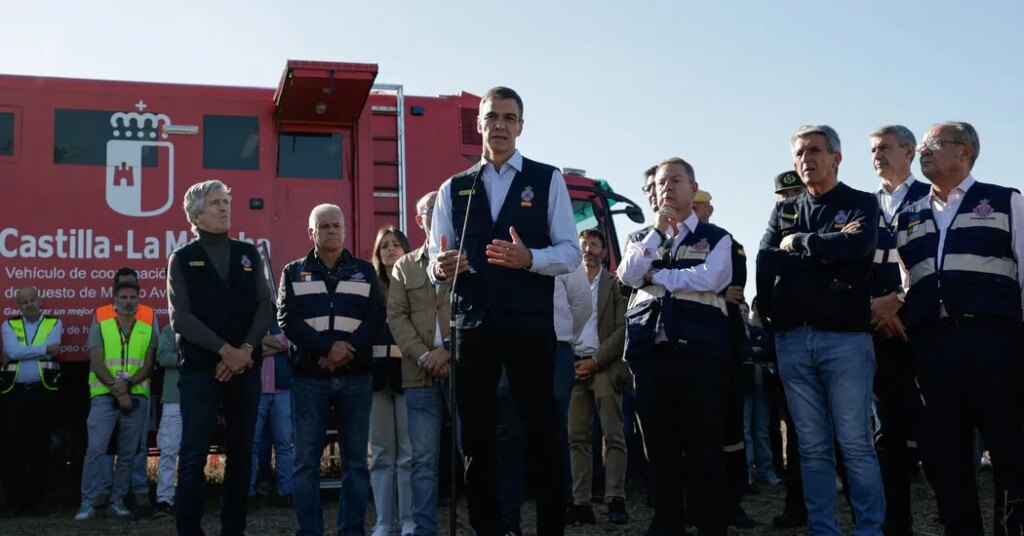
Mr. Sánchez, loath to seem politically motivated in the midst of a tragedy, has spoken every day near the crash site, clad in the kind of utility vest worn by emergency responders, and expressing support for them and for victims’ families. His focus, he has repeatedly said, is getting to the bottom of what happened.
“It is unacceptable for a country like Spain, with a high-speed system as powerful as the one we have, to suffer two accidents of this nature and magnitude in a single year,” he said on Friday. “What we are going to do is not only investigate the causes of what took place but also provide solutions to further strengthen the high-speed rail network.”
Mr. Puente, the transportation minister, who usually relishes his role as the government’s attack dog, insisted during a news conference on Friday that “I don’t have the electoral campaign on my mind.” He instead gave a chapter and verse description of the missteps of the traffic controllers that he said had caused the accident.
The government’s right-wing opponents, on the other hand, are trying to make the accident a symptom of a systemic problem, for which they hold Mr. Sánchez accountable.
“Attempting, as they did, to hold an operator at Atocha station responsible for a systemic failure across all safety layers is unprecedented,” said Alberto Núñez Feijóo, the leader of the Popular Party, Spain’s main opposition conservative party, who is favored in polls to win the election. “Everything that could fail, failed. The safety systems, the control center and the backup system. Every single layer.”
He said the government sought to deflect blame by faulting individual controllers. “If they don’t resign, we will vote them out at the ballot box.”
Santiago Abascal, the leader of the far-right party Vox, went even further. He has called Mr. Puente the “minister of death,” and at a rally on Thursday described Mr. Puente and Mr. Sánchez as a “sinister couple.”
Even before the crash, Mr. Sánchez faced an uphill climb in his bid to lead his fourth consecutive government since 2018.
He has sought to gain back momentum by talking about Spain’s significant economic growth, its declining unemployment, its attraction of immigrants and tourists, and its global status under his leadership as a progressive voice against President Trump and Israel’s war in Gaza.
Earlier this month, after protests erupted over unaffordable housing, his minority government sought and failed to pass measures popular with his left-wing base. He used the defeat in Parliament as an opportunity to call for early elections, hoping to gain momentum and enthusiasm with liberals, and to frame the election as a contest between moneyed elites and regular Spaniards whom he championed.
After the train crash, housing is less prominent on the national radar, and the country has retrenched into its deep polarization. With few undecided voters, enthusiasm within the country’s left and right blocs remains decisive.
In the last election, in 2023, Mr. Sánchez pulled off what many considered a political miracle by motivating his traditional left-wing base and cobbling together a coalition of far-left parties supported in Parliament by secessionist movements, in part by scaring them all to his side with a vision of a coming far-right government.
This time, experts say, Vox is more familiar and the threat less effective, and he is struggling to mobilize the left. His aides, confident in the prime minister’s campaign-trail talents and robotic ability to stay on message, had painstakingly planned a campaign schedule for him to hit inflection points like a national strike next month. The idea was to crest on a wave of enthusiasm before Election Day.
Then a Seville-bound high-speed train plowed into the back of a train sitting on the tracks.
The problem for Mr. Sánchez, said Mr. Urquizu, is that crises like the train crash “open cracks through which voters abstain or switch sides.” Infrastructure has not been high on the list of priorities for voters, he said, but the second train accident in a year “breeds distrust toward the government.”
The post Train Disaster Is a Blow to Spain’s Leader, Already an Election Underdog appeared first on New York Times.