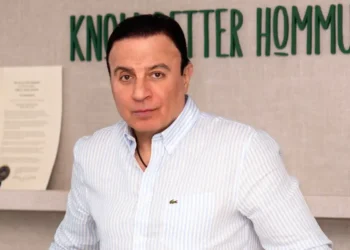
If one “X” factor has loomed over this year’s Senate races, it might be the independent candidate in Nebraska, Dan Osborn.
Two years ago, he came within seven percentage points of winning a Senate seat, even as President Trump won the state by 20 points. With the national environment much more favorable for Democrats now, the race seemed to have the makings of a barnburner.
Today’s New York Times/Siena University poll did not find a barnburner. Senator Pete Ricketts, the Republican incumbent, led Mr. Osborn by six points, 49 percent to 43 percent.
This is a somewhat surprising result. There haven’t been many polls of this race, but most of the polling — usually sponsored by partisan organizations — has shown a tight contest.
The result is not as surprising, or as much of an outlier, as our poll of nearby Minnesota, which found the Democrat there up 14 points Wednesday. But it is a better result for Mr. Ricketts than any poll since Labor Day. This time it’s the Republicans who will cheer the result.
Why is Mr. Ricketts faring so well? If the poll is right, there’s a straightforward explanation: Nebraska’s conservative electorate isn’t buying that Mr. Osborn is an independent.
For the second straight cycle, Democrats have stepped aside to give Mr. Osborn a better chance, as they have for independents in states like South Dakota and Idaho. We asked Nebraskans whether they think of Mr. Osborn more like a Democrat, a Republican or an independent, and 55 percent said a Democrat, compared with 33 percent who said an independent. Among self-identified Trump voters, 78 percent see him as more like a Democrat.
We didn’t ask this question when we polled Nebraska ahead of the 2024 election, so we can’t say that voters are likelier to see Mr. Osborn this way than two years ago. But voters have had two years of additional opportunities and television ads to learn more about him.
For good measure, this is a midterm electorate, a better-informed group of voters. The kind of Republican who votes in a midterm might be more aware of and sensitive to Mr. Osborn’s ideological bent. In our 2024 poll (which showed him trailing by two points overall), Mr. Osborn trailed by 10 points among those who had voted in the 2022 midterm, and led among those who didn’t vote in 2022 by seven points. The voters with an independent, populist, anti-system streak simply might not show up in big numbers for a midterm.
That strikes me as a plausible story, but it does suppose that the poll is right. Most other polls have shown a tighter race.
A poll this week sponsored by a pro-artificial intelligence group and fielded by Echelon Insights, a Republican firm, found Mr. Ricketts ahead by just one point.
Is the poll underestimating Democratic turnout? (Wonk rating: 7/10)
If the Times/Siena poll is underestimating the support for Mr. Osborn in Nebraska, the explanation might be the turnout.
In the midterms Tuesday, Democrats are generally expected to enjoy some kind of turnout advantage, at least in terms of Kamala Harris’s supporters turning out at greater rates than Mr. Trump’s supporters.
This Nebraska poll, however, doesn’t really show any Democratic turnout advantage at all. Among those who say they voted in the last election, respondents to our survey said they backed Mr. Trump by 21 points in the last election — roughly the same as his actual margin.
This may help explain why the poll has a relatively conservative result. Other Times/Siena polls, on average, have shown Democrats doing about four points better on recall vote than the actual result in a given state.
Why is the Nebraska electorate more conservative? The answer might not have anything to do with the 2026 midterm election, but actually who showed up to vote in the 2022 midterms.
To understand, it’s important to know that the Times/Siena turnout model incorporates data about whether voters turned out in past elections based on voter records, since those with a robust track record of voting are much likelier to vote. On average, this approach works out for the best, but like most things in survey methodology, it’s not guaranteed to work in any particular race — especially if turnout was quite a bit different for that race in the past.
In the 2018 midterm election, Times/Siena polls tended to systematically underestimate Democrats in states where the turnout in 2014 was especially low, like in Texas or Nevada. That’s because there were fewer Democrats and particularly Hispanic voters with a record of voting in a recent midterm, and thus they were projected as a relatively small share of the electorate. In the end, turnout surged in these states and the polls underestimated Democrats.
We attempted to design these models in a way that corrected for these state-by-state and demographic idiosyncrasies — and tried to do so even more aggressively this time — but they’re hard to account for entirely.
The relatively conservative Nebraska result could be a sign that a similar pattern might be emerging in Times/Siena polls this time, where Democrats fare a bit better in the states where they did well in 2022 and a bit worse in those where they struggled. You can see it yourself in our Times Voter Trends estimates for the last presidential election. For each state, we report estimates for the result of the 2024 election among voters who turned out in the 2022 midterm election (you can see it if you click the “show all” button on the table).
Nationwide, our estimate is that Ms. Harris narrowly won 2022 midterm voters in both the popular vote and in the Electoral College, including in Wisconsin, Pennsylvania and Michigan. If you’re a longtime reader, this is not surprising: Throughout the last campaign, our data consistently showed that President Joe Biden and Ms. Harris held up well among regular voters while Mr. Trump’s gains were disproportionately among irregular voters. This helps explain why our polls usually find a likely electorate where Ms. Harris did better than her result in the last election.
But this story varies state by state. There are some places where Democrats had a relatively strong turnout in 2022 and others where the Republicans had a strong turnout. And it so happens that these turnout patterns loosely correspond with the results of our latest polls. Nebraska is a state where Mr. Trump actually fared better among 2022 midterm voters, according to our estimates. Florida, where our last poll supposed a relatively vigorous Republican turnout as well, is another one. On the other hand, our polls of Minnesota or, earlier, Michigan showed an above-average Democratic turnout advantage, much as our estimates suggest for 2022.
There’s really no way to say whether any lingering 2022 effect will help or hurt our results in any particular state. Maybe Nebraska really is a state where the midterm electorate is just a little more solidly Republican. Or maybe this lingering effect nudges our result the wrong way, as it did in Texas or Nevada in 2018.
There’s one additional risk, albeit not one in Nebraska: Our turnout model might be completely right about a strong Democratic turnout, but if the polls aren’t getting enough Trump supporters, our accurate turnout model might make our poll results even more Democratic and thus less accurate.
As a matter of principle, it is very difficult to defend a “two wrongs make a right” approach to survey methodology, where a pollster does something “wrong” to cancel out a deeper flaw like nonresponse bias. There are pollsters who benefit from these kinds of practices, intentionally or not, like those who talked up their ability to reach Mr. Trump’s supporters but who were really just excluding young Democrats by only calling landlines or in-state telephone numbers. Similarly, there are pollsters today who seem to be weighting to an extremely favorable electorate for Republicans, even though there is little reason to believe that’s the likely electorate this time around.
Nonetheless, it’s entirely possible that these approaches will yield the most “accurate” results if, in a given election, a pollster is right about how their poll is otherwise wrong. But if the pollster guesses wrong, the result could be a colossal misfire — like the polls that badly underestimated Democrats in Virginia and New Jersey in 2025. That’s a possibility as well.
Regarding the Nebraska poll, it’s never fun to release a poll that feels as if it’s out on a limb, but there is one small consolation in this case: The big risk of polling error in this election is the possibility that the polls might underestimate Republicans in red states. If that’s the main fear, stronger Republican results on the Great Plains offer a certain kind of reassurance.
The post In Nebraska Senate Race, the Independent May Have an Identity Problem appeared first on New York Times.