On a restaurant patio in Burtonsville, Maryland, a crowd pushed its way to the front of a stage area.
“We want Will! We want Will!” they shouted on a recent, chilly October evening.
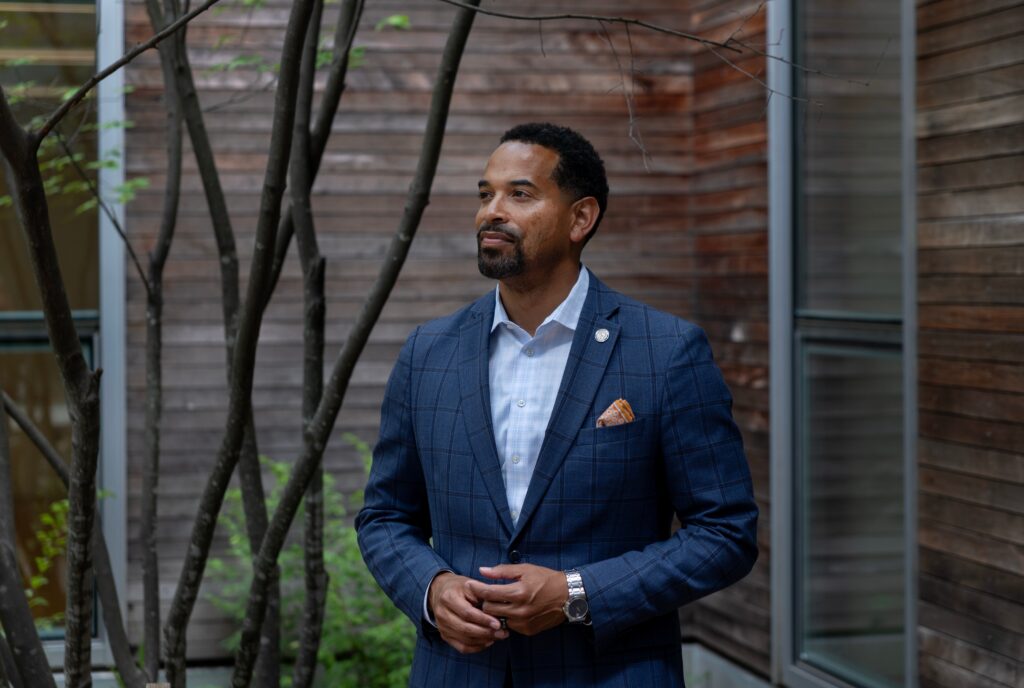
They were eager to hear from Will Jawando, the Montgomery County council member widely expected to win Tuesday’s race to become county executive of the largely blue jurisdiction.
His supporters had reason to cheer. The event was one of Jawando’s most visible since he suffered a heart attack in early September during his usual pickup basketball game.
The moment changed the way Jawando viewed life and politics, he said in an interview. Gone are the days of “going, going, going.” Instead, he’s making room for rest, exercise and eating well to help him lead more intentionally — a message he wants to spread to others, too.
“There’s a before and an after” the heart attack, Jawando, 43, said after cracking a few jokes with the gathering of more than 100 community members and local and state politicians. “And I’m definitely in the after.”
Jawando, a county council member for eight years, has devoted his career to public service and is poised to take his highest position yet.
He clinched this year’s Democratic primary in a competitive race against some of his council colleagues, buoyed by staunch support from Maryland Gov. Wes Moore (D). Republican Esther Wells, a 39-year-old senior tax manager, has challenged Jawando in the general election on issues ranging from taxes to policing. A Republican hasn’t held the county’s top seat since the 1970s.
As Election Day nears, the next leader of Maryland’s most populous county faces headwinds — opposition from the federal government and economic pressures, such as keeping the county affordable, growing its tax base and attracting businesses.
“I think Will’s vision is the best one for the county going forward,” said Art Brodsky, a 73-year-old retired journalist and speechwriter from Olney who attended the event.
Jawando’s vision appears to be rooted in a common theme: togetherness.
“This is our moment and we have to seize it,” Jawando said to the crowd. “So, are you with me to seize it?”
A defined purpose
Born to a Nigerian father and a Kansan mother, Jawando’s family put down roots in Silver Spring. He credits his teachers and education in Montgomery County schools for helping him earn a scholarship to college and law school at Catholic University in D.C.
But coming out of high school, the loss of one of his best friends to gun violence forever affected him.
Jawando said he recalled thinking, “I want to make sure that doesn’t happen for more people and that people have opportunity.”
He thought law enforcement might be the answer and got an internship at the FBI. When that didn’t quite fit, Jawando ended up in law school.
Then came an opportunity to work for Rep. Nancy Pelosi (D-California) on Capitol Hill.
“It really all clicked because I realized when you get policy right, you can really change circumstances,” Jawando said.
Shortening someone’s commute to work buys them more time with their family, he said. Earning a living wage can ease the burden of working multiple jobs. Improved schools and after-school programming offers an environment for opportunity.
“And so that’s really all I’ve been doing my whole career in one way or the other,” Jawando said.
A civil rights attorney, Jawando said he homed in on education, criminal justice and workforce policy when he worked as an adviser and judiciary legislative assistant for then-Sen. Sherrod Brown of Ohio, and later the associate director of public engagement in the Obama White House.
Jawando began running for office in 2014, narrowly losing a Maryland House of Delegates race. Two years later, he lost a run for Congress.
The losses were “only lessons,” Jawando said.
He stayed busy in the community and launched the nonprofit organization Our Voices Matter, which advocated to build civic engagement in low-income census tracts in the county, and co-founded the African Immigrant Caucus. Jawando also created Summer R.I.S.E., a summer youth jobs program in the county.
In 2018, Jawando won an at-large seat on the Montgomery County Council, a role he has held since.
Jawando said he ran on what he coined the Montgomery promise: Everyone should have the opportunity to learn at a good school, afford a home and have a job that pays a living wage. That includes his own family, as a husband and father of four children.
Whether stabilizing rent, investing in public education, leading criminal justice reform or supporting small businesses, Jawando said his work on the county council stayed rooted in purpose.
“My wife jokes with me, I’m still that same teenager trying to make the world, my community, better,” Jawando said. “It’s all tied to that.”
In his early time on the council, he sometimes would take 12 meetings a day.
He plans to take a new approach as county executive. Scheduling the best use of his time, and accounting for quality of life, will be key, he said.
Jawando said bringing together a strong team of leaders also will allow the load to be shared and for his administration to be more effective.
“We will have great people in place, and we’re all going to be a part of the team, and it’s not just about me, it’s about all of us,” Jawando said.
Outgoing County Executive Marc Elrich (D), who is term-limited and running to serve on county council, endorsed Jawando to be his successor.
Elrich said Jawando brings “continuity” to the county and shares values with him and former county executive Isiah “Ike” Leggett, who pushed for promoting diversity and addressing disparities within Montgomery.
“He just didn’t glom on to, ‘Oh, everybody’s going this way, I guess I better go that way, too,’” Elrich said of Jawando. “I think he’s demonstrated a willingness to learn and to have his ideas develop. And that’s a good thing.”
Not everyone agrees.
Wells, his Republican opponent, said Jawando supported raising an income tax for high-income earners, which she argued could dissuade entrepreneurs and businesses from the county.
Jawando opposed eliminating a nearly $700 property tax credit earlier this year. The measure was approved by his colleagues, and Wells criticized Jawando for later weighing in during budget talks on how the county should allocate money generated by eliminating the credit.
Jawando rejected Wells’s interpretation.
“I was against it. I lost,” Jawando said of slashing the credit. “You don’t get your way every time in politics and you got to move on and then do the greater good.”
“We have to be responsible and pass a budget,” Jawando added.
Overall, he wants a “fair tax system,” he said, that would include addressing the county’s flat regressive tax. He said a property tax rate for a mansion shouldn’t be the same as one for a condo.
Jawando also said raising the income tax for higher earners, such as people making more than $1 million, would create “tens of millions of dollars” for the county and enable it to potentially lower taxes for more than 90 percent of residents.
Wells also criticized Jawando’s platform on policing, pointing to his stance during the 2020 racial justice demonstrations to “defund the police” and efforts to remove school resource officers.
Jawando said he supports police and has voted to increase the police budget every year. Although he efforted to remove officers from schools in a law enforcement capacity, he supports having them there for community engagement, he said.
His mission for community safety centers on a system invested in police, mental health resources, public spaces, fully staffed schools and after-school programming, he said.
Lee Holland, president of the police union representing law enforcement in Montgomery County, said in a statement that the union once endorsed Jawando as a council member, but the relationship began to deteriorate.
Holland said Jawando “attempted to restrict collective bargaining rights” of police officers and local government employees.
“Our members know that while Councilmember Jawando has supported pay and benefits, he has not supported their working conditions and has rushed to judgement of officer’s actions,” Holland said in the statement.
Jawando said there have been some “very limited circumstances” of him challenging collective bargaining, primarily a provision in a use-of-force bill.
“When you’re talking about human life in that way, there are some things that I don’t think should be collectively bargained,” Jawando said. “Working conditions, pay, time off … I’m 100 percent” in support of.
He said a power-wielding government, including police, should be held to a high standard.
The next county leader must choose a new police chief, too, after its most recent chief resigned. Jawando said he believes the right person for the role would operate with integrity, build morale and instill trust in the community.
“I intend to take it very seriously and look at a wide net of qualified people,” Jawando said of the search.
A new normal
The current political moment in Montgomery County is “unprecedented,” Jawando said.
Thousands of federal workers lost their jobs. The Trump administration has sued the county over a bill Jawando championed to prevent law enforcement from wearing masks. And many residents have recently lost Medicaid eligibility, Jawando said.
Barbara Dominguez, a health care worker who has lived in Montgomery County for 30 years, said she has seen the impact of the loss of Medicaid firsthand.
“People can’t survive,” said Dominguez, 54, who attended the event in Burtonsville.
Jawando said that, as county executive, he will work with regional partners at the state and local level from D.C. to Maryland to “protect people as much as possible.”
Top of mind for his agenda includes creating a regulatory package that would make it easier to start a business in the county and establishing an early-care and -education regime for affordable, high-quality child care, he said.
Most importantly, though, Jawando wants to keep the right pace.
His campaign had its share of stress over the past year, he said, with negative ads and other pressures. Then came that weekend basketball game on Sept. 5.
He recalled sending his wife, Michele, a text before he was rushed to George Washington University Hospital: “I’m having a heart attack.”
Nearly two months later, the former college athlete said he is recovering well and feels “better every day.”
At the campaign event at Restaurant 198, with his wife seated close by, Jawando ended by telling his supporters that Maryland and Montgomery County’s best days are ahead, too.
The post He’s gearing up to lead Maryland’s largest county, with a new outlook on life appeared first on Washington Post.