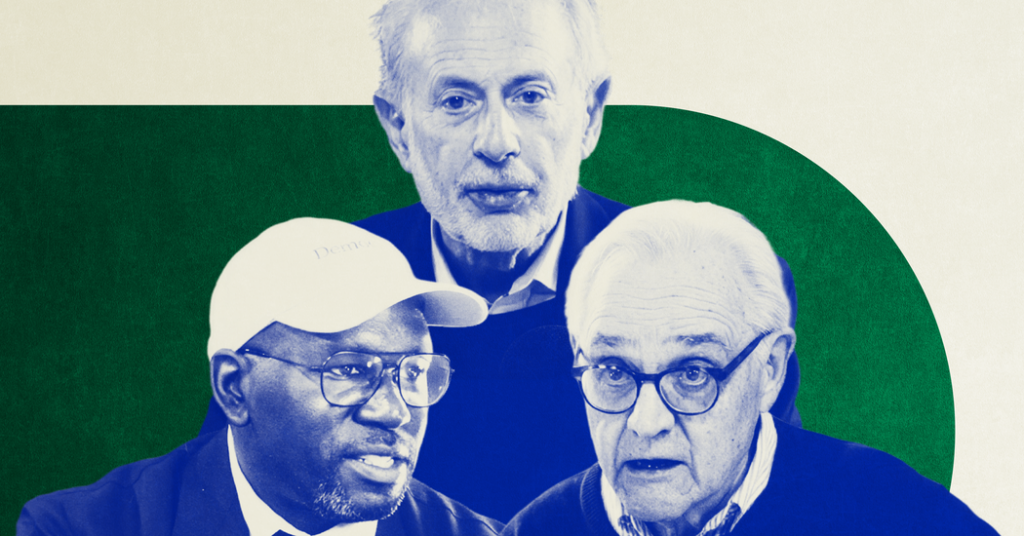
With just days to go until the midterms, the Opinion contributor Robert Siegel joins the contributing writer E.J. Dionne Jr. and the columnist Jamelle Bouie to discuss potential outcomes, the polls and what the result might signal for the country moving forward.
Below is a transcript of an episode of “The Opinions.” We recommend listening to it in its original form for the full effect. You can do so using the player above or on the NYTimes app, Apple, Spotify, Amazon Music, YouTube, iHeartRadio or wherever you get your podcasts.
The transcript has been lightly edited for length and clarity.
Robert Siegel: This is our last political conversation before Election Day. I will spare you any predictions of the outcome, but that still leaves a great deal to say.
So let’s get into it. An election that is unusual for many reasons is just a few days off. What are Republicans and Democrats running on? What might victories in congressional races permit either party to do about the problems they’re decrying, or to continue achieving what they call success?
E.J., I suppose the question I’m starting out here with is: What’s the election of 2026 all about?
E.J. Dionne: Well, you know, a lot of elections seem issueless. This one does not. This one has really clear contours. And Democrats, in my experience both being out there — and particularly Mississippi and Kansas, which I’ll talk about — but watching it elsewhere, the discipline that Democrats have had in sticking to economic issues and the discontent that people feel with President Trump is really striking.
Scott Colom down in Mississippi had the crowds yelling, “Higher wages! Lower costs! Save health care! Save hospitals!” He knows what he is running on. David Jolly, running for governor of Florida, speaks about housing, health care, education, and no data centers. Senate Democratic leader Chuck Schumer was busy with reporters this week, on the same day — in my case in the afternoon and Jamelle in the evening. He called us both and wanted to talk about the election, and Schumer said that when we feel comfortable with strong economic issues, we feel in sync with the party and the voters, and it brings us together.
And I think you’re actually seeing that after all the talk of division, and there is still some division in the party and a lot of soul-searching to do after. But it’s really striking. The Republicans are really strikingly not running on Donald Trump’s record. And they seem to be running everywhere on Democrats as socialists or communists, on trans issues, and on the threat that somehow Democrats will open up the borders. And they’re spending a lot of money to push these messages, but they really are backing away from Trump in some cases, and aren’t even trying to run on any achievements of the last two years, even tax cuts. A little bit on tax cuts, but not very much.
Siegel: Jamelle, does it all boil down to the election of diesel prices and data centers?
Jamelle Bouie: I think that is very well said. So with diesel prices and gasoline prices as being kind of a basic stand-in for cost of living issues — groceries, the cost of housing, all these things are very acute for voters — but obviously, when you drive anywhere, you see the gasoline prices, you see the diesel prices, and that’s the thing that sticks in people’s craw.
As far as data centers, that is an interesting one because it is a new issue, right? Like, we haven’t gotten very many new issues over the last decade. A.I. and, I think, the influence of the tech industry in terms of our ability to govern ourselves are these new issues. And the extent to which the president has been a full-throated supporter of building data centers has the A.I. industry behind him, it has given Democrats this opportunity to really sort of say, not just, “Oh, you don’t want this big behemoth warehouse in your community,” but “This is this representation of the way that these powerful corporations do not care about your well-being and your ability to just live your life as you see fit.”
Dionne: And I am really struck by the fact that the whole A.I. data center issue almost feels like an incipient Progressive Era, like the last one, where then it was railroads and other big interests. I think you’re seeing this progressive energy not in the sense of how we use it now, but in the sense of how they used it then to say, “We’ve got to get some of these big, big industries under control or they’re going to control us.”
Bouie: I wrote about this not too long ago, kind of making this comparison between A.I. and railroads as these similarly transformative industries that prompted a real effort on part of the public to assert democratic control over them. It’s helpful, in both cases, that they’re so physical, right? A data center is this physical construction, and loud, and it’s hot, and it’s visceral in a way that I think lends itself very well to being utilized as a political tool — as Democrats, I think, are doing across the country.
Siegel: It’s hard to see how any result on Tuesday can leave the Democrats in a position to legislate successfully.
But Times reporter Annie Karni has written about what Democratic House leadership intends to do, which is, in a sense, to vote in favor of a kind of legislative program, knowing that it’s doomed to be blocked by Senate filibusters and White House vetoes. Does this make any sense to you?
Bouie: I think it does to the extent that messaging bills can be used by national Democrats, by people in particular districts, to say: “Hey, this is what we’ll do. If you give us the presidency in two years, we’re going to do more of this.” And I think that there are places where there might actually be real constructive legislation, right? Budget bills have to be passed, and so, I think there’ll be leeway there for Democrats to say, “Restore funding for Obamacare subsidies,” that kind of thing. “Restore funding for Supplemental Nutrition Assistance Program.”
But I do think that, in terms of the bulk of the work to be done, it is and has to be on the investigative side; that for the past almost two years now, we’ve had a Congress that is largely disinterested in looking into what the administration is doing, that has largely abdicated its obligation — its constitutional obligation to exercise oversight over the executive branch. And it feels like there’s a lot there. It feels like there’s a lot of material for House Democrats, if Democrats from the Senate, Senate Democrats, to engage in lucrative and fruitful investigations of what is happening in this administration.
Siegel: But returning to this idea of passing a kind of a legislative agenda — E.J., does it make sense for the Democrats to pre-empt what might come out of the 2028 presidential campaign as the most important issues? That is, as you say, if two years ago, Democrats had set out an agenda, data centers would not have made the cut. Could they become wedded to simply restoring Medicaid cuts, as opposed to another health care reform act?
Dionne: I think not. One of my heroes, Michael Harrington, talked about visionary gradualism. And I think taking a step forward here can lead to further steps forward down the road. We saw that with civil rights, where there were some weak but still real civil rights bills passed in the late ’50s that eventually led to the ’64 Civil Rights Act.
And I think Annie Karni’s story is a really good piece, because what it underscores is that Democrats are saying, look, we ran on these issues, and we’re going to keep our promises, and it’s up to Trump and the Republicans to decide what they’re going to do about it, particularly in restoring all the health care subsidies and Medicaid and the food stamp cuts, and repealing most of the tariffs. On Jamelle’s point of, you cannot, as some people have argued — well, you either are a legislator or you investigate — no. Democrats have to do both. And I think one way to look at the investigations is that this isn’t just about going after Trump.
This is about laying out things that we really need to reform in the long run. Jamelle had a column on this, where we really need to reform the president’s pardon power, for example. We probably need stronger rules to prevent a future president from doing some of the stuff Trump did with crypto and God knows what else. So I think that the investigations can be justified on legislative grounds, as well as just telling the people: “This is what has happened to you over the last two years.”
Siegel: This is a midterm election. There’s nobody at the top of either ticket, literally. So that means it’s really dozens of elections. And I wonder if each of you could talk a little bit about some of the races that have struck you as being especially interesting that haven’t gotten as much attention as the Texas Senate race or Maine, now maybe even the Alaska Senate race. What struck you as being especially interesting, E.J.?
Dionne: At the end of the summer, I talked with my editors about where I wanted to go, and the two races I picked out were Kansas and Mississippi. And I picked those out because, in both cases, you have very interesting Democratic candidates. Adam Hamilton — the pastor of the largest Methodist church in the country, 24,000 members, really thoughtful guy — talks about himself as an independent-minded Democrat. And a relatively weak and, we’ve seen in some ways, problematic Republican incumbent, Senator Roger Marshall. And then in Mississippi, you had an extraordinary Democratic candidate called Scott Colom, who is a district attorney, was the first Black D.A. elected in a majority-white judicial district, who was really organizing the state very effectively.
And so, I went there, and lo and behold, Kansas is in play. It may now be one of the better Democratic chances of a pickup on Tuesday. And Scott Colom finally has persuaded the national party that, hey, this is possible. You know, historically in Mississippi, a Democratic candidate needs high Black turnout, which Colom is clearly mobilizing, along with the backlash against the Supreme Court’s Callais decision, and about 25 percent of the white vote. He’s getting close.
Just quickly, I’m going to pay close attention — this is Jamelle’s part of the world — two Virginia House races; partly because they’re going to report early on election night, partly because I really respect the two Democratic candidates there. Quite different kinds of candidates. Second District, former Representative Elaine Luria against current Representative Jen Kiggans. That’s a rematch. Luria seems to be ahead at the moment. If she takes that, it’s a real indicator of a good night for Democrats. And Tom Perriello has gone back to his district in southern Charlottesville, down to Danville in southern Virginia. And he is also running a strong race.
And then — just to mention them — Sherrod Brown I always pay attention to, because he is such a voice for labor and worker rights. Watch David Jolly’s race in Florida. David Jolly is running very close. The notion of Florida flipping was totally off anybody’s radar a year ago. I think he’s got a shot.
Siegel: Jamelle, what are some races that strike you as especially interesting?
Bouie: Well, E.J., I am interested in the two Virginia races — the Fifth District and the Second. I say I’m from the Second District. I grew up in Virginia Beach. And so, it’s fun for me that two of the most interesting competitive races in the state are where I live and where I’m from. And to echo E.J., the Second District has long been this bellwether.
Both these districts are interesting mixes of rural and urban, but the Second District, in particular, is almost like a microcosm of the political geography of the country. And in every election I’ve been paying attention to, who wins the Second really is a kind of indication of what the overall House vote might look like. So I’m very interested in what happens down there. Beyond those two races, South Carolina is fascinating to me.
Siegel: The Senate race.
Bouie: Senate race in South Carolina.
Siegel: To succeed Lindsey Graham, I believe.
Bouie: I’m very parochial. My parents live in South Carolina. So I’m there a lot. I’m very locally loyal. But the recent Times/Siena poll has the statistical tie between Darline Graham, the late Lindsey Graham’s sister, and Annie Andrews, the Democratic candidate. And that is, I don’t think, anything anyone expected. Now, even with Graham being a totally novice candidate, I think the expectation was that this is South Carolina, one of the reddest states in the nation. Arguably — I mean, all respect to South Carolinians — a hotbed of reaction in American history. Like, it’s very, you know, obviously——
Siegel: The beginning of the Civil War, for example.
Bouie: Before the Civil War, nullification crisis in the 1830s, the secession crisis, Jim Crow — like, you’ve got to go down the list, and South Carolina tends to be at a genesis point for a lot of that stuff. And obviously, the state, in its history, elected Democrats, but it’s never elected liberals, right?
It’s always been a very conservative state. And so, the fact that you have this very competitive race that, much like in Mississippi, backlash to Callais may be energizing the Black vote in South Carolina. There is some real demographic change in the white voters in the state, in migration from other parts of the country, growing educational institutions, major aerospace factories.
Siegel: A real manufacturing base, yeah.
Bouie: These political, economic changes are creating, maybe, the space for more partisan competition in this state. And so, I’m just fascinated by that, and I had been asking for months to various people: Can someone produce a high-quality poll of South Carolina? And we have one this week, and it really is a striking thing to observe.
Siegel: Speaking of polls, by next Wednesday morning, some pollster, or an aggregator of polls, is going to be looking prescient and declared a genius, and others not so much.
Dionne: It’ll all be an accident, too.
Bouie: Right.
Siegel: E.J., what does polling do to our politics? What has it done?
Dionne: Yeah, well, you had a particularly egregious case earlier in this cycle, where somebody put out a poll that he later said was fake. And a candidate in Michigan, Senator Mallory McMorrow, dropped out of the race because this poll put her at 9 percent, which dried up her fund-raising. That’s a particularly egregious form of manipulation by polling. You also have some polling outfits that seem to produce results to tilt the polling averages in a certain direction. And those are not helpful. I think in this case, you’ve got such a multitude of polls that I think we have a fairly good idea of what’s happening in a lot of these races.
And we know, in case of the Senate races, a whole lot of them are close, and that the line between a Democratic sweep in the Senate and, maybe just narrowly, falling short is pretty thin. And so, we’re going to overread whether polls are right or wrong. And the last point I’d make is that I think there’s a bit of a debate about whether the polls are subject to the old problem of undercounting Trump-oriented voters or maybe overcorrecting for that problem. In one case, the Republicans will do better than they are indicated, but in the other case, the Democrats could end up doing better than these polls are suggesting.
Siegel: We should note that the impact that a couple of fake polls had, briefly, on races is a measure of what suckers we are for data. I mean, it didn’t take much scrutiny of these polls to get them included in some aggregate. But what do you think about this?
Bouie: I mean, beyond the points E.J. made, about how the polls are looking, the state of polling, I think it’s important as political news consumers — as people who maybe consume polls — to understand what they can and cannot do. Polls can’t actually predict. They’re giving you a snapshot of what things look like in that particular time. And what that snapshot can help you do — if you’re a campaign, if you’re a candidate, if you’re a consumer and observer — is give you a sense of what the landscape looks like, right? This is the hill you might have to climb, this is the slope you might be going down — that kind of thing.
But ultimately, what happens is still up to the campaigns, the individuals, the people who do the thing. And in some cases, the landscape is such that there’s no amount of effort you can really throw in that’s going to help you overcome the obstacles. But many times, it is the case that things are a little more fluid than they look, right? That voters are a little more undecided than they appear to be.
That the quality of campaigns — E.J. mentioned the Kansas election — that is as much about the quality of Adam Hamilton as it is about the weakness of Roger Marshall, right? Marshall just does not appear to be equipped to run a competitive campaign. And so, even if, on paper, this looks like a very difficult reach, and it is a hard reach, the fact of a poor incumbent and a very strong challenger changes the game. I think polling, in maybe a somewhat counterintuitive way, should remind us that these things are much more fluid than I think we like to believe, and that outcomes can change in big ways in relatively short amounts of time.
Dionne: And I think this notion that things can change in the last week of a campaign has come back to bite predictions over and over again. Things really do change. In that conversation I had with Schumer, Schumer said that for him the question is, can massive amounts of Republican money defeat overwhelming Democratic advantages? Because when you look at the non-polling indicators here, early voting, the Democrats have a huge advantage over Republicans compared to where they were two years ago or even four years ago. Trump’s approval ratings are just going down, down, down, down. All the fundamentals are there for a very strong Democratic result.
And the real key for Republicans is, can they — in the final week and now the final days of the campaign — mobilize enough of their supporters who may not be happy to come out and say, “Well, I guess I’ve got to vote for the Republican again.” And some of those races could tip on voters who may not use their pencils very hard, may not be enthusiastic about it, but still put their marker in the Republican box. And that’s a thing that the polls have a really hard time measuring.
Bouie: Right. Although I’ll say, I feel like all of us have been covering politics long enough to ——
Siegel: We’re all reading a zillion polls.
Bouie: But every cycle you have this, “Things aren’t looking great for us, but if we can just get our supporters to the polls, things might look better.” And I’ve not seen a cycle where that has ever worked.
Siegel: OK. I want to wrap up this discussion with something that an old friend of mine, Steve Roberts, told me many years ago. He was a Times reporter back then, back from an overseas assignment in Athens, and I was heading off to London for NPR. And he told me that covering foreign elections, he said, is never about the horse race dimension. He said that an election reveals something — it tells some story about a country. And I’m just curious, as we look ahead to this election on Tuesday: E.J., what story might unfold? What might this election answer? What questions might it answer about ourselves as we see the results next week?
Dionne: Well, I see two interrelated connections here: One, the simple one is just frustration, anger, disappointment — and on the part of a substantial number of Trump voters — a sense of betrayal. He promised to bring down prices, not go to foreign wars, and all the rest. And he now seems utterly indifferent to the promises he’s made, and kind of poo-poos affordability, and really is saying to those working-class voters who voted for him: I don’t really care very much. He even talks about making a lot of money himself.
So I think there’s that frustration, exhaustion, anger. But I also sense that this may be the end of a cycle, the end of a 10-year cycle. And that doesn’t just depend on whether there is a Democratic sweep or not. I think people are looking for a different kind of politics, and I think it’s a marriage of two seemingly contradictory things. I think a lot of candidates on the Democratic side are saying — Barack Obama said it in a speech down in Atlanta — that people are just tired of hating on each other all the time, having a politics rooted in division and hate.
And I think there’s this sense — and I think the A.I. issue really gets to it — that there are just a lot of unanswered problems. We’re wasting our time now, when we should be dealing with problems. I’ve been saying all year that there’s a John F. Kennedy get-the-country-moving-again campaign to be had sometime in our future. And I just sense that that’s where the country slowly is moving, and I think that may be where we are in the ’28 election.
Bouie: On a similar point, it’s really interesting to look at the candidates on the ground for Democrats and how they bear a lot of similarities. Hamilton’s a pastor, Talarico’s a seminarian. You have people who are from nontraditional backgrounds running. There’s both a sense of maybe a politics that is less about division, less about hatred, more about trying to understand each other.
There’s also a sense of a politics of morality, of ethical commitment. I’ve long been fascinated by Jon Ossoff’s campaign for his re-election — which is all about a sense that it’s not just that the country’s gone awry economically, but that we’ve gone awry morally and ethically, that we’re tolerating stuff that we know we’re not supposed to tolerate. And I do think that this election might be the beginning of a real — I’m not going to say majority demand, but a real demand among at least a subset of the public for meaningful accountability. And so, I think there’s going to be a sense that among the things that we need to do, that is one of them.
Dionne: Can I say amen to that? And I wrote a column a while back, saying it was really striking how many Democratic candidates are running on moral issues, and how many of them — Hamilton is a prominent example of that — have a real connection to faith. And I think what you’re seeing in this campaign, potentially — we’ll see what happens in the long run — is that the culture wars are often talked about as moral issues; but in fact, we’re having a real debate on morality in a broader sense displace, to some degree, culture war politics. And we’ll see if that lasts. We’ll see if these trans attacks still work. My hunch is they’re not going to work the way they did before, and that this larger moral debate is something that will begin to take hold in the country.
Siegel: You remind me that when I met Adam Hamilton in Kansas City about 10 years ago — I interviewed him — he mentioned that in this enormous church that he presides over, he said: Whenever I talk about politics from the pulpit, there are people out there who are thinking, “Please never talk about politics,” and others saying, “Please always talk about politics.” But he looked at those people and that mix, that political mix was the group of Kansans whom he spoke to every Sunday. And in a way, that’s the country that he’s talking to. It’s the state that he’s talking to right now, which is people who are divided about their politics, but on the other hand might gather together in the same church every week.
Dionne: He said his church is about a third Republican, Democrat and independent, and that’s a pretty good focus group to be dealing with over many, many years.
Siegel: OK. It’s time to wrap up, and we always wrap up by checking in on what has brought joy into your life since we last spoke. E.J., you start.
Dionne: I take joy in voting every year, and my wife and I early voted last Monday. And I love going in. I love all the people working the polls. God bless each and every one of them everywhere in the country. And I developed this love, I think, because of my mom. My dad would vote late, my mom would vote early, and after school I’d go to vote with my mom. She took me to the polls for the first time when I was 7 years old. And the election, the polling place, happened that year to be in somebody’s garage in the neighborhood.
And I still remember — I don’t remember many specifics about it, but I remember the whole thing feeling like a party. And everybody in the neighborhood was there, and they were talking with each other. It wasn’t a particularly bitter local race. And I thought, “This is really cool.” And from that moment on, I sort of stayed interested in politics. And so, that was my real source of joy this week. And I urge everyone who has a kid in their life, whether as their own kid or maybe a niece or nephew, take them to the polls with you because it has an effect on their future citizenship and their attitude on politics.
Bouie: E.J. stole my thunder a little bit here. The thing that will give me joy is that I am voting on Friday, early voting, and I’m going to take my kids with me to go cast their ballot, to hang out. We’ve been talking about the election all week. Obviously, I care about politics. My wife cares about politics quite a bit. And so, we’ve just been chatting about what’s on the ballot, the candidates, and the kids have been asking a lot of questions about that.
So we’ve had a lot of family conversations, not just about, “OK, this is what the Senate is, this is what the House is, this is what these elections are,” but my son wanted to know — on the ballot in Virginia is an amendment that would end felon disenfranchisement. And my son was like, “What’s felon disenfranchisement?” So we just had this nice conversation about voting and what it means as a right, and why people might have lost this right and so on and so forth.
And so, just first engaging with my kids about this stuff brings me joy, and then I’m looking forward to just bringing them with me to go cast a ballot, to participate in this civic ritual. They’ll probably see people that they know. Charlottesville’s a small town. The community aspect of it will be in a real effect.
Dionne: It should be a joy. Election Day should be a joy.
Siegel: What gave me a special joy though, I have to say, was the World Series. And I’ll give it for two specific reasons: One, to me, it proved the value of Major League Baseball’s reforms that a night game could end before I fell asleep. And second, the two teams that played — you’ve talked about Elon Musk’s money in politics. The two teams that played in the World Series were Milwaukee, who won — they rank 19th out of 30 in the size of their payroll in Major League Baseball — and they beat Tampa Bay, which ranks 25th out of 30 Major League Baseball teams. So in a way, it was a triumph for low-budget, minor-market teams as well.
Dionne: Amen.
Siegel: Amen. Guys, it’s been terrific. We’ll talk sometime after the election.
Bouie: Looking forward to it.
Thoughts? Email us at [email protected].
This episode of “The Opinions” was produced by Vishakha Darbha. It was edited by Jillian Weinberger. Mixing by Carole Sabouraud. Video editing by Arpita Aneja and Mahdokht Mahmoudabadi. The postproduction manager is Mike Puretz. Original music by Pat McCusker and Carole Sabouraud. Fact-checking by Mary Marge Locker. Audience strategy by Shannon Busta, Kristina Samulewski and Ali Baluch. The director of Opinion Video is Jonah M. Kessel. The director of audio engineering is Isaac Jones. The deputy director of Opinion Shows is Alison Bruzek. The director of Opinion Shows is Annie-Rose Strasser.
The Times is committed to publishing a diversity of letters to the editor. We’d like to hear what you think about this or any of our articles. Here are some tips. And here’s our email: [email protected].
Follow the New York Times Opinion section on Facebook, Instagram, TikTok, Bluesky, WhatsApp and Threads.
The post Brace Yourself for an ‘Unusual Election’ appeared first on New York Times.