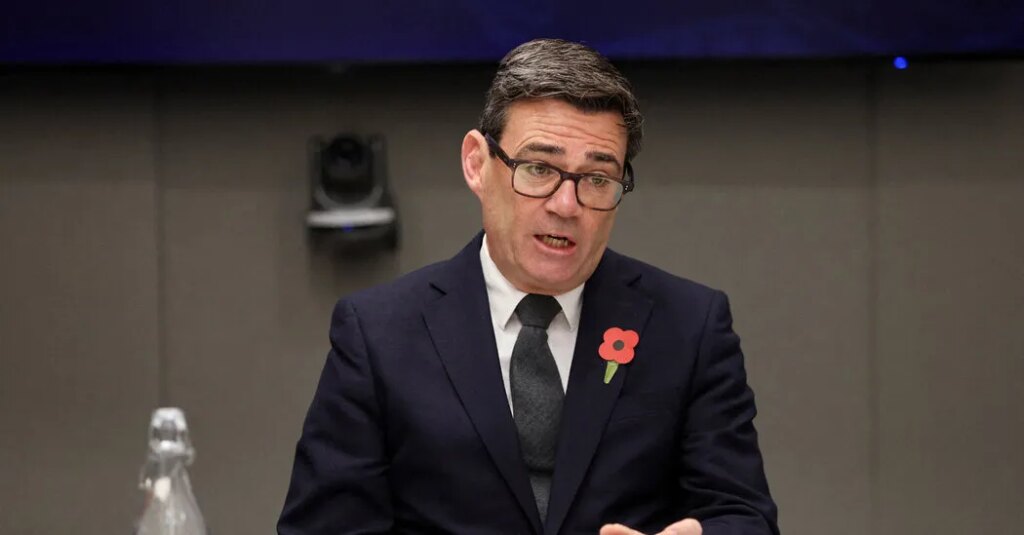
Prime Minister Andy Burnham of Britain said Friday that he was open to his government issuing a formal apology for the country’s historical participation in the slave trade, a major shift in British policy.
The change could clear the way for King Charles III to apologize at a meeting of former British colonies next week.
Writing in an opinion essay for The Guardian, Mr. Burnham rejected calls for Britain to pay financial reparations to the descendants of slavery, saying that British people should not be “held liable for historical wrongs, however heinous, that happened in a different age under different laws and in which they played no personal part.”
But he said that his predecessors had refused to have an “honest conversation” about the legacy of British involvement in the slave trade “by sticking our heads in the sand.” He said he had asked the former Prime Minister Gordon Brown to lead a global effort to restructure the debt of some of the poorest former British colonies.
“Listening to calls for a formal apology on behalf of the British state will form an important part of this process,” he wrote, “and I am open to them.”
A formal apology, if it comes, is unlikely to satisfy some of Britain’s critics, who have for years demanded that the government and the crown provide financial compensation for trafficking about three million enslaved Africans on British ships across the Atlantic in the 1700s and 1800s to work on colonial plantations. Attempted rebellions were brutally crushed.
Last week, Hilary Beckles, the chairman of the Reparations Commission for CARICOM, an organization of Caribbean states, told reporters that he was appealing to the king to do more for the royal family’s former subjects.
“He can see the enrichment that slavery has presented to his family,” Mr. Beckles said. “He can see that the wealth he’s passing on to his children and his grandchildren all came out as significant sums to this process of the chattelization of the African people.”
Representatives for the king at Buckingham Palace have long said that the decision to apologize for Britain’s role in trans-Atlantic slavery, or to pay reparations, is the responsibility of the government, not the monarchy. Until Friday, Britain’s government had rejected both.
It is not clear whether, or when, Mr. Burnham might formally apologize for slavery, or if his essay will persuade the king to do so. In the past, the king has said that the “appalling atrocity of slavery” was one that “forever stains our history.” But he has not formally apologized for the actions of the empire his ancestors once ruled.
Charles is on a seven-day visit to the Caribbean, where he will attend a meeting on Tuesday with leaders of the Commonwealth in Antigua and Barbuda. Last week, he said that “it is only right that we should acknowledge the great suffering of the past, in these islands and beyond, even as we rejoice in the successes of the present and build new opportunities for the future.”
A spokesman for Buckingham Palace did not respond to questions about the prime minister’s essay Friday night as the king landed in Antigua and Barbuda.
“We need to face up to the past,” wrote Mr. Burnham, who will also attend the Commonwealth meeting in Antigua and Barbuda on Tuesday.
The post Britain’s Prime Minister Says He’s Open to a Formal Apology for Slavery appeared first on New York Times.