At the edge of a closed amusement park where cartoon rabbits greet visitors, a dozen young soldiers tugged at the mud, searching for the remnants of comrades killed during the war.
Ho Chi Minh City — noisy, neon, frenetic — seemed to quiet down. It was a busy weekday in October, and only the scratch of a trowel could be heard near tiny Vietnamese flags marking the locations of decaying warriors, lost when the city was still the southern capital known as Saigon.
“Why are you moving the dirt there?” asked Lt. Col. Le Ngoc Ha, a commander, pointing toward a young soldier inside a pit the size of a soccer field. “Did you find something?”
The soldier nodded. He deposited a brownish lump into a red plastic tray. Another soldier carried it to a building with more than 700 bodies already pulled from the park’s graves.
The exhumations led by Vietnam’s Communist government are part of a 500-day campaign that began in March. Returning to battlegrounds across the country, the goal is to find 7,000 “martyrs” who died fighting for North Vietnam’s victory over the South and the United States.
Few nations have as many missing war dead as Vietnam — hundreds of thousands are still unaccounted for. And with technological advances offering new hope for identification, officials have been promoting their recovery efforts in state-run media and sending messages to cellphones nationwide seeking information about lost heroes.
But the project is only for the winning side. Even as the country’s top leader, To Lam, has welcomed back Vietnamese Americans with Southern ties, encouraging them to contribute to Vietnam’s growth, the identification effort follows a pattern of marginalization: Vietnam’s postwar government has destroyed or neglected former South Vietnam memorial sites and limited commemoration to its own fighters.
And yet, around the excavation zone, daily life reflects how much Vietnam has changed since the war ended. Hoa Hung, a former stronghold of the Southern military that was the site of heavy clashes during the 1968 Tet offensive, has become more urban, entrepreneurial and eager to move beyond the old tropes of divisive propaganda. Many residents argue that national remembrance needs updating, too.
“There are no enemies among the dead,” said Nguyen Thanh Hieu, the owner of a coffee stand overlooking the dig site. “For the wounds to heal, it’s important to treat every Vietnamese with dignity.”
Graves Old and New
Wars are fought twice: once in battle, then again in memory, as the Vietnamese American author Viet Thanh Nguyen has written. Thus for some, the 500-day campaign offers a chance at closure. For others, it feels like a missed opportunity for reconciliation. North and South have never worked through the cruelty and losses each experienced during and right after the war.
It remains one of the nation’s most delicate topics, whispered about only in the tightest circles of trust, leading some to fear that the exhumations will resurface suppressed fury from both sides.
“The effort to find remains is a way to look back and dig deeper,” said the Rev. Dominic Tran, a Catholic priest at one of the area’s older churches. “It may also trigger further hatred.”
The neighborhood certainly holds ghosts and horrors, starting with Chi Hoa Prison, an octagonal hellhole that the French colonial regime finished in 1953. During the war, detainees included high-profile dissidents such as Le Thi Rieng, a revolutionary leader who was killed by her South Vietnamese captors during the early days of the Tet offensive.
Street fighting ripped through Hoa Hung at the time. The North attacked across the South. The South and the Americans retaliated, leaving a trail of dead soldiers, guerrillas and civilians.
Those far from home had no one to claim their bodies. Many landed in mass graves, including Rieng. Now a park named after her covers the cemetery and fields where she and others were buried. It is where soldiers have been sifting for lost lives between palm trees and kiddie rides.
Dr. Tran Van Ban, a veteran who fought with the Vietcong, a group of local guerrilla forces, recalled helping the authorities find unmarked graves when the park was under construction in the 1980s. They found 16 bodies, intact enough to still have hair.
The park would later become a popular family hangout, but when we met in October, Dr. Ban was there again guiding the grisly work, wearing a dress shirt with the sleeves rolled up, pointing to darker dirt signaling the presence of profound human decay.
“I never thought so many remained,” he said.
In a nation where the dead are revered and typically buried near family homes, he knew how much it meant to be lost and then found. In 1968, he said, his parents were notified of his death. He had lost contact with his unit in the South. The truth of his survival emerged only when he returned to his village north of Hanoi in 1976.
“Everyone was so happy to see I was alive,” he said. “But there were also so many mothers and fathers who started carrying the hopes that their sons would return home, too.”
His village sent 29 men to war — 26 died.
“I’ve been carrying that weight my whole life,” Dr. Ban said. “So far, I’ve brought back 13.”
A storm rumbled overhead. He returned to the pit. Minutes later, a few soldiers carried out a stretcher with something close to a full cadaver.
“That person was tortured — the hands and legs were tied together,” Dr. Ban said as the procession passed.
“I’m so frustrated,” he added, his eyes distant, caught in a loop of dark memories that still felt fresh enough to explain why reconciliation can be so hard. “I’m overwhelmed with hatred.”
Funeral Rights
The park’s dead, however, do not tell only one story. Government records, artifacts and other evidence — including an Associated Press photograph from Feb. 12, 1968 — suggest that while most of the deceased came from the ranks of the North Vietnamese Army and Vietcong, several civilians and two South Korean journalists were also interred with combatants. Communists and anti-Communists could have been laid to rest side by side.
“It’s impossible to identify all the remains even with the technological advances since it’s been so long,” said Nguyen Xuan Thang, an architect who has been instrumental in locating abandoned graves, in the park and elsewhere. “But we have to try.”
Military officials have resisted that kind of broad appeal. The army’s main newspaper recently published an essay warning that those who demand “‘fairness’ between heroic martyrs and soldiers of the puppet army” are not motivated by humanitarianism, but rather by “plotting to ‘rewrite history’ — or, to put it bluntly, to ‘whitewash history.’”
When asked what would happen to the dead who were not martyrs, Colonel Ha was dismissive. “They are all soldiers from the liberation army,” he said.
Following that official line, the government held a memorial service at Le Thi Rieng park for 731 sets of remains in early October. Just one person had been officially identified. Two people with knowledge of the dig said the military had also collected and set aside bones from additional bodies that did not appear to be Communist soldiers. Their fates remain unknown.
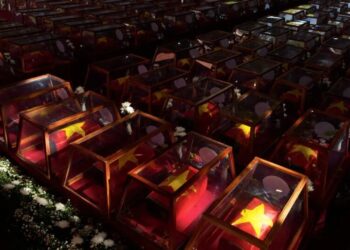
Those identified as martyrs were lined up in brown caskets, each numbered and draped in the Vietnamese flag, red with a yellow star.
The ceremony, which the prime minister attended, was broadcast live nationwide. Prayers, music, songs, speeches and incense offerings celebrated those whom the authorities determined to have died for the country.
“The fatherland honors your service,” said Nguyen Manh Cuong, the vice chairman of the Ho Chi Minh City People’s Committee. “Your compatriots and comrades remember!”
Near the back, Dr. Ban, the Vietcong veteran, stood quietly, a black armband around his left arm. He joined the crowd for a final minute of silence as a crow called out from a tall tree.
When the event finished, he sounded more conciliatory than he did a week earlier at the graves’ edge. He said he hoped the search would continue, and not just for martyrs.
“War spared no one,” he said.
“Whatever the circumstances, those who died were also Vietnamese,” he said. “If we keep dwelling on hatred, on this side and that, how can we achieve national reconciliation? How can we achieve unity?”
The post Will Digging Up Vietnam’s War Dead Heal Old Wounds or Reopen Them? appeared first on New York Times.