Born into a scientific dynasty that produced four Nobel laureates, including his grandparents, Marie and Pierre Curie, Pierre Joliot was the first researcher in his family to make the biological sciences his life’s work.
As a pioneering French biophysicist, he walked a different path from his forebears, who conducted research into nuclear physics and physical chemistry. In choosing biology, he discovered how photosynthetic organisms split water to release oxygen.
Dr. Joliot died Oct. 10 in Paris. He was 94. His death was confirmed by the Curie Institute in a tribute on its website. The renowned research center in Paris was co-founded in 1909 as the Radium Institute by Dr. Joliot’s maternal grandmother, Marie Curie.
As a scientist, Dr. Joliot didn’t need the influence of a family legacy to excel, said his friend of nearly 60 years, Govindjee Govindjee, an emeritus professor of biophysics and plant biology at the University of Illinois at Urbana-Champaign.
“Pierre’s own scientific accomplishments stand firmly on their own merit,” Govindjee said in an email, reiterating what he wrote in a tribute to Dr. Joliot in the July edition of the journal Photosynthetica.
A Notable Life
This article is part of A Notable Life, an obituary feature telling the stories of remarkable people every Saturday. Read more from the series here:
An Army colonel who stuck to his principles, even when it cost him a dream
The ‘king of burlesque’ built an X-rated empire of theaters and clubs
Starting during his graduate school years at the University of Paris in the 1950s, Dr. Joliot forged a path in what was then an emerging science: plant bioenergetics. Later, often working collaboratively with his wife, biologist Anne Gricouroff Joliot, he began asking entirely new questions about photosynthesis and combined his skills as a biophysicist, biochemist and cell biologist to conduct his research.
Photosynthesis occurs predominantly in plants but also is the process that algae, microalgae, cyanobacteria and some protists use to convert sunlight and carbon dioxide to chemical energy. These organisms expel oxygen into the atmosphere.
Dr. Joliot was in the vanguard of investigators seeking to understand at a molecular level how plants wake up after a night in total darkness. But no matter how deep his questions or arcane his study, his link to the Curie legacy loomed large throughout his life.
Dr. Joliot was 3 when his parents, Irène and Frédéric Joliot-Curie, jointly won the 1935 Nobel Prize in chemistry for their discovery of artificial radioactivity.
Working at the Radium Institute, the couple bombarded nonradioactive substances, such as aluminum and magnesium, with alpha particles to induce radioactivity. They proved that radioactive isotopes could be inexpensively generated using the technique. Irène was the eldest of Marie and Pierre Curie’s two daughters. Their other daughter, Ève, became a writer and pianist.
Dr. Joliot’s grandparents shared the 1903 Nobel Prize in physics for their work involving “radiation phenomena,” according to the Nobel Prize website. In 1911, Marie Curie won a second Nobel, this time in chemistry, for her discoveries of two radioactive elements, radium and polonium. She remains the only laureate to have won two Nobel Prizes in two scientific disciplines.
Research by the Curies and the Joliot-Curies helped usher in the 20th century’s Atomic Age. Marie Curie is credited with coining the term “radioactivity.” But she and her daughter ultimately paid a terrible price for working with radioactive materials. Marie died in 1934, at 66, of aplastic anemia, a disease linked to her prolonged radiation exposure. Irène died in 1956 of leukemia, also associated with radiation. She was 58.
Dr. Joliot’s older sister, Hélène Langevin-Joliot, 99, who survives him, followed her celebrated forebears’ lead and became a nuclear physicist. Greater knowledge of radiation’s hazards and adherence to safety measures protected later generations from perilous risks.
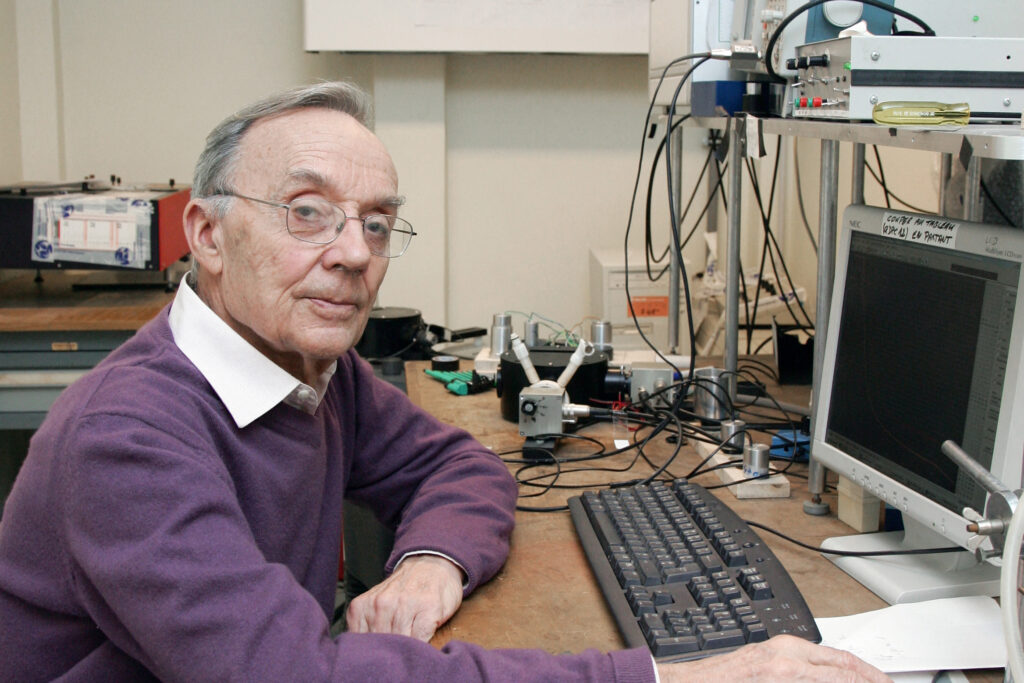
Still, Dr. Joliot rejected nuclear physics as a career path, according to the Curie Institute’s tribute, which noted that he viewed the discipline as an example of “Big Science” that required massive instruments and sprawling teams. Biology, he said, offered the opportunity to conduct experiments “on the corner of a table.”
When he began doctoral studies in the mid-1950s, photosynthesis was only rudimentarily understood. What he discovered in a series of deceptively simple experiments answered one of the key questions in the cycle of life itself: how photosynthetic organisms split water to produce the very oxygen that sustains life on Earth.
“Pierre Joliot was one of the modern pioneers of photosynthesis research,” said Robert Blankenship, a longtime friend and fellow member of the International Society of Photosynthesis Research. In 2013, the society honored Dr. Joliot with its Lifetime Achievement Award.
“His most remembered contribution was made in the 1960s, when he gave dark-adapted algae a series of very short flashes of light and observed a remarkable pattern of oxygen production,” added Blankenship, an emeritus professor of biology and chemistry at Washington University in St. Louis.
Each flash of light advanced a four-step chemical cycle, extracting electrons and protons from water molecules. Dr. Joliot discovered that instead of a steady stream, oxygen was released in a striking periodic pattern, peaking on the third flash and every four flashes thereafter.
At its most fundamental level, his experiments revealed that four electrons must be removed from a water molecule for one molecule of oxygen to be produced.
Dr. Joliot considered the finding one of his crowning achievements. It became known as the Kok-Joliot model because Dutch American biophysicist Bessel Kok provided the mathematical framework that explained the periodicity of the oscillations.
“I conducted the decisive experiments, and my colleague, friend, and rival, Bessel Kok, provided the correct interpretation,” Dr. Joliot wrote in a 1993 article published in the journal Photosynthesis Research. “This goes to show that a certain ethical standard is indeed possible within the realm of international competition.”
Friends say Dr. Joliot continued conducting research and writing scientific papers into his 90s. In recent years he explored gene-regulatory mechanisms and protein supercomplexes in photosynthesis, said Jean Alric, a friend who worked with Dr. Joliot for a decade at the Institute of Physico-Chemical Biology, a division of the French National Center for Scientific Research in Paris.
“He was one of the most committed scientists I have ever known; he loved his science,” said Alric, himself an expert in photosynthesis at CEA Cadarache, a research center in Saint-Paul-lès-Durance, in southeastern France.
Govindjee of the University of Illinois wrote in his July tribute, intended to recognize Dr. Joliot’s 95th birthday in 2027, that the biochemist made an indelible impact on photosynthesis research.
“His discoveries fundamentally changed our understanding of how photosynthetic organisms harvest light, transfer electrons, split water, and generate the oxygen that sustains life on Earth,” Govindjee wrote.
Pierre Adrien Joliot-Curie was born March 12, 1932, in Paris. His first name honored his grandfather Pierre Curie, who was killed in 1906 at the age of 46 when a horse-drawn wagon struck him on a rainy Paris street.
Young Pierre used the hyphenated surname throughout his youth but dropped Curie in adulthood. His father, Frédéric, had adopted his wife’s maiden name when they married in 1926 to recognize their scientific partnership and to help carry the Curie name into the future, Govindjee wrote in the July Photosynthetica article.
During World War II, Irène and Frédéric were active in the French Resistance as Nazi Germany occupied France. The family fled to Brittany after the Germans seized their home. As tensions mounted, Frédéric was briefly arrested by the Gestapo, which accused him of developing phosphorus bombs, according to the French newspaper Le Monde.
After the war, Pierre studied biology at the University of Paris and in the early 1950s joined the laboratory of René Wurmser at the Institute of Physico-Chemical Biology in Paris, where he began the photosynthesis research that would define his career.
In 1954, Dr. Joliot joined France’s National Center for Scientific Research, or CNRS, where he became research director in 1974. He conducted much of his work at the Institute of Physico-Chemical Biology, leading its photosynthesis laboratory for decades. There he met Anne Gricouroff, who became his wife and longtime scientific collaborator.
In 1981, Dr. Joliot was appointed chairman of cellular bioenergetics at the Collège de France, the distinguished Parisian institution founded in 1530. He held the chair until 2002, continuing research that helped transform the understanding of how photosynthetic organisms capture light energy and release oxygen.
The Joliots’ two sons also have pursued careers in the biological sciences, extending the family’s scientific legacy into new fields. Alain Joliot is a cancer researcher at the Curie Institute, while Marc Joliot is a neuroscientist at the University of Bordeaux.
Dr. Joliot was elected to the U.S. National Academy of Sciences in 1979 and the French Academy of Sciences in 1982. That year, he also received the CNRS Gold Medal, one of France’s highest distinctions for scientific research.
In addition to his wife and sons, Dr. Joliot is survived by his older sister, Langevin-Joliot, and three grandchildren.
“He was scientific royalty in France, and received nearly every award and commendation possible,” Blankenship said. “He continued his hands-on research program until he passed.”
Grieving a loved one? Tell us what made them special.
The Post is publishing reader-submitted obituaries as part of a weekly feature, What We Remember.
Last week’s installment included a night hike in the forest and a friend of the trees.
The post Born to a science dynasty, he broke away and made a photosynthesis breakthrough appeared first on Washington Post.