As I pedaled my bicycle toward the gunfire and Tiananmen Square, dodging people in crowds fleeing in the opposite direction, I kept thinking: What a crazy occupation this is.
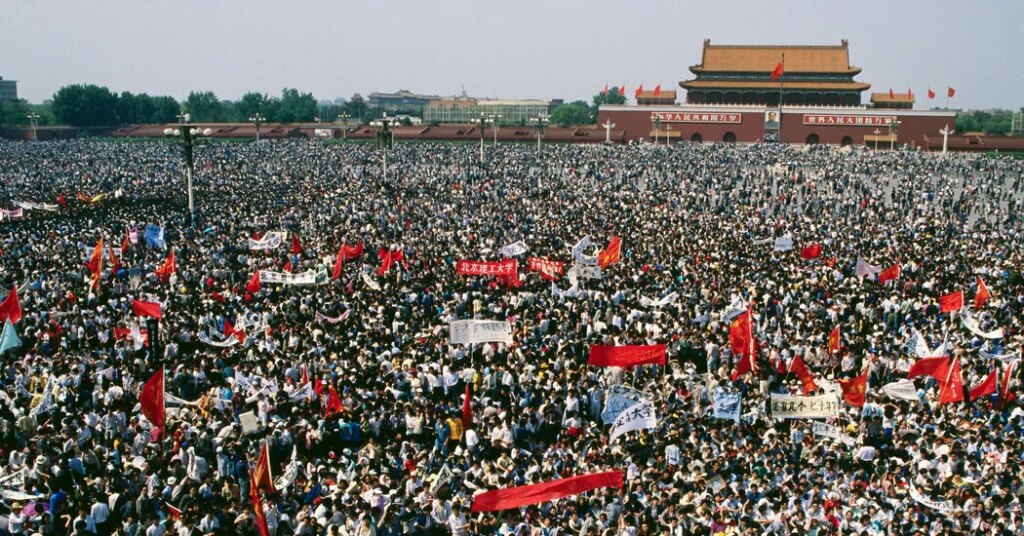
For weeks during the spring of 1989, the question preoccupying the world had been whether the student-led Tiananmen demonstrations paralyzing China would end with a democratic revolution or with massacres. That night, June 3, the phone began ringing in the apartment in Beijing I shared with my wife and fellow New York Times correspondent, Sheryl WuDunn. We had our answer: Tens of thousands of army troops were forcing their way into central Beijing, mowing down crowds of unarmed protesters and bystanders who tried to resist.
So I jumped on my bicycle, legs pumping madly, careening around tank traps students had set up, so I could report on a modern army waging war on its people.
It was probably the most important story I’ve covered and I got at least one big thing wrong — I’ll get to that — but I did manage to reach Tiananmen Square before the troops. I parked my bicycle near the famous portrait of Chairman Mao and began interviewing people in the throng of students and workers.
Although it was already dark, the square was lit by overhead lights and by the glow of two armored personnel carriers that protesters had set ablaze. At first, the troops, arriving by the truckload, fired over our heads. Then they lowered their aim and fired right at us.
The gunfire was episodic, coming in cacophonous bursts every few minutes. People would fall, we would retreat, the guns would fall silent for a time and our retreat would halt.
I was rushing around, interviewing people in Chinese, always trying to keep a layer of protesters between me and the bullets. Until I realized that I was taller than almost everyone around me, so that a valuable few upper inches of me were still exposed. I began stooping as I spoke to people.
“General strike!” the crowd shouted. “General strike!” Some people hurled rocks or Molotov cocktails toward the troops, but they couldn’t hit the soldiers — and then there would be another round of gunfire, and more would drop.
Groups of protesters commandeered two buses in hopes of reaching the troops. About a dozen young people boarded each bus, holding iron bars or other weapons with which they intended to attack the soldiers. The crowd screamed encouragement, but their courage was misplaced. As the protesters drove the buses toward the troops, the soldiers opened fire. The buses came to a halt, one of them on fire, and in a moment, these young people transformed from heroes into corpses.
I found myself in the midst of a massacre. With each round of gunfire, we were pushed backward on the blood-soaked Avenue of Eternal Peace. My bicycle was now close to the troops and not recoverable, so I ran to a nearby hospital to count corpses, and then back home. I had forgotten that it was a Saturday evening, which for the paper meant early deadlines.
When I didn’t return on time, Sheryl, who had filed her own story about the slaughter, was increasingly fearful that I had been shot. “There’s no point in worrying,” the foreign editor, Joseph Lelyveld, kept telling her on the phone; the anxiety in his voice made her worry even more. He tried to distract her by asking her to reach out to all the hospitals to document the death toll — a request that didn’t help Sheryl’s mood.
Finally, I burst in, hugged Sheryl, called New York to reassure editors there that I was fine and then filed my story by telex — a few paragraphs at a time, as I wrote them. I had never been so sad to have my byline and Sheryl’s under a banner headline across the front page.
Guilt nagged at me that night, and this brings me to my first great mistake in covering the crisis. During the demonstrations in the weeks before the bloodshed, I had periodically written condescendingly that the workers and peasants in the protest movement talked about democracy but couldn’t define it. I had suggested that they were driven by anger at inflation and corruption but didn’t necessarily believe in democracy for Tibetans or fully embrace the kind of free and pluralistic society they spoke of so glowingly.
There was something to this idea, but that night in June I had seen extraordinary courage from the workers and peasants. I was terrified that evening — my notebook was so damp with sweat from fear that I had trouble writing in it — and the bravest people of all were the poorly educated laborers from the countryside who drove bicycle rickshaws. Whenever there was a pause in the shooting, they would pedal their carts into the fray to pick up the bodies of students who had been killed or injured, then turn around and race to the hospitals. They might not have been able to define democracy but they were ready to die for it.
Another hard lesson I learned covering Tiananmen: Victims lie or, more charitably, misremember. It’s human nature to doubt oppressors and believe victims, but in the aftermath of the massacre there were many “eyewitness” accounts claiming that thousands or tens of thousands of students had been slaughtered in Tiananmen Square; that huge numbers of them had been shot from machine gun emplacements there; or that many were killed when tanks rolled over tents with students inside. None of this was true.
Since then, I’ve seen many times in my career that perpetrators of atrocities lie to cover up their abuses, and that victims respond with exaggerations of their own. This has taught me that we must be as vigilant in verifying accounts of victims as we are in grilling oppressors. While many estimates of the Tiananmen death toll are in the thousands, I’m reasonably sure these are wrong. Sheryl and I made great efforts to cultivate sources at hospitals and morgues to determine the toll, and our best guess is that between 400 and 800 people were killed and several thousand injured.
Accessing hospitals was difficult. Soldiers turned us away at entrances and doctors were threatened if they spoke to journalists. Chinese citizens and even some officials cooperated nonetheless, because they wanted the truth to come out. Disenchanted employees at one hospital sneaked us inside through a tunnel system from a neighboring building. We found that even the hallways were filled with shooting victims.
One young wife was weeping beside the unconscious figure of her husband, an inventor with seven patents in his name. Despite her warnings, he had gone out when the shooting started, in order to support the students, and she loved and admired him for his courage. But, she added between sobs, she hated that he might leave her alone with their 4-year-old daughter.
Journalists like to project toughness, but I was shattered, physically and morally exhausted. We went days with barely a wink of sleep, and once, when we did nap, the army fired on our apartment compound with automatic weapons. Moving around Beijing to interview people, Sheryl and I were afraid of being shot, but worse was to see the hopeful, vibrant China we had been covering morph into a crushing dictatorship. I remember collapsing on my bed one day and finding tears trickling down my cheeks.
The Chinese government rewrote history, calling the protesters “hoodlums” who had engaged in “rioting.” The state media singled me out, denouncing me for spreading lies and “writing not news reports but fiction.” The next day I ordered lunch at an empty Sichuan restaurant, where the staff gathered in a corner, pointing to me and whispering. I feared they had recognized me and I wondered if they might poison my food. Then several waitresses approached my table. “Are you the one they mentioned on television last night?” one asked. “The reporter who lies?”
“Yes,” I said, and I started to explain, but she cut me off. “Never mind,” she said, beaming. “There’s no need to pay your bill. We’ll take care of it. We’re all ‘hoodlums’ here.”
As the government began mass arrests, one of our sources was a Chinese student whom we had inadvertently gotten into trouble. “Shawn,” as he called himself in English, was a student at Tsinghua University who had helped us cover the protests. Now he was being interrogated about his connection to us, yet he still dared to meet secretly with Sheryl — who is Chinese American and could melt into crowds in a way I could not — to update her on the crackdown at the universities. His courage was breathtaking, and we were frightened for him when he suddenly disappeared.
This incident brings me to another moment that I still turn over in my mind. More than a year after his disappearance, Shawn reappeared in Beijing, met with me in secret and explained what had happened: He had been imprisoned but had escaped and was on the run. Now he asked for my help in fleeing China.
One basic rule of being a foreign correspondent is that you obey local laws. You certainly don’t help an escaped felon leave the country. Yet here was a young man who had endured prison because he had helped us cover this story. If we didn’t assist him, he would almost certainly be caught.
What to do? I wanted to consult editors in New York, but that was impossible because my phones were tapped. In any case, no editor could recommend helping an escaped prisoner.
Another concern: I harbored a nagging doubt about Shawn’s story. He said he had escaped while working in the fields of a prison farm, but we had never heard of anyone escaping from a Chinese prison. I wondered, Could this be a setup? The Chinese prime minister at the time, Li Peng, disliked my coverage, and his office was looking for an excuse to expel me. Was Chinese state security hoping to entrap me so that the authorities could arrest and imprison me and close The Times’s bureau?
I wavered, but Sheryl had a firmer compass. She doubted that Shawn would agree to entrap me, and she insisted that, given the risks he had taken, we owed him our assistance. So we did help him, including providing money to finance his escape.
Shawn was able to slip into Hong Kong on Christmas Day, 1990, when he figured there would be fewer British police officers along the border. He called me that night, and the next day I flew to Hong Kong, where, with the help of Human Rights Watch, I negotiated to get him a visa to the United States. Shawn is now a U.S. citizen.
Once I was out of China and could speak freely on the phone, I confessed to the paper’s top editors what I had done. To my surprise, they were congratulatory rather than scolding. A retired executive editor, A.M. Rosenthal, confided that three decades earlier he had helped sneak someone from Communist Poland to the West. And a Times correspondent, Sydney Schanberg, had tried desperately (though unsuccessfully) to doctor a fake passport for a Cambodian colleague, Dith Pran, to save him from the Khmer Rouge slaughter. Dith Pran eventually made it out on his own and worked as a much-loved colleague in The Times’s newsroom, a constant reminder that we have complex human obligations as well as professional ones.
There’s nothing I’ve done in my career that was as unprofessional as helping Shawn. But there are also few things I’m prouder of.
The post I Covered the Tiananmen Square Massacre. It Still Weighs on Me. appeared first on New York Times.