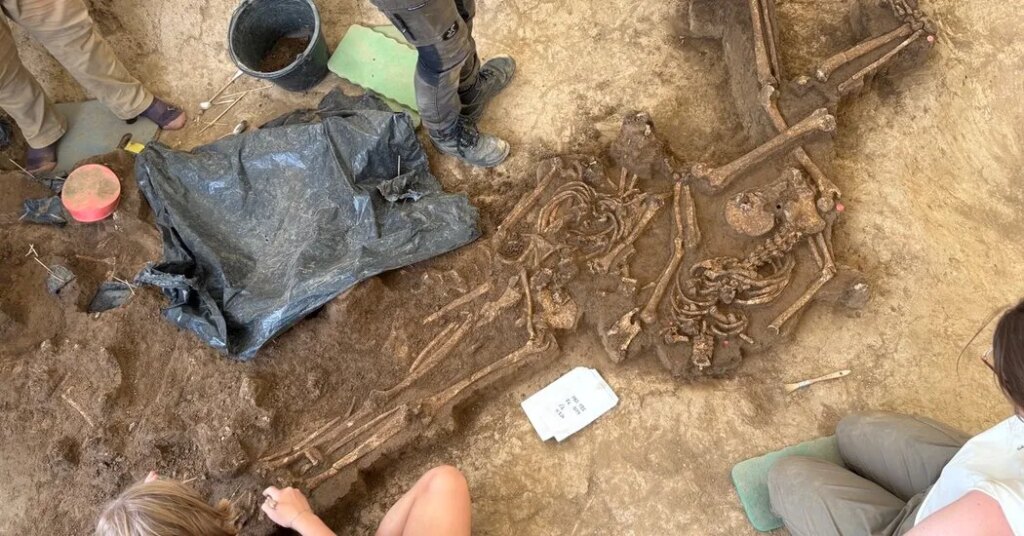
Amid the monotonous expanse of a Slovakian wheat field, archaeologists unearthed something unsettling: four human skeletons, each missing its head.
The remains had been deposited some 7,000 years ago within a V-shaped ditch marking the perimeter of a farming settlement. Burying the dead near the living was a routine feature of Neolithic life — but the systematic absence of skulls and lower jaws was decidedly not.
Since that initial discovery in 2017, excavations on the outskirts of Vrable, a quiet hamlet about 60 miles east of Bratislava, have yielded a progressively more gruesome census. In June, researchers at Kiel University in Germany documented the remains of 77 headless individuals — men, women and teenagers — packed together near one of the settlement’s entrances.
The bodies had been interred in a chaotic jumble within a space no larger than a single-car garage. They lacked the standard grave goods typical of the period, such as ceramic bowls, beads and arrowheads. Some remains were layered two or three deep.
This summer, a joint team from Kiel University and the Slovak Academy of Sciences exhumed dozens of additional bodies from the nearly mile-long defensive ditch, raising the grim tally of the headless even higher. Unlike the initial mass grave, these newer findings included young children buried alongside scattered artifacts, further complicating the narrative.
Despite a thorough combing of the topsoil, the missing skulls remain elusive. The virtual absence of cranial fragments within the trench has left researchers baffled about why the heads were removed or where they might have been taken.
“What makes the scenario so dramatic is that the villagers all seemed to have died about the same time,” said Martin Furholt, an archaeologist at Kiel University and the lead author of the study. The discovery raises a macabre question: Why did these people lose their heads?
Vrable Flips the Script
In life, these early European agrarians belonged to the Linear Pottery Culture, named for their handle-less ceramics decorated with flowing, incised lines. Beginning around 5500 B.C., they embarked on a multigenerational migration across the continent, clearing dense primeval forests to introduce agriculture to Central Europe.
For much of the 20th century, scholars tended to see them in a remarkably pastoral light. Excavations routinely revealed sprawling timber longhouses and tenderly arranged graves — the apparent blueprints of an egalitarian society untouched by social stratification or the impulse to fortify against enemies.
Then, in the 1980s, a series of digs across Germany and Austria uncovered mass graves filled with shattered and bludgeoned remains, exposing an undercurrent of collective slaughter. The twilight of the era, which unfolded around 5200 B.C., became generally understood as a harrowing collapse marked by fracturing social bonds and sudden bursts of lethal hostility.
Vrable flips the script once again.
The site is substantial, comprising at least 313 longhouses grouped into three distinct neighborhoods that were occupied from about 5250 to 4950 B.C. At the settlement’s peak, as many as 80 buildings were inhabited simultaneously, making it one of the largest residential clusters of its time.
One neighborhood featured a prominent double-ditch enclosure system with at least six gateways piercing the defensive perimeters. The outer trench — the larger of the two — is 10 to 13 feet wide at the top and as much as six and a half feet deep. Researchers recovered the clump of headless skeletons within this earthwork, concentrated near one of the primary entrances.
The heads were harvested with what archaeologists call surgical deliberation. Jagged score marks from flint blades on the cervical vertebrae, combined with minimal decay of the surrounding tissue, suggest a precise extraction performed shortly after death.
According to Dr. Furholt, the surviving bones show none of the blunt-force trauma that typically marks a sudden skirmish or a violent raid; the skulls, it seems, were not seized as crude trophies of battle.
The deliberate, targeted removal of the skulls points toward a complex architecture of meaning, one that sets the site apart from other prehistoric mass graves. This grisly curation could be linked to an invocation of magic, a response to an environmental crisis or a veneration of the dead.
“It may also have been a way of demonstrating power, or part of a special ritual for abandoning a central settlement area,” said Katharina Fuchs, a biological anthropologist at Kiel University who has spent her summers since 2021 excavating the site.
For contemporary observers, the discoveries present a profound conceptual challenge. Penny Bickle, a funerary archaeologist at the University of York in England who was not involved in the study, cautions against the modern instinct to project our own cultural anxieties onto the deep past.
“No doubt violence took place,” Dr. Bickle said, “but not necessarily for the reasons and motivations we expect within modern societies.”
Seeking the Absent Heads
At this stage, the investigation hinges on a rather ghastly logistical puzzle: What, exactly, happened to the heads?
Daniela Hofmann, an archaeologist at the University of Bergen in Norway, proposed that future excavations within the surrounding settlement might, with luck, reveal whether the skulls were preserved on public display or subjected to further, secondary ritual treatments.
To find them, she said, would be to gain a rare, intimate insight into how these early humans conceptualized the human body and, by extension, the very nature of personhood.
Crucial clues remain embedded in the relationship between the silent occupants of the ditch and the living community surrounding them. Were the dead a discarded subsection of the community itself, or did they arrive from elsewhere? If they were outsiders, were they familiar neighbors or complete strangers?
Researchers hope to narrow these possibilities through bone chemistry, mapping the ages of the deceased and analyzing shared behavioral markers, like diet, left behind in the remains.
The final picture remains tantalizingly incomplete. “There may never be definite answers,” Dr. Hofmann said, “but investigating this further will be able to tell us how people dealt with each other, what brought communities together and what ultimately tore them apart.”
The post Dozens of Headless Skeletons Pose a Macabre Mystery appeared first on New York Times.