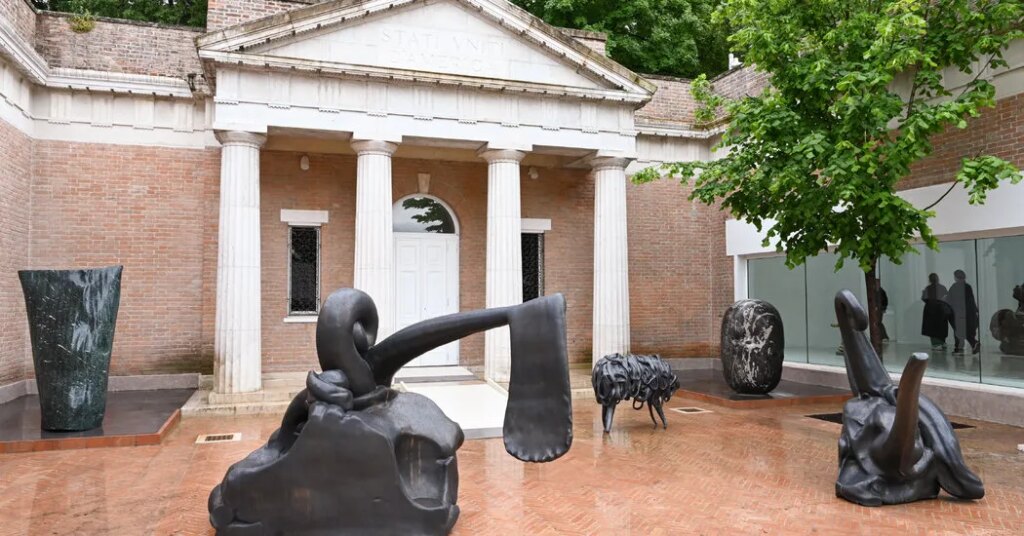
Sculptures from the U.S. Pavilion at the Venice Biennale may be stranded in Italy after the team selected by the Trump administration to mount the exhibition said it urgently needed funds to bring the works home.
The State Department covered a small part of the costs of mounting the American contribution to the world’s most important art exhibition this year. It was up to a nonprofit group to raise the rest of the funding. But that group fell short when it came time to go home.
“We are facing an urgent funding need associated with the final deinstallation and safe return of the artworks to the United States,” Jenni Parido, the commissioner for the U.S. Pavilion, wrote in a letter this week to potential donors seen by The New York Times.
Before the Biennale opened this spring, organizers of the U.S. entry boasted about mounting “one of the least expensive shows in the history of the Biennale” with a budget of less than $2.5 million. Parido said in her letter, however, that her nonprofit, the American Arts Conservancy, had only raised $1.4 million.
“While we have accomplished a tremendous amount in a relatively short period,” Parido wrote, “the final phase of this undertaking has presented financial challenges that I am working tirelessly to resolve.”
A spokeswoman for the State Department said it was not involved in fund-raising and would “have no further comments regarding the 2026 Venice Biennale.”
The Venice Biennale, which has been likened to the Olympics of the art world, typically runs from May to November every other year and features work by hundreds of artists from all over the world. It attracts more than 800,000 attendees — an enormous crowd for art exhibitions.
For nearly a century, America’s participation followed a familiar pattern. A team of prominent museum leaders or curators would propose exhibitions that showcased the nation’s leading artists. Then, an independent panel of experts working for the State Department would choose the best of the bunch to send to Italy as representatives of American cultural excellence.
This year was different.
Like many traditions under this Trump administration, this one was turned on its head. The art world veterans who once proposed the exhibitions were out. Taking their place were the members of a new nonprofit run by Parido. Parido, who had no professional arts experience, was previously the owner of a Tampa, Fla., pet boutique with her husband.
Last fall, the State Department appointed Parido as commissioner of the U.S. Pavilion after scrapping its normal selection guidelines and following the recommendation of Erin Scavino, a member of President Trump’s inner circle who runs the department’s Art in Embassies program. The State Department said that Parido was selected through a review process.
Scavino is close friends with Parido. The pair recently curated an exhibition in Washington to celebrate the 250th anniversary of the United States that was panned in one conservative publication as a “junk show.”
Parido worked on the Biennale exhibition with the curator Jeffrey Uslip. After several artists rejected offers, Alma Allen, an American sculptor living in Mexico, agreed to participate. Allen said the curator and commissioner had little exhibition oversight; neither visited his studio to see his large stone and metal sculptures. By the end of previews, the artist and curator were not on speaking terms.
Allen said in a statement on Wednesday that he knew nothing about the American Arts Conservancy’s funding.
“I received only reimbursement for travel and my Airbnb, which was cheap,” he said.
The American Arts Conservancy did not respond to questions about what would happen to the artworks if the commissioner failed to raise funds for deinstallation and shipping.
The conservancy raised only a fraction of what has been previously raised for exhibitions. The budget for the U.S. Pavilion in 2024 was about $5 million while the 2022 exhibition cost nearly $7 million.
The State Department offers a $375,000 grant for the Biennale exhibits, so commissioners are expected to raise the rest from private donations. According to three former organizers of the show, previous guidelines for the Venice Biennale required commissioners to present clear budgets and enough institutional backing from museums and foundations to raise the necessary funds.
The bulk of the fund-raising by the American Arts Conservancy was done through private events such as a party during Art Basel Miami Beach and a dinner at President Trump’s Mar-a-Lago resort. Donors to the pavilion included the fashion designer Tommy Hilfiger and the businessman John Phelan, who served as U.S. Navy secretary under President Trump until he was fired in April.
“Budgeting normally is very careful; maybe there is no oversight now,” said Katy Siegel, an art historian who helped curate the 2017 U.S. Pavilion. “This is crazy.”
Siegel noted that the commissioners would have few options to store the artwork in Venice. The pavilion has no on-site storage facility and the Guggenheim Foundation, which oversees the maintenance of the building, doesn’t have space for Allen’s massive sculptures.
The post Urgent Funding Sought to Retrieve U.S. ‘Art Olympics’ Sculptures appeared first on New York Times.