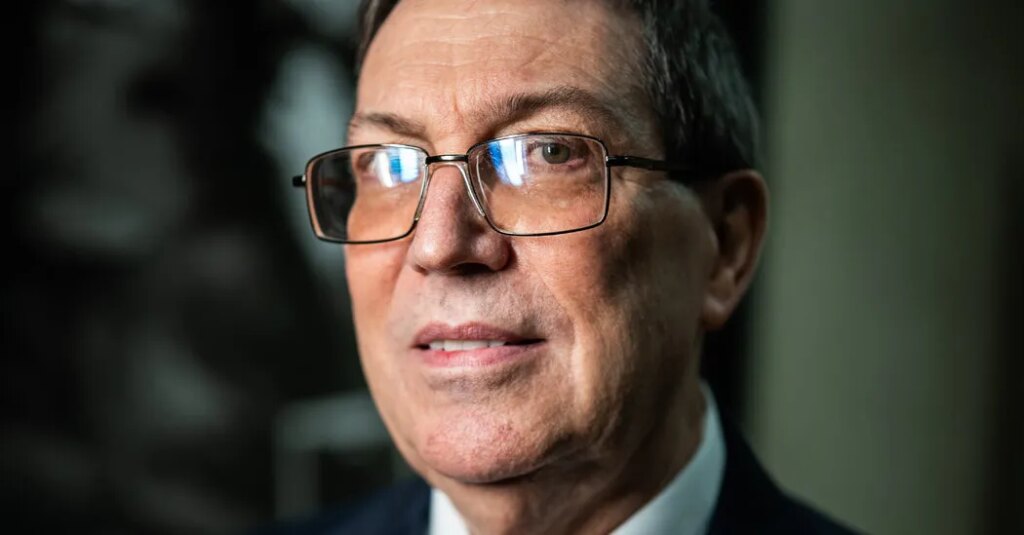
Few foreign ministers are in a worse diplomatic position than Bruno Rodríguez Parrilla of Cuba.
His country is nearly out of oil. It can hardly receive other goods. The Trump administration wants to topple the government. And its allies have largely vanished.
But in an exclusive interview this week, Mr. Rodríguez projected confidence that the current Cuban government would survive President Trump. That is because, he said, its strategy is to simply endure, much as it has for six decades, in the hope that Washington moves on or shifts course.
“For as long as it takes,” he said. “U.S. policy toward Cuba will change. It has to. It’s inevitable.”
His reasoning? A majority of Americans and foreign governments oppose the U.S. pressure on Cuba and, for decades, it has failed to cause change.
“For 60 years now, U.S. policy toward Cuba hasn’t worked,” he said, “while Cuba’s policy of resisting and adapting to that aggression has.”
Mr. Rodríguez, 68, has served as foreign minister for 17 years and has been a Cuban diplomat since 1993 — a career primarily focused on countering U.S. policy. But, he said, he has never encountered a U.S. pressure campaign like this one.
Since January, the Trump administration has sought to make the Cuban government submit to its demands by imposing intensifying sanctions and an oil blockade on the island. The measures have triggered Cuba’s worst energy and economic crisis in decades, leading to prolonged blackouts, shuttered schools and a disintegrating health care system. The Cuban government’s frustration broke through on the floor of the United Nations on Tuesday, when Mr. Rodríguez directly confronted Mike Waltz, the U.S. ambassador to the U.N., in a spat that was captured on video.
Less than two minutes into a speech by Mr. Waltz in which he accused Cuban officials of corruption, members of the Cuban delegation began shouting and banging their hands on a table. Mr. Rodríguez formally objected, his third time interrupting a U.S. diplomat’s speech at the U.N. in the past year.
But this time he marched up the aisle with the Cuban delegation in tow, lodging their complaints within a few feet of where Mr. Waltz was standing.
“You’re a liar!” one Cuban diplomat screamed at him.
“Back up!” Mr. Waltz shouted back. “Do you understand who you’re dealing with?”
It was perhaps the most heated altercation between U.S. and Cuban officials in years, and it reflected Havana’s growing desperation and Washington’s increasingly belligerent posture.
On Monday, the U.S. Embassy in Cuba posted a photo of the top American diplomat on the island meeting with the top American military general overseeing the Caribbean. “Much to discuss about Cuba,” read the caption.
Mr. Trump mused about deploying a warship off the island’s coast to intimidate the Cuban government. And Secretary of State Marco Rubio recently made an extraordinary public call to recruit spies in Cuba to aid the U.S. effort against the government. “Seize this opportunity to create the change you desire,” he wrote.
But all the intimidation has failed to make the Cuban government yield.
“Honestly, I have no idea what the secretary of state is trying to do with those posts,” Mr. Rodríguez said of Mr. Rubio’s call for spies. “They come across as a bit childish.”
The Cuban government has lasted longer than many expected under the oil blockade. That is partly because the government has stretched out its fuel supplies by rationing electricity and building solar parks.
In the meantime, the Trump administration has signaled that it is willing to be patient. Mr. Rubio has said change could take years.
In a statement, Tommy Pigott, a State Department spokesman, blamed worsening conditions in Cuba on the Cuban government and said the United States was sending humanitarian aid. “The failing Cuban regime continues to blame the United States and everyone else for their own incompetence and corruption,” he said.
Mr. Pigott added that “President Trump continues to apply pressure to drive much more substantial economic and political reforms” in Cuba.
U.S. officials have acknowledged that they are seeking a sympathetic and malleable figure in the Cuban government, much like Venezuela’s new interim leader, Delcy Rodríguez. But Mr. Rubio’s public plea for informants suggests that they may be struggling to find one.
When asked about his post this week, Mr. Rubio told reporters, “We think Cuba needs very dramatic change,” then added that “it’s a totally different case from Venezuela.”
Mr. Rodríguez said that talks were continuing with U.S. officials — including in-person meetings and phone calls and WhatsApp messages — but that little progress was being made. “It’s very difficult for talks to progress when they’re constantly accompanied by threats,” he said.
Ric Herrero, director of the Cuba Study Group, which pushes for more dialogue between Washington and Havana, said that Mr. Rodríguez’s stance of trying to wait out the Trump administration was shortsighted.
“It’s easy for Bruno to claim that they’re there resisting when the ones that are really bearing the brunt of it are the Cuban people,” he said.
Cuba may also find it much harder to maintain its resilience than in years past. It government long relied upon Russia or Venezuela to help it stand up to U.S. pressure, but those allies are now largely gone. Russia sent a large tanker of oil in March but has declined to test the U.S. blockade since. Venezuela is effectively controlled by Washington.
“The hard fact is that Cuba is alone,” Mr. Herrero said. “They can resist, but it’s just managed decline. Ultimately you’re heading toward the abyss.”
Mr. Rodríguez disputed any suggestion that Cuba was collapsing or that it had been abandoned on the world stage. He pointed to decades of U.N. resolutions that denounced U.S. trade embargoes on Cuba.
On Wednesday, 130 nations again sided with Cuba on such a resolution, yet it was one of the island’s lowest levels of support ever. Seventeen nations voted against the resolution, or 10 more than last year, with Colombia, Costa Rica and Ecuador switching their votes. Another 25 abstained, or 16 more than last year, including Germany, Italy, South Korea and the Dominican Republic.
Those results largely reflect the Trump administration’s success in persuading and pressuring nations to support its Cuba policy, or to at least look the other away.
Mr. Rodríguez argued that the American lobbying, as well its decision to increase sanctions, showed the Cuban government’s strength.
“If they really think Cuba’s strategy and the Cuban state are so ineffective, why go to all this trouble?” he asked.
Despite Mr. Rodríguez’s contention that Havana can simply ride out the Trump administration, the Cuban government is enacting change. Earlier this year, it announced the most sweeping economic measures since the Cuban revolution in 1959, including allowing private banks, selling shares in state companies and removing many restrictions on foreign investment and private businesses.
Mr. Rodríguez claimed that the slow economic liberalization of Cuba — one of the world’s few communist countries — was being done not to appease the Trump administration but to respond to global economic challenges.
“It opens many new opportunities to private capital, foreign investors and companies from various countries,” Mr. Rodríguez said. “But the Cuban economy will remain socialist.”
At the same time, he said, American companies should invest.
“We wouldn’t allow the United States to control sectors of the Cuban economy,” he said. “But American companies are competitive, and we’d welcome them in Cuba.”
The post Cuba’s Foreign Minister: We’ll Outlast Trump appeared first on New York Times.