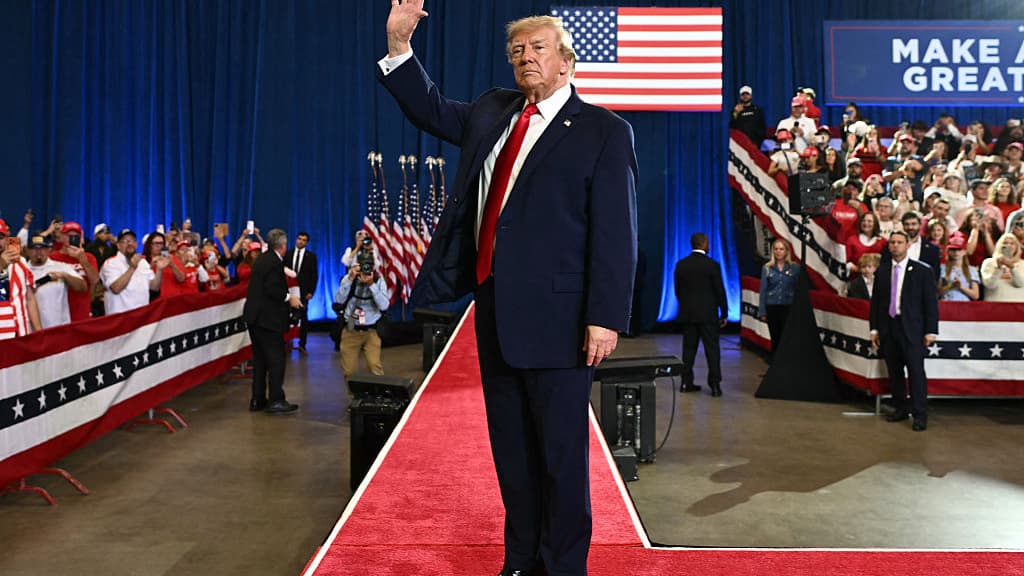
With the pivotal November elections looming, President Donald Trump’s approval rating earlier this month dropped to the lowest point of his second term—and the lowest level any President’s has reached heading into the midterms in decades.
Trump’s approval rating fell to 30% in early October, according to polling from the Pew Research Center. The last time an American President’s approval rating was at a comparable low this close to the midterms was Harry Truman in 1946.
“This is historically low approval ratings for a President,” says Peter Enns, a professor in the department of government at Cornell University and co-founder of the survey research company Verasight.
Data indicates that much of Americans’ dissatisfaction with the Trump Administration is being driven by the economy; according to polling from The Associated Press-NORC Center for Public Affairs Research, released earlier this month, only 26% of U.S. adults express support for how Trump is tackling it.
Similarly, just 17% of adults in the country say they approve of how the President is addressing the cost of living, according to the AP-NORC poll. Many adults also disagree with the Trump Administration’s war in Iran: the same AP-NORC poll found that only 28% expressed support for how Trump is handling the issue.
Read More: The 7 Key Governor Races to Watch in the Midterm Elections
“Part of the reason Trump’s approval ratings are so low is he’s pushing policies and pushing positions that are very unpopular, and so the conflict in Iran is a great example; the public understands that this was Trump’s decision, and they understand this connects to extremely high gas prices,” Enns says. “It’s very unusual for a President to position himself on the side of so many unpopular positions.”
Those issues could be critical ones for voters as they go to the polls. The Pew Research Center found that the vast majority of registered voters—84%—say that the economy is a “very important issue” for them heading into the midterms. A smaller majority of 57% also deemed foreign policy “very important” to their vote in the upcoming elections.
Even without a historically low approval rating, midterm elections are a challenging environment for the sitting President’s party. And political experts say that this year’s election looks like a difficult one for Republicans.
How does the President’s party typically fare in midterm elections?
Typically, the party in the White House loses congressional seats in the midterms. Enns says this is a “well-known phenomenon” that is likely a result of frustration from both a President’s supporters, who may feel that there hasn’t been enough progress on the policies they wanted to see coming out of the Administration, and those who didn’t vote for the President, who may be even more frustrated because they disagree with the Administration’s actions.
“That doesn’t mean everybody’s changing their vote,” Enns points out. “It just means the backlash, the tides, are working against the incumbent President.”
Costas Panagopoulos, a professor of political science at Northeastern University, says that a possible explanation for this historical trend is that voters may be seeking “partisan balance in Washington.” When voters aren’t satisfied by policies coming out of the Administration, they may try supporting the opposition party in the midterms—particularly when one party controls the White House and both chambers of Congress, as is the case with Republicans right now, Panagopoulos says.
“There’s simply nobody else to blame for government actions and current policies if voters are unhappy with those besides the Republican Party [right now],” he continues. “It’s very easy for [voters] to point the finger to the Republicans if they’re not happy with what they’re seeing.”
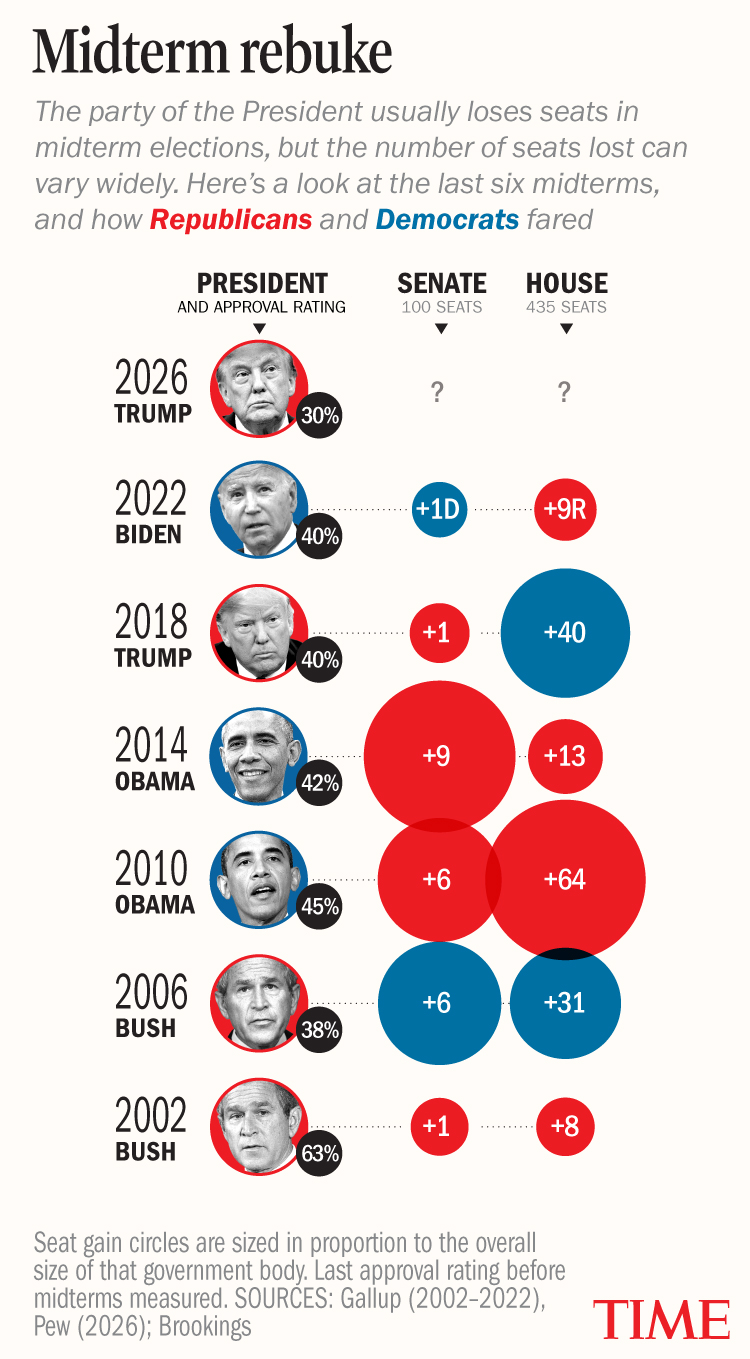
There are, though, exceptions to this trend. In 2002, then-President George W. Bush’s Republican Party actually gained seats in both the House and the Senate in the midterm elections.
“It bucked the historical trend,” Panagopoulos says. “It’s one of the rare examples [of that].”
Political experts like Panagopoulos largely attribute the GOP’s success in the 2002 midterms to Bush’s high approval rating—63% heading into the midterms, according to Gallup data—in the aftermath of the Sept. 11, 2001, terrorist attacks.
There have also been some instances when the opposition party was expected to win big in the midterms but fell short of those predictions. Going into the 2022 midterms, for instance, then-President Joe Biden’s approval rating sat at 40%, according to Gallup polling, and Republicans were widely expected to see major victories in the election. And while the GOP gained nine seats in the House, that wasn’t as substantial a win as many had predicted—and Democrats actually gained a seat in the Senate.
Panagopoulos suggests that part of the reason for that could be because Biden’s approval rating wasn’t at a historic low. He also points out that 2022 was the first election cycle with newly drawn district lines, which also could have affected the results.
Michele Swers, a professor of American government at Georgetown University, puts forth another explanation: the 2022 midterms took place just a few months after the Supreme Court overturned Roe v. Wade, which may have harmed Republicans’ advantage in the election.
“Sometimes, the political environment can intervene,” Swers says.
How can a President’s approval rating affect the midterm elections?
Swers likens the midterm elections to “a referendum on how things are going with the presidency.”
“The President is the one figure that everybody in the nation knows,” she says. While the President himself isn’t on the ballot in the midterms, “in general, the President loses seats because people are angry with the President, and they take that out on the President’s party because the President is also the leader of their party.”
Panagopoulos says that a President’s approval rating is “among the best predictors of outcomes in midterm election cycles” because it encapsulates “a wide range of sentiments about how voters perceive the performance of the incumbent party or president.” And Panagopoulos adds that the lower the President’s approval rating is, the greater the likelihood that his party will lose more congressional seats in the midterms.
Read More: What Early Voting Data Is Showing About the Midterm Elections
What does Trump’s low approval rating mean for Republicans’ chances in the midterms?
Political experts agree that Republicans are grappling with a difficult political climate right now.
The vast majority of generic ballot polls—surveys that ask respondents which party they would back in the midterms or which party they would like to hold the majority in Congress after Election Day—show that Democrats are outpacing Republicans. Polling also indicates that Democratic voters are more enthusiastic about this midterm election than Republicans are; about 91% of Democrats compared to 86% of Republicans, according to a recent PBS News/NPR/Marist poll.
Republicans are even struggling to maintain their usual advantage in staunchly red states, including in Texas, where Democratic Senate candidate James Talarico holds a small lead in the polls over his Republican opponent Ken Paxton.
“I think we can expect Republicans to be facing an uphill battle at the polls,” Panagopoulos says. “We can expect that they will likely lose seats in the House and also the Senate. And the question is will they lose enough seats to lose the majority in either or both those chambers. That is entirely within the realm of possibility. And that has to do both with Trump’s relatively low approval rating, historically speaking, but also the constellation of candidates in the mix.”
Panagopoulos points out that, while the party in the White House typically loses seats in the midterms, that doesn’t necessarily mean that the opposition party gains enough seats to win the majority in the House or the Senate; flipping the majority in both chambers can be challenging to do.
Enns also notes that polling—both presidential approval ratings and vote intentions—is “a snapshot in time” and is “a representative sample” of likely or registered voters.
“We don’t know until Election Day who is for sure going to vote,” Enns says. “The election outcome may not map onto exactly what we’d expect from the polls because who votes, we don’t know until Election Day.”
The post Trump’s Approval Is at a New Low. Here’s Where Other Presidents’ Stood Before the Midterms—and How Their Parties Fared appeared first on TIME.