Where were you when the A.I. revolution came for stand-up comedy?
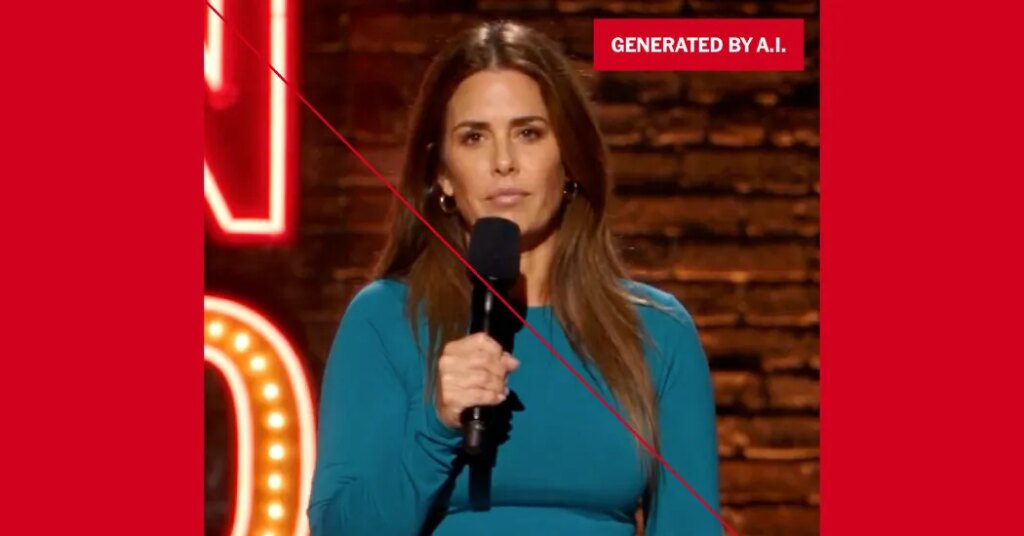
I was looking at my phone this month when all of a sudden my social media scrolls filled with teasingly seductive female comedians in front of brick walls, drawing hundreds of thousands of followers through flirty onstage punchlines.
If the jokes of these Stepford stand-ups, packed into crop tops and body suits, seemed familiar, that’s because they were stolen.
This taut, deftly crafted joke by Olivia Carter …
… was copied word for word, with a less expressive delivery:
In another, Olga Namer, a real stand-up, exuberantly acted out a date she had with a nice guy …
… with timing and language that was aped by this realistic-looking bot whose more deadpan version ends on a slightly darker note:
I had been a skeptic about the threat that artificial intelligence poses to stand-up comedy. Sure, ChatGPT may spell doom for the screenwriter of “Toy Story 12.” But I’ve spent enough time experimenting with large language models to conclude that they would figure out how to destroy a city before an audience.
That’s because laughter is inherently social. So much of the appeal of stand-up is in its connection with another human face, sensibility, consciousness. Or at least, that’s what I believed until the invasion of virtual comedians shook my confidence. Now I am here with a warning: Saucy synthetics are coming for our jokes and they might end up taking much more.
Strikingly, this industrial-scale heist swiped from one demographic almost exclusively: young, non-famous female comics making jokes about dating or sex. No bots were aping Jim Gaffigan or Dave Chappelle. But the New York club comic Natalie Cuomo, whose crowd-work videos often go viral, told Deadline.com that seven to 10 of her jokes were taken.
It now seems obvious that A.I. comedy would find success with a bot less like the Terminator than the one in “Ex Machina,” the film in which a tech billionaire designs a sexy android to appeal to the male gaze.
After all, Mark Zuckerberg’s empire began with male students rating their female classmates. Instagram sex-robot comedy builds on a similar impulse.
What might have been more disturbing than the theft was the response to it. For one thing, I thought the uncanny valley would protect human comedy, because the closer A.I. came to imitating real people, the creepier it would seem. But the comments on the accounts of these fake comics suggested viewers either couldn’t tell the difference between real stand-ups and bots or didn’t mind. Being creepy might not matter on a site that can appeal to the creep in everyone.
In early October, many comics whose jokes were stolen posted videos sounding the alarm.
Would it shock you that the response from the platforms was tepid? Adam Mosseri, head of Instagram, commented on the account of one comic, saying he wanted to drive more traffic to original artists, but that it wasn’t practical to ban A.I.
Joke stealing has long been considered a reputation-ruining offense. But unlike humans, A.I. comics can’t be shamed.
You might say that A.I. is just using the same old Hollywood playbook: selling a version of reality with more sex appeal. The difference is that the tech companies have already manipulated the market to give themselves a better chance of success. As traditional networks decline, young comics rely on social media to make a living. It’s where they market their work and make money by going viral — and everyone knows the way to gain followers is through outrage or sex appeal.
Comedians feel pressure to post bikini pics to promote shows. And comment sections filled with men assessing female comics’ looks has become normalized. It wasn’t that long ago that being attractive was slightly taboo in comedy. Now there’s a premium on it.
The message received by female comedians is grim. Olga Namer saw a joke of hers get more engagement for an A.I. version of a comic. She posted a video concluding: “I know my writing is good. It’s my boobs that are the problem.”
We don’t know who is behind the fake comedian accounts, but the strategy of stealing from young female comics has a dystopian business logic. Because social media incentives led the real stand-ups to post sexual material, A.I. conveniently has a large supply of jokes to steal. If comedy is a bellwether, this represents a dark future in which tech players exploit human labor until the quality of the imitation is good enough that it can cut us out of the equation.
They started with comics without much fame and clout. But stars shouldn’t get too comfortable. Recently, the virtual comedians have moved from standing in clubs to sitting near the desk of fake versions of late night talk-show hosts:
One video combines O’Brien’s hair with Fallon’s face, creating a bizarre creature out of a talk-show version of David Cronenberg’s “The Fly.”
The other advantage that the A.I. creations have is that they can more easily adjust to the increasingly globalized comedy market, telling the same joke in English …
… and in French:
The most damaging part of this trend might be how A.I. is training audiences what to expect. The first time a young viewer sees stand-up these days, it’s more likely to be in front of a digital brick wall than an actual one.
Audiences want well-crafted jokes, clever premises, punchlines that pop out of nowhere. But some viewers will settle, then develop a taste for that reduced quality. Then a nostalgia for it. Audiences will not only grow less discerning. They will become increasingly docile, easily manipulated and even replaced.
The popularity of videos of comics doing crowd work, long considered a less ambitious way to get a laugh than crafted material, is already an example of how social media has lowered standards. Outsourcing this cheap trick to a collection of raunchy pixels is just the next step.
Take a closer look at those videos of fake comedians: The crowds are computer-generated as well. Whether we realize it or not, those canned laughs have a job to do: They encourage us to laugh. It works.
It’s a pleasing fiction that laughter is always a purely honest response to what we think is funny. The truth is that humans are easier to manipulate than we think. We laugh more if we see others doing it. A.I. surely knows this and is using the social aspect of comedy against us. If we’re not careful, the most human of activities — cracking up — could be slowly drained of humanity.
Produced by Tala Safie
The post Invasion of the Sexy A.I. Joke Thieves appeared first on New York Times.