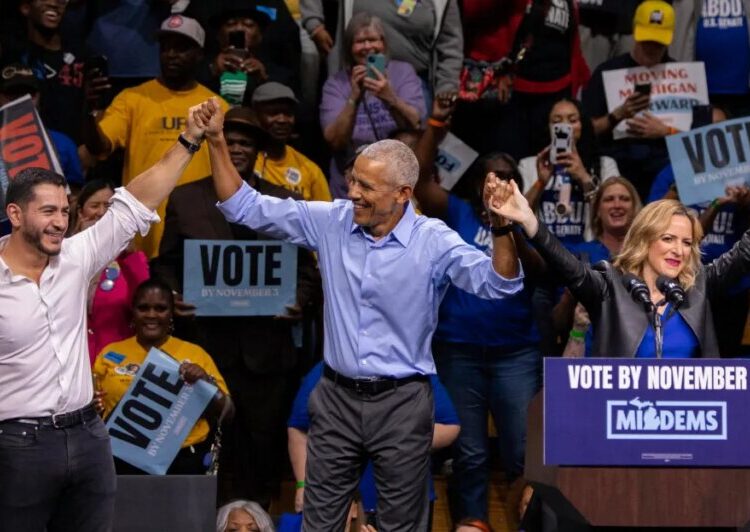
Nobody wants to jinx it. The election is still days away. But Republicans are pulling money out of North Carolina, assuming they will lose there, and spending in Mississippi, where they hope to save a Senate seat. A Democrat could win the governorship of Texas. Polling suggests the biggest margin of victory in any congressional election in nearly two decades, and Republicans desperate to save their seats are repudiating each major item on President Trump’s second-term agenda: tariffs, war, and ICE. All the signs we have suggest that, historic or not, these midterms are likely to mark the end of a political era.
So — what was the Trump era and what might it tell us about what comes next? Some of that story is pretty familiar, 10 years on. But here are 12 perhaps more surprising, or counterintuitive, takeaways.
1. MAGA defined the epoch, but the movement — and its leader — was always weak.
It may seem ridiculous to say, given Trump’s domination of the American political landscape for the last decade and the concrete damage his movement has done to American institutions and the country’s faith in them. But over three presidential campaigns, Trump won eight million fewer votes than his Democratic opponents. Add up the days when more Americans approved of him than disapproved of him since he descended the golden escalator, and you get about two weeks.
During the 2016 primaries, Trump’s rise looked like a sign of Republican Party weakness — how had it lost so much institutional strength that this interloper could waltz in and take right over? In retrospect, the weakness looks more general and enduring. A haphazard demagogue who never managed to achieve a majority mandate nevertheless commanding power and attention for so long and to such consequential ends — this is not the sign of a healthy republic.
Perhaps nobody but Trump could’ve mobilized the mass of national discontent the way he did. Even so, he never approached the popularity of Bill Clinton or Barack Obama, let alone Franklin Roosevelt or Ronald Reagan. Which does raise the question: Is this about as good as anyone can manage, now? Are we doomed to weak leaders pretending to be strong? Or will one era of constrained possibility give way to something else?
2. MAGA doesn’t mean what it used to.
In 2016, conventional wisdom held, Trump was carried to victory by a resentful anti-elite coalition — in particular by surprising strength across the deindustrializing Rust Belt in the upper Midwest.
Out of power during the Biden years, MAGA nursed professional-class grievances against various tools of inclusive liberalism — first raging against C.R.T. and later D.E.I. and lamenting the loss of test-based standards in college admissions and the rise of what it saw as anti-white racism in corporate hiring practices.
Once it returned to power in 2025, the movement looked like it had been reshaped once again, this time in Elon Musk’s image — a mix of moralistic social Darwinism, anti-woke retribution and acquisitive tech accelerationism, pay-to-play access for billionaires and a kind of corruption free-for-all in the White House.
Ten years ago, Trump could somewhat plausibly claim to be giving voice to the American voiceless. Now, he is speaking largely for a different constituency, when he isn’t speaking for himself.
3. But the influence of Christian nationalism endured — even grew.
The class portrait for Trump’s second term is conspicuously full of performative macho libertines from the manosphere. But the strongest part of the Trump coalition has always been its committed white evangelical base.
In each of Trump’s three elections, religiosity was the single best predictor of voter preference, even more than it was in the George W. Bush years. As MAGA stares down a possible midterm endgame, it’s notable that Mike Johnson, an evangelical and a social conservative, is the speaker of the House — and that despite looking like such a strange match temperamentally, he is the longest-serving Republican leader of this era. Less than a week out from the election, Trump’s most loyal voters remain evangelical Christians.
4. The traditional Republican heartland is looking pretty purple all of a sudden.
The midterm map now looks like an entirely new political world, one in which Senate races in North Carolina and Georgia are solid blue, in Texas and South Carolina are tossups and in Florida and Mississippi are contested. Add in close governor’s races in Nevada and Arizona and you get a battleground band stretching through the Old South, Deep South and Sun Belt.
Not so long ago this was the spiritual heartland of red America. And in almost all these races Democrats appear to be either winning handily or competing seriously. (As they are in Ohio, Kansas, Iowa, and Alaska, among other places.)
All of these races are obviously shaped by disenchantment with President Trump and don’t necessarily signal lasting partisan shifts — wave elections tend to set a high-water mark for a new majority. But the reality that each of these historically red states is in play tells you something about just how much things have changed — and how much less secure the Republican Party’s legacy claim on the heartland has become. The upper Midwest looks redder than you might expect in a year like this, but head a little ways east and Gov. Josh Shapiro is very likely to win re-election in Pennsylvania by 20 points or more.
Where, then, are the true G.O.P. strongholds?
If Ohio, Kansas, Iowa and Alaska can be pulled into play, as they have been this year, the pretty empty states of the Great Plains and the Mountain West are the obvious answer. But even there it’s not at all clear whether the Republican Pete Ricketts can hold off the liberal-minded independent Dan Osborn. The race for the South Dakota Senate seat isn’t exactly up for grabs, but the Republican margin of victory could easily stay within single digits, too. As John Anzalone, a Democratic pollster, has taken to saying, all of America is a battleground state now — at least in this midterm.
A few years ago, you heard a lot about the possibility of a Democratic crisis given the population exodus from blue states and coastal capitals to red states and start-up cities (thanks not just to weather but also to more affordable housing, a friendlier business and regulatory environment and perhaps some frustration with liberal governance in places like San Francisco and New York).
A few years later, many of red places are still thriving, but they are also growing more Democratic. Whatever the legacy politics of those states, this probably shouldn’t come as such a surprise — in general, when places grow denser and richer they get bluer, too. The gains of this year will likely recede, but the stories about the rightward lurch of the country look much more questionable. We might’ve thought red states were winning a demographic tug of war, but the same forces are tugging leftward, too.
5. We have entered an era of whiplash politics.
After the 2020 election, many liberals believed that some natural-seeming order had been restored and the accident of Trump’s first election had been somewhat expunged. In 2024, it looked briefly like Trump and MAGA had engineered a new generational majority, poised to reduce the Democrats to the kind of rump party they had been through the 1980s. Two years later, it looks increasingly silly to extract lasting ideological meaning from any of these elections.
It also looks increasingly intuitive that we should conceptualize this period — perhaps beginning with Trump or the 2010 election — as being marked by the same serial anti-incumbency backlash visible in so much of the rest of the world. In any given election, one party seems up and the other down, but the consistent pattern is voters’ wanting change almost regardless of who is in power. Maybe most distressing is the self-reinforcing nature of the pattern: When parties are given only slim legislative majorities for a very brief period, it’s extremely hard to persuade voters they’re anything but ineffective embodiments of a broken status quo. Which makes it much easier to imagine a big blue wave next Tuesday than an enduring Democratic majority lasting long enough to pull the country out of political despondency.
6. MAGA is often framed as a reaction to progressive overreach. Maybe it’s the other way around.
It’s almost hard to believe, given how frequently they are characterized as a phenomenon of imperious liberal excess, but the Black Lives Matter protests of 2020 took place under Trump, as, in part, a response to his rule. The #MeToo era began, as well, in 2017 — in the aftermath of the “Access Hollywood” tape and the Women’s March. These were not the Obama years or the Biden years.
In fact, by the time Joe Biden took office in early 2021, the phenomenon had by many measures already crested and begun its decline. And it is remarkable how little oxygen liberal race politics now takes up in the national discourse.
The climate awakening and protest movement began in Trump’s first term, too, when the United States announced its intention to quit the Paris agreement at a news conference where “Summertime” played in the Rose Garden. Bernie Sanders had made his mark on Democratic politics in 2016, of course, but it was in the Trump years — and particularly the first years of his second term — that the Democratic Socialists of America became a national political force. (Its national star, Zohran Mamdani, first really introduced himself to New Yorkers as a candidate for mayor by interviewing Trump voters on the street and asking what he could do to win their votes.)
Public health grew tribal partly in response to Trump’s supervision of the pandemic. And though it looked for a time as though MAHA would be the lasting political legacy of Covid, it now seems quite possible that liberal former public health officials will be elected in Michigan to the Senate and the governorship of Ohio — and perhaps that measles-stricken South Carolina, too, will elect to the Senate a Democratic pediatrician who began her campaign running against Kennedy and MAHA.
7. Abortion has largely disappeared from the political landscape, but the gender wars remain.
As recently as the last midterms, in 2022, outrage about that year’s Supreme Court decision to end the federal right to abortion was seen as one driving force behind Democrats’ surprisingly good electoral performance. These days, you can find abortion ranking as low as 36th on surveys of national political issues.
But you can see the lasting legacy of the Trump-era gender wars in other ways. The number of Republicans saying women should return to their traditional role in the home nearly doubled in just a few years, and the number of Republicans who say gay sex is morally acceptable has fallen from 56 percent to 35 percent in just three years. The fight over trans rights has taken a more ambiguous turn — hysterical Republicans made it the centerpiece of their closing argument in the last election cycle, but just two years later Americans appear to trust Democrats more on the issue.
There’s been a lot of talk, over the last decade, about the crisis of the American male, but the Trump years just seemed to steer those in crisis toward gambling and crypto. Almost every job created anywhere in the country in Trump’s second term has gone to a woman, and employment is growing only in sectors traditionally coded as female. Which is all to say: These gender issues are probably not going away soon, however poorly Republicans may do with young men on Tuesday.
8. Trump’s two biggest political legacies are problems the country must solve.
One of these is a practical challenge for any future Democratic administration, with Trump responsible for more than a quarter of the national debt. The other is a political challenge: The country disapproves of ICE and mass deportation programs, but it’s not at all clear what immigration policy Americans actually want to see or to what degree they would protest a return to the old liberal consensus.
9. Trump turned China into America’s foil.
In 2016, Trump’s constant invocations of China became such a joke that you could watch supercuts mocking his pronunciation of the word. Obama had tried to shift the country’s foreign policy attention in that direction with his “pivot to Asia,” but the rise of a new geopolitical rival still lived primarily on the outskirts of public discourse. By the time Trump left office in 2021, it was central enough to a new bipartisan consensus that it served as the basis of Biden’s entire policy agenda and has shaped liberal conversations about A.I., abundance and industrial policy since.
10. And he torpedoed America’s reputation around the world.
As the sun sets on MAGA, the actual state of global status competition is a bit ambiguous. China is struggling with economic slowdown and demographic decline, but racing past the United States in green technology, robots and, increasingly, science — and now can claim to be a more popular diplomatic partner, too.
The U.S. economy has proved pretty resilient, though much of the country’s strength comes from financial firms and A.I. companies that increasingly seem to lie outside the realm of the state and operate instead almost as autonomous city-states. And in Iran, Trump has tried to impose his will militarily — only to be humiliated on the world stage in an episode of imperial comeuppance that has doubled as a lesson that the American way of war is now a thing of the past.
11. The Silicon Valley “vibe shift” may have been primarily about A.I.
In explaining their sudden lurch to Trump in 2024, the tech chief executives told a variety of stories, mostly about the excesses of Biden-era liberalism: that administration officials had gotten too involved in policing public health information on social media, that regulators had gone too far in trying to control and tax Big Tech, that the culture of the country had grown too feminine and we needed an injection of new masculinity, which happily coincided for the tech leaders’ with a hands-off approach to corporate oversight (as everyone knows, there’s nothing more masculine than a tech C.E.O.).
Then, the argument seemed shortsighted — how sure were any of these people that the new Trump era would actually last? In retrospect, the answer may be that they weren’t thinking as much about the next election cycle as about the high stakes for tech policy in the short term, given that the A.I. age seemed to be dawning.
12. Trump violated the politician’s code when he declared the country broken in 2016. Now, everyone seems to agree.
“America is already great,” Obama declared in 2016. “America never stopped being great,” Hillary Clinton echoed. Meanwhile, Trump declared that the country was a “dumping ground,” a “third-world country” and a “laughingstock” around the world. “We never win anymore,” he said again and again on the campaign trail.
At the time, Americans were somewhat evenly divided on the question of whether the country’s best days were ahead of it or behind it, according to polling by Pew. When the question was asked again last year, the gap had grown from -5 to -19. Among Democrats, almost two-thirds of the country now says our glory days were in the past.
Partly, this was a kind of self-fulfilling prophecy: Trump stripping the country for parts, exposing longstanding hypocrisies and dropping the pretenses that for so long sustained our sense of American exceptionalism. Partly it reflected just how heavy a blow his re-election had been to liberals, a vote that made the national character look far uglier to them than they might ever had acknowledged before.
But this shifting sentiment has also paralyzed the Democratic Party, which has retreated on many commitments from the previous cycles that it now considers controversial or alienating without offering much in the way of a successor vision. In 2020, Biden dreamed of a Franklin Roosevelt-scale presidency, and his party is heading for power again. But while Democrats are now much less likely to defend the status quo, they don’t exactly have an ambitious plan to remake it, either.
Many on the left have framed an expanded horizon of political possibility as the silver lining of Trump’s norm-breaking presidency. But at least at the national level, the ambitions of liberals seem to have narrowed, not widened. Even among those competing for office and national leadership positions, the rhetoric is more defiant than optimistic: “It’s the most corrupt administration of all time and everybody knows it,” Jon Ossoff recently declared on the campaign trail. “I refuse to leave my girls a world as dark and dangerous and cruel as this one threatens to become.”
And yet that generational note contains its own message of hope. Bill Clinton, George W. Bush, and Donald Trump were all born in 1946. Joe Biden was born even earlier, in 1942. Ossoff is a child of the 1980s, as are Alexandria Ocasio-Cortez, Abdul El-Sayed and JD Vance. Marco Rubio and Josh Shapiro were born in the 1970s. Among everything else, the last decade of American politics has often looked like a gerontocracy. The close of the MAGA era may bring an end to that, too.
The post The Trump Era Is Fading appeared first on New York Times.