Good morning. It’s Thursday. Today we’ll find out how the ocean of cash from cannabis retailers moves through the city — and into the financial system. We’ll also get details on a concert group that had been shut out from a favorite venue, according to the Manhattan borough president, but is about to return.
Two tough-looking guys spilled out of the store, moving fast. Someone on the sidewalk might have thought that they had just pulled off a holdup, and their getaway car was waiting at the curb.
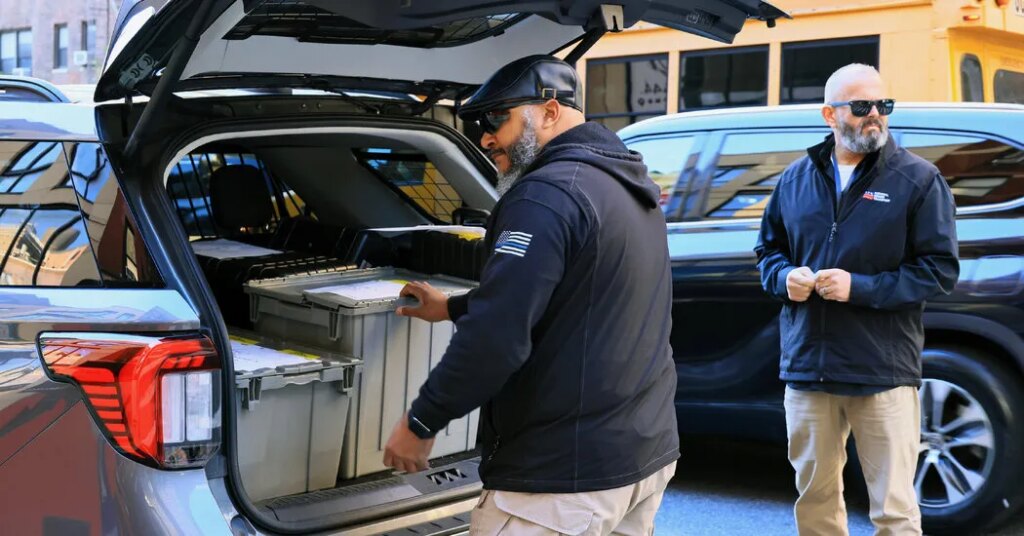
The two, Junior Rodriguez and Stephen Klos, were making off with cash — between $5,000 and $8,000. But the haul was legitimate. They are the somewhat intimidating faces of a new niche in retailing: They pick up cash from cannabis retailers in New York City.
By the end of the day, Rodriguez said, they could be carrying as much as $250,000 in their S.U.V.
In the nearly four years since the state’s first licensed adult-use dispensary opened, legal marijuana has created a new ocean of money for retailers and the financial system to navigate. Gov. Kathy Hochul said on Tuesday that legal cannabis sellers took in $1.41 billion in the first nine months of 2026. Since the first legal marijuana stores opened in 2022, sales have totaled $4.1 billion, Hochul said.
The state’s Office of Cannabis Management says that since recreational marijuana remains a controlled substance at the federal level, some credit card companies won’t accept cannabis transactions on their networks.
The result? Dispensaries take in a lot of $100 bills — and $10s, $20s and $50s.
“We take that cash and get it into the banking system,” said Ari Raptis, the chief executive of Talaria Transportation, the company that Rodriguez and Klos work for. It hires retired law-enforcement officers to collect what’s in the till and take the money to a financial processing center and deposit it into a store’s bank account. They also drop off $1, $5 and $20 bills so cannabis stores can make change for customers.
Raptis, who started Talaria after Pennsylvania legalized medical marijuana in 2018, said that in its early days, the company found banks that would open accounts for dispensaries. He matched them with sellers who needed to write paychecks and cover the rent. “We helped legitimize their cash by working with the financial institutions,” he said.
Talaria services about half of the 250 dispensaries that have opened in the five boroughs, Raptis said.
It also delivers marijuana to retail stores, using separate teams and vehicles from the ones that carry cash. Rodriguez, who retired as a New York City police officer last year, said he once arrived at a store when a merchandise drop-off was in progress. “I had to wait,” he said. “They go first.”
He and Klos faced no delays when the S.U.V. pulled up to the curb for their first pickup on a recent morning. Rodriguez said he had been assigned to the Police Department’s Strategic Response Group, a unit deployed at protests that has been accused of heavy-handed tactics. Klos is a former Suffolk County deputy sheriff.
Rodriguez said that he applied to Talaria because retirement did not suit him. “I spent seven months at home, doing nothing,” he said. “I was like, ‘I’ve got to find something to do.’ I started looking at jobs on websites.”
The S.U.V. that Rodriguez was driving looked like just another nondescript S.U.V. nosing through Manhattan traffic. “You wouldn’t know if it’s a plumber’s truck or holding money,” Raptis said.
But it was up-armored, Raptis said. It had cagelike bars on the rear windows, although the tinted glass was so dark that the bars couldn’t be seen from outside. And at least two cameras behind the front seats were trained on where the money was.
“I never go the same route at the same time,” Rodriguez said. “Nobody can say, ‘They’re coming through here at 9 o’clock.’ I’m coming at a different time the next time. It’s a little trick of the trade that you have to implement sometimes. You don’t want to be too predictable.”
He said he had “no sense of the amount” he would walk out with until he arrived for the pickup. Dispensaries count the money and seal it in a tamper-proof container. “I go there, I get my pickup, I continue to the next stop,” he said.
He said that he had “stayed away from cannabis when I was working in the N.Y.P.D. — I didn’t see the need to arrest someone for smoking something natural that grew on a tree.” And now that New York has legalized it, “it’s like smoking a cigarette.”
Weather
Today will be sunny with a high near 69. Partly cloudy skies are expected tonight, with a low around 57.
ALTERNATE-SIDE PARKING
In effect until Sunday (All Saints’ Day).
QUOTE OF THE DAY
“ISIS did not force women to get training. Women wanted training from ISIS.” — Amanda Shami, a prosecutor who handled the case of Halima Salman of Brooklyn. Salman, who had been taken to territory controlled by the Islamic State terror group when she was 17, was found guilty on charges that she trained with ISIS.
The latest New York news
-
Sentenced in fatal crash: Tiffany Howell, the former police sergeant who admitted she had been drunk when she crashed her car into another vehicle, killing a Manhattan doorman, was sentenced to four to 12 years in prison.
-
Judge in Maduro’s case dies: Alvin Hellerstein, a senior federal judge in Manhattan who was overseeing the case of the captured Venezuelan leader Nicolás Maduro, was 92.
-
Lithium-ion battery fire kills boy: An 11-year-old boy died in an apartment fire caused by an electric bicycle that was stored in the doorway. Four other people, including two teenagers, were hospitalized in critical condition.
-
Mamdani proposed a new head for the Commission on Racial Equity: The mayor proposed replacing the chairwoman, Linda Tigani, an outspoken critic of the administration’s handling of the city’s first, long-delayed racial equity plan, with Christopher Alexander, executive director of the state’s N.A.A.C.P. conference.
-
Judge removed after using racial slur: Walter Jones, a longtime town justice in upstate New York, was removed from the bench after he repeatedly used a racist slur aimed at Black people while telling a story set on his grandfather’s cotton farm.
How People’s Symphony Concerts returned to Washington Irving High School
In a city with an affordability crisis, the People’s Symphony Concerts are known for bargain-priced tickets, as little as $10 a concert. There is no People’s Symphony — the organization has long booked soloists and small- to medium-size ensembles, including the violinists Isaac Stern in 1943 and Itzhak Perlman in 1967; the cellist Yo-Yo Ma in 1981; and the pianist Yefim Bronfman in 2010.
For years the group’s home was the auditorium at Washington Irving High School in Manhattan. But a couple of years ago, the school said it could no longer accommodate the concerts. People’s Symphony found other venues last season.
The group’s co-manager, Frank Salomon, missed Washington Irving — “it has one of the best halls acoustically,” he said. So he called Ruth Messinger, the former Manhattan borough president. Her father had done his parents’ tax returns and his sister had babysat for her, he said, adding that she, in turn, had called a couple of her successors, first Mark Levine, now the city comptroller, and Levine’s successor, Brad Hoylman-Sigal.
Hoylman-Sigal said that he, in turn, had called the schools chancellor, Kamar Samuels. “I said, ‘Can’t we work this out?’ And he said, ‘We must,’” Holyman-Sigal said, and four concerts were scheduled at Washington Irving for this season, starting with a performance on Saturday by the Dover Quartet. Fifteen other concerts are on the People’s Symphony calendar for the season, including six at Town Hall.
Salomon said that arranging concert dates at Washington Irving had been complicated by the rise of magnet schools and charter schools. “With five or six different schools in the building instead of one high school,” he said, “they started running into scheduling difficulties because of all these schools.”
METROPOLITAN diary
Breakfast special
Dear Diary:
I lived on West 14th Street in the mid-1970s. One weekend morning, I decided to take myself out to breakfast at a diner around the corner on Greenwich Avenue.
As was my custom then, I ordered coffee and scrambled eggs with home fries and sausage.
The waiter was all smiles, and my breakfast was served in short order.
The next weekend, I went to the same place. I took a seat in a booth, and the same waiter approached me.
“Coffee, scrambled eggs, sausage and home fries,” he said.
It was exactly what I wanted to have, again.
Of course, I returned a week later.
No sooner had the waiter spotted me than he said, “It’ll be right out, hon.”
I had arrived.
— Michael Sklaroff
Illustrated by Agnes Lee. Tell us your New York story here and read more Metropolitan Diary here.
Glad we could get together here. See you tomorrow. — J.B.
Davaughnia Wilson and Ed Shanahan contributed to New York Today. You can reach the team at [email protected].
Sign up here to get this newsletter in your inbox.
The post They Pick Up Cash From Weed Stores. Up to $250,000 a Day. appeared first on New York Times.