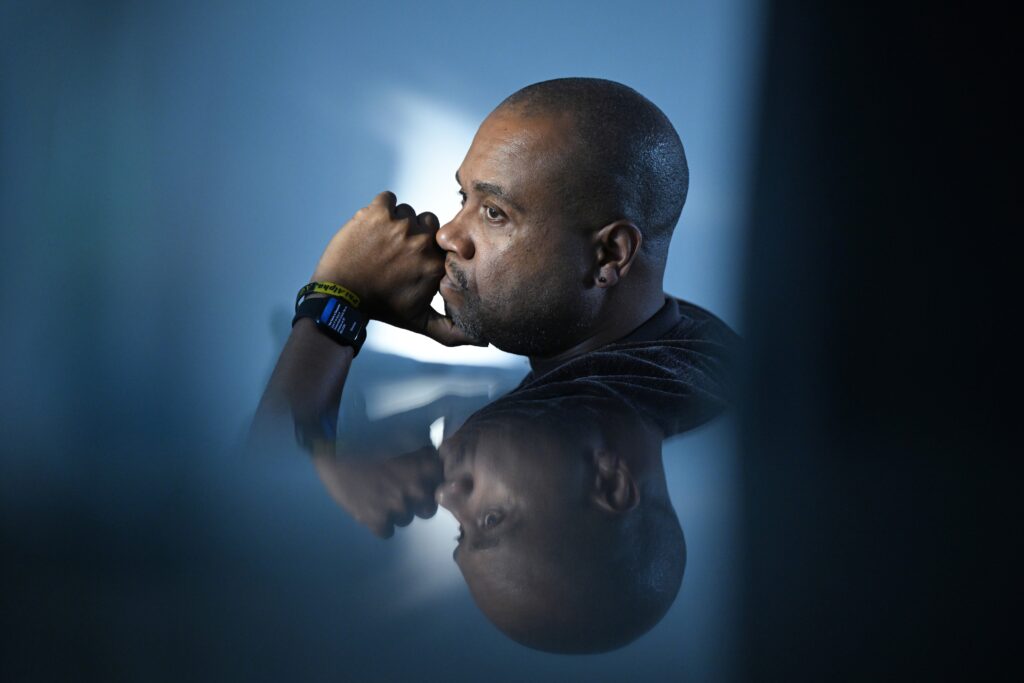
On his 368th day without a job, Dia Harris woke at 8:30, slipped a coffee pod into his Keurig and checked his iPad to see how many more rejections had come in overnight.
There were two automated messages from “Meta Careers,” thanking him for applying to be a program manager. “Our recruiting team will contact you if your qualifications are a strong match,” Harris read. By his count, those were the 560th and 561st roles he’d sought since getting fired from the federal government.
After he showered, he found another message waiting: this one from the Trevor Project, a nonprofit organization that combats suicide among LGBTQ+ youth. Harris, 53, recalled thinking that the Trevor Project’s “chief people officer” was the rare posting that felt like something he would be good at and actually wanted to do.
“While your qualifications and experience are truly impressive, they don’t fully align …,” Harris read now, and he deleted the latest rejection unfinished.
He grabbed a bottle of frozen water and a zip-top bag of granola. He pulled on a maroon polo and matching baseball cap embroidered in white thread with the logo of the store where he worked part-time. Sliding into his car, he drove in the opposite direction from the nation’s capital and the limestone-and-brick federal building where he’d once found his purpose and had hoped to remain until he retired.
Since President Donald Trump returned to office, nearly 426,000 of the nation’s 2.2 million civilian federal employees have left the government. That is a rate of departure significantly higher than those recorded during the first 18 months of Trump’s first term or President Joe Biden’s term. Trump campaigned on trimming federal bureaucracy, which he declared was bloated with wasteful, lazy and incompetent workers. Within days of his inauguration, he enlisted billionaire Elon Musk to drive the cuts. Musk’s U.S. DOGE Service slashed across the government, cutting spending and eliminating jobs.
Of the hundreds of thousands who left, 85 percent resigned or retired early through incentive programs offered by the Trump administration, a Washington Post analysis found. Thirty-two thousand full-time workers were fired. Harris was one of them.
Harris was the first chief equity officer for the Administration for Children and Families, or ACF, a large agency in the Department of Health and Human Services that helps vulnerable Americans with foster care, home energy needs and early education. He was among more than 200 employees targeted for dismissal by DOGE after Trump issued an order to rid the government of diversity, equity and inclusion initiatives, which he declared were divisive and destructive and “would have ruined our country.”
Diversity programs and initiatives have been around for decades but became much more common after the 2020 murder of George Floyd. Businesses and federal and local governments adopted antibias trainings, employee resource groups and recruiting programs and created new jobs, including Harris’s federal position.
The mass embrace of DEI programs felt to Harris like the capstone of his professional life, despite growing opposition from many on the political right who portrayed DEI efforts as reverse racism that disadvantaged White people. The president’s order accelerated that opposition, triggering a rapid retreat from DEI policies throughout government and the corporate world — and, Harris feared, devastating the field in which he built his career.
Harris’s job search was made harder by his membership in an even smaller group: He’d been named, with 92 others — two-thirds of them Black — on a public website called the “DEI Watchlist.” Run by a little-known conservative group with ties to the Heritage Foundation, the site claimed to expose “behind-the-scenes bureaucrats who push divisive DEI agendas that undermine merit, fairness, and accountability.”
A full page devoted to Harris shared his federal salary and employment history alongside a smiling photo of him wearing a blue button-down.
Harris had been out of government for more than a year, but the site was still the first result when anyone Googled his name. One prospective employer confided to him that the watch list made him unhirable. Harris often checked with friends and colleagues also named on the list, and most of them were still out of work, too.
Asked about Trump’s federal downsizing and details reported in this story, Office of Personnel Management Director Scott Kupor wrote in an emailed statement that “the vast majority of individuals who left government since the beginning of the Administration did so voluntarily — through early retirement or the deferred resignation program, which provided eight months of severance to participating employees.”
Harris received no severance. Now, his $16-an-hour paycheck was barely enough to cover utilities. It was supplemented by a second part-time job and help from his 71-year-old mother, who’d recently picked up extra hours at the Hallmark shop where she’d worked for the past two years. But he was also using his 401(k) to pay the mortgage and his credit card bills, and that would be empty by next year.
Pulling into a long, low strip mall, he parked and closed his eyes. He didn’t have to clock in for another 15 minutes. He told himself to forget the Dia Harris who’d earned two degrees; the sought-after HR expert who’d drawn six-figure salaries from Fortune 500 companies; the little boy who grew up in North Philadelphia eating blocks of yellow cheese from the government and who swore he’d never work part-time jobs like his mother.
He thought of his mom, on her aching feet at Hallmark. “If she can do it,” Harris said to himself, “I can do it.” He got out of the car, adjusted his cap and vanished through the sliding glass doors of the supermarket Harris Teeter.
Help us report on civil liberties
The Washington Post wants to hear from people whose civil liberties have been affected by recent federal, state or local actions.
You can contact Hannah Natanson by Signal encrypted message: HannahNatanson.2026
You can contact John Woodrow Cox by Signal encrypted message: johnwoodrowcox.01
You can contact Andrew Ba Tran by Signal encrypted message: abtran.202
IN THE LAST DAYS OF 2024, as his colleagues swapped rumors that the incoming president was going to delete DEI from the government, Harris and his boss came up with a plan to save his job.
As chief equity officer, Harris was tasked with ensuring that the workforce of the ACF resembled the Americans it served. Before Trump’s inauguration, he switched to become a “senior advisor” in the Office of Community Services, which distributes funds, diapers and legal services to the poor. He saw it as more or less the same worthy mission: bringing in good people and helping them help the neediest Americans. Who, he wondered, could find fault with that?
Then, a few hours after Trump was sworn in, Harris was scanning one of 26 first-day executive orders — “Ending Radical and Wasteful Government DEI Programs and Preferencing” — when he noticed a date in the eighth paragraph. The president was ordering the termination of all DEI positions “in existence on November 4, 2024.” Uh-oh, he thought.
Later that week, he was working from home — talking on an all-hands video call about how the Trump administration’s policies would change things for his office — when a Teams message popped up. His boss wanted to talk.
Harris logged onto the video call to find his boss holding up a piece of paper. “Hey,” Harris remembered her saying. “I need to read you this.” Effective Jan. 23 “at 3:30 p.m. EST, you will be placed on administrative leave,” she read. “This … is not being done for any disciplinary purpose.”
Harris was not allowed to check his email, use his work devices, step inside the office or contact his colleagues “with regard to any work matters,” she recited.
The letter, according to a copy obtained by The Post, never gave a reason for the leave, nor a hint of when it would end.
“You know I have all fives,” Harris said, the highest grade in the federal rating system.
“I know,” she said.
He’d only worked for the government for 17 months, after a nearly 30-year career spent mostly in talent acquisition for Johnson & Johnson, Boeing, Northrop Grumman and Amazon. It was not a life he’d ever imagined growing up in Philadelphia, but it had happened, Harris believed, because of the federal government.
When he was 3, Harris’s mother — raising him alone on her minimum-wage factory salary — had sent him to Head Start. The HHS program offers free child care and early education to low-income families. The staff at Head Start inspired an interest in learning that propelled him to an undergraduate degree in communications at Pennsylvania State University and a master’s in education administration from Virginia Tech.
As Harris approached 50, it felt like time to give back. He designed a two-story home in a wealthy Maryland suburb and invited his mother to live with him, building her a basement suite. In November 2022, he spotted a job announcement on LinkedIn. The Administration for Children and Families was seeking someone to fill a new position dedicated to “recruiting and sustaining a diverse workforce” so that all employees could better “[contribute] to the mission, vision and strategies of the organization.”
It was one of many jobs created by the Biden administration after the 46th president signed an executive order on his first day in office “advancing equity across the Federal Government.” The order directed every agency to assess whether its policies and programs posed “systemic barriers” to “people of color and other underserved groups.”
The role paid less, Harris realized, than his private-sector salary. But he also knew that ACF oversaw Head Start. He applied.
After he beat out the other applicants, he called a longtime friend with the good news. The friend, who spoke on the condition of anonymity because she still works for the government, said Harris was elated. “Finally,” she remembered him saying, “I get to make a real difference.”
Now his phone screen filled with messages from other federal employees he knew, all of whom had also focused on diversity issues. They’d been placed on leave, too, they said. All were people of color. Most were women.
The Trump administration stopped publishing federal workforce diversity data last year, reversing decades of precedent and obscuring how the makeup of the government changed following the president’s sweeping job cuts. Federal resignations and retirements soared in September 2025, the month when programs designed by the Trump administration to incentivize departures took effect. To determine how that spike altered employee demographics, The Post examined data from a household survey conducted for the Bureau of Labor Statistics. The Post found that, by the final two months of 2025, the estimated number of Black federal workers had dropped by 30 percent — compared with a 4 percent decline among government employees of other races.
Black employees were also heavily affected by Trump’s DEI purge, according to internal DOGE documents obtained by The Post. The DOGE team planned to remove roughly 200 people from DEI-related jobs. More than 100 of those jobs were held by Black people — double the count of positions held by White employees.
Close to 5 p.m., still sitting at his desk, Harris heard the garage door rumble. It was his mother, returning from a shift at Hallmark. He found her in the kitchen, unloading groceries.
“Hey, you got a moment?” he said. “I was put on administrative leave. I’m not sure how long it’s going to be.”
His mother had questions: What did it mean? Why was it happening? What about their bills? As she grew tearful, Harris told himself to stay calm.
“For now, I still have full benefits,” he said, again and again. “I still have full pay.” Finally, he said he had to walk the dog. He leashed his boxer, Maxwell, and stepped out into the winter evening, pulling sunglasses from his pocket so the neighbors wouldn’t see him cry.
HARRIS KNEW SOME ON THE POLITICAL RIGHT had been waging war against DEI for years, arguing it is racist and unconstitutional to consider race in the workplace or the classroom.
Conservative activists scored a victory in 2023 when the Supreme Court struck down race-conscious college admissions, ruling that such policies violate the equal protection clause. Almost immediately, advocates filed a burst of lawsuits alleging corporate, government and other academic programs that account for race are discriminatory, too. Trump’s second election, Harris had suspected, would open another, more aggressive phase of the battle.
Still, he was not prepared for the message that popped up in February 2025 in one of the many federal worker Signal chats he’d joined. “Did you see the watchlist?”
He clicked on the link someone had shared, saw his own grinning face, and snapped the laptop shut. He began texting friends for help: “Have you seen this?” “What the hell?”
One friend, the chief diversity officer of an accounting firm, started researching the site. This “DEI Watchlist,” the friend messaged Harris, claimed to name and shame what it termed “the unelected career staff driving radical Diversity, Equity and Inclusion (DEI) initiatives within the federal government.” It was put up by the American Accountability Foundation, a conservative group founded in 2020 to derail the confirmations of people appointed by Biden.
After a half hour, Harris reopened his computer and read through the entire DEI Watchlist. There were dozens of faces and names. He recognized at least seven people he’d worked alongside.
He clicked on the “dossier” devoted to him. It detailed his employment and education, seemingly pulled from his LinkedIn page, and a photo taken from his social media. It also included a clip from a 2024 “National Call to Action on Equity” webinar, at which Harris had called himself “unapologetically a Black man” and vowed to “embed equity into every aspect of our lives.”
“DEI isn’t just a career for Dia Harris. He sees it as [a] mission outside of work, too,” the site stated — like it was a sin, Harris thought.
He’d taken the federal job because he wanted to help kids who would never make it to college without the child care, breakfasts and lunches provided by Head Start. That’s what DEI meant to Harris: helping the people everyone else overlooks. It was all he’d ever wanted to do in his professional life.
Suddenly, that career seemed to be disappearing, and every value Harris had promoted was becoming a reason not to hire him. “This didn’t just cost me my job,” he said in an interview. “This cost me my livelihood.”
Harris pulled out his phone and started deleting: Instagram, then Facebook. He temporarily deactivated his LinkedIn. When people noticed his electronic disappearance, he told them he was “taking a break.” With his closest friends, he was less guarded. “There’s a website,” he confided. “You can Google it.”
A few days later, he was at his desk around 2 p.m., idly examining a handful of roles he felt sure he wouldn’t have to apply for once he got his federal job back. Then his phone tinkled with a sound like wind chimes, announcing someone at the front door.
“Pizza for Dia Harris,” a delivery boy from Domino’s said. “COD” — cash on delivery.
“Who still does that?” Harris asked. “I didn’t order pizza.”
The boy squinted and read an address off his phone, asking Harris if it was his. He nodded.
“I don’t know what you’re going to do with the pizza,” Harris said, “but I don’t want it.”
The boy shrugged and left, taking the large cheese pie with him.
The next day, a friend of Harris’s called — a woman who was also named on the DEI Watchlist. “My husband is going crazy about this website,” Harris remembered her saying. “And the pizza.”
“Pizza?” Harris asked. “What about pizza?”
“They sent pizza to my house,” she said. “It’s a scare tactic. They want you to know they know where you live.”
At least three other people listed on the DEI Watchlist and reached by The Post confirmed they or colleagues named on the site were sent pizza around this time. Judges who ruled against the Trump administration received similar pizza deliveries from strangers.
One woman on the list said she was approached by someone she didn’t know at a public library with her 5-year-old son. “I know who you are,” the person told the woman, who spoke on the condition of anonymity for fear of further harassment. “You’re disgusting.”
Patricia Kramer, a former federal worker listed on the site, said she stopped letting her teenage son walk home from school alone. When she watered her front yard, she scanned the street to see who was coming and going — reassuming a “hypervigilance” she had learned in the military.
“It was a massive emotional toll and tax,” Kramer said.
After the pizza delivery, Harris decided to purchase floodlights and a camera for his backyard. And he applied for a permit to carry a concealed handgun.
LATE ON VALENTINE’S DAY LAST YEAR, Harris’s boss left him a voicemail on his personal cell. It was urgent, she said.
He waited until the next morning to call back. She told him he was being fired — one of hundreds of thousands of probationary workers swept into the administration’s messy attempt to dismiss all federal employees in their first or second year of service, when they have fewer job protections. His last day, she said, would be March 14.
Harris sat down at his desk and emailed every professional and personal contact he could think of — some four dozen people. “If you know of any opportunities, either within your organization or elsewhere, that may be a good fit, I would greatly appreciate your consideration,” he wrote.
Six people responded, fewer than he’d hoped, and nobody seemed to have open positions. Meanwhile, the date of his termination came and went. Then someone from the government reached out to say he was back on administrative leave, he recalled — one of many policy reversals that defined the second Trump administration’s chaotic treatment of federal workers last year, shaped by judges’ orders, necessity or error. Again, Harris was given no end date. Maybe, he thought, he would get his job back after all.
Still, he decided to keep applying for other work — even though, under the terms of his leave, he could not accept another position while drawing his federal salary. He looked for corporate roles similar to those he’d held before. He felt sure he’d find something before the end of the year.
Then the rejection emails began arriving.
“Thank you very much for applying to the People & Culture Manager opportunity,” one read. “After reviewing your application, unfortunately, we will not be proceeding with your application at this time.”
“We know that job searching takes time and effort, and we appreciate that you considered the Principal Belonging Diversity & Equity Manager role at UKG,” read another. “Unfortunately, after careful review, we have decided to pursue other candidates.”
And: “Thank you for taking the time to apply for the Director, Equity and Inclusion position at the ACLU. We have given your application careful consideration and unfortunately have decided not to proceed with your candidacy.”
At least those places replied, he thought. Many others never acknowledged his applications. In six months, Harris scored just one interview: for a position as director of lateral recruiting at a law firm. The firm never called him again.
Then in July, a man phoned, introducing himself as a recruiter who worked for a company to which Harris had applied. He asked if Harris had a few minutes to chat confidentially. (Harris could not recall the man’s name, but he recounted their discussion in detail. His friends said in interviews they remembered Harris telling them about the conversation shortly after it happened.)
“You have an amazing résumé,” Harris remembered him saying. “But have you thought about changing or deleting some stuff?”
“Why?” Harris asked.
“Well, it has ‘diversity’ and ‘equity’ all over it. And … have you Googled yourself?”
Trump’s anti-DEI campaign had forged a new world, the recruiter said, and Harris had to alter his résumé if he wanted to survive in it. If he’d served as “chief equity officer,” for example, he should rebrand the position as “director of organizational development.” If he’d served as a “diversity recruiting manager,” the man advised, he should delete the first word.
Harris thanked him. The recruiter paused. His company depended on contracts with the federal government, he said.
“So I can’t hire you because of who you’d be working with,” he said. “Look. They probably support the watch list.”
Of the 43 federal employees named on the watch list who lost or left their government jobs, 2 out of 3 remain unemployed as of this month, a Post analysis of their social media profiles and postings shows. Their fates differ sharply by race: Nearly 40 percent of Black people included on the list are still out of work, The Post found, compared with 10 percent of White people.
The Post attempted to reach every former government staffer named on the list. Most declined to comment on the record, citing fears they and their families would face yet more harassment, or find it harder to get another job.
“I do wonder if it’s affecting my job search,” said one man named on the list, who has applied for several hundred positions over 12-plus months. “For some jobs I understand, maybe I don’t have the direct experience. But there were jobs I definitely had the direct experience — and I didn’t even get an interview.”
Kiana Atkins, a former National Institutes of Health employee also included on the list, said she has not found a job after more than a year of searching and is now seeking a teaching certification. Meanwhile, she is moving between the homes of family and friends, she said, unable to afford a place of her own.
“I was a civil servant, doing this job that the government wanted me to do — and they made us the villains for that,” Atkins said. “They demonized my work. They took away my livelihood.”
Tom Jones, the president of the American Accountability Foundation, said he was proud of his organization’s work.
“If the Post’s reporting that the 2/3rds of the DEI staffers on the list can’t find work is accurate, we cannot overstate our joy that trafficking in anti-white bigotry now makes you unemployable,” Jones wrote in an email. “Our only regret about the watchlist is that we didn’t have the time or resources to profile more left wing woke bureaucrats.”
Asked later about The Post’s finding that Black workers on the list are having a more difficult time finding new employment, Jones wrote: “Sounds like hiring managers are racist, that’s very disappointing.”
IN AUGUST 2025, HARRIS WAS FIRED AGAIN — for good this time.
Three paragraphs long, his termination letter said the ACF had “decided not to certify your continued employment,” effective immediately.
Harris let himself sit for an hour in his bedroom, Maxwell’s head resting on his knee. Then, calculating when his health coverage lapsed, he crammed a year’s worth of medical appointments into a week. He also contacted a lawyer, Andrew Weeks, who would eventually help him file a complaint with HHS, alleging that his dismissal amounted to illegal discrimination and that, overall, the DEI firings undertaken by the Trump administration disproportionately affected Black federal workers.
This month, after more than a year of investigation, HHS concluded it had not discriminated against his client, Weeks said. He is now preparing a federal lawsuit that will charge the Trump administration violated Harris’s constitutional right to equal protection under the law. It would add to a surge of similar suits brought by private citizens alleging infringement of their civil liberties by the president and his policies.
Asked about Harris’s allegations, and details reported in this story, press secretary Grace Davis Jamison wrote in an emailed statement that the Department of Health and Human Services “is following President Trump’s Executive Order, ‘Ending Radical and Wasteful Government DEI Programs and Preferencing,’ and all applicable federal law.”
Through the fall of 2025, Harris averaged two job applications a day. To keep track, he programmed an AI tool to update a spreadsheet of possibilities and rejections at 9 a.m. and 6 p.m.
Recalling the recruiter’s advice, he developed two versions of his résumé. To most jobs, he submitted a copy scrubbed of all mentions of DEI. He sent an unedited CV only to jobs with the words “equity” or “diversity” in their titles.
It didn’t help.
His federal paychecks stopped coming in September 2025. He applied for unemployment from the District of Columbia, where his job was located, and started collecting $51 in monthly SNAP benefits. In October, Maxwell died unexpectedly, from cancer. The next day, Harris began looking for part-time jobs.
For a while, he worked as a bartender, but those opportunities waned with the holiday season. He tried driving for DoorDash and Roadie, but realized that, with the high cost of gas, the delivery trips were costing him money. He applied for a job at Harris Teeter, because he’d read they offered dental and vision benefits for part-time employees. Nobody with the grocery chain responded, so he expanded his search, trying locations further away.
One day, his mother told him she’d decided to pick up extra hours at Hallmark. Not long after, she walked up to him holding a bill and said, “Let me get this.” Soon, she was covering almost everything except the $4,000 mortgage and Harris’s monthly credit card payments, which he started drawing directly from his 401(k).
Harris was changing, his friends noticed. He never hosted parties anymore or went to happy hour gatherings. On the rare occasions Harris did go out, said longtime friend Gordean Sanders Williams, he was different. He no longer circulated through the crowd, giving special attention to anyone who looked lonely. He almost never smiled.
“Now it’s like, ‘Eh, I’m smiling at you because you’re smiling at me,” Sanders Williams said. “I would say his light has been dimmed.”
In April, someone called him from a Harris Teeter in northern Maryland, a 30-minute drive from his house. When he arrived for an interview, the woman lifted an eyebrow at his résumé. “What was the last thing you did full-time?” he remembered her asking.
“Federal government,” Harris said.
“Enough said,” she replied. After asking a few more questions, she told him she wanted to hire him to fill online orders and deliver food to waiting cars. But first, she said, they had to discuss his pay.
Harris already knew the range: between about $16 to $21 an hour. He’d felt sure he would qualify for the higher end, maybe even the maximum. Now, though, she told him the best she could do was $16, even though he was “definitely overqualified.”
“Is this negotiable?” Harris asked. It wasn’t, despite his degrees and years of high-profile corporate roles. The problem was, she said, he had “no direct customer service experience.”
Harris nodded. He took the job.
A WEEK AFTER HE TURNED 53, HARRIS met up with Paul Carter, a fellow graduate of Penn State about 10 years his junior.
Carter had insisted on taking him out for drinks as a belated birthday celebration. Over a Caesar salad, catfish tenders and cocktails — an old-fashioned for Harris, bourbon for Carter — the two men caught up. Harris told Carter about the grocery store job, as well as a second gig he’d picked up working the overnight concierge shift on weekends at a D.C. apartment building. It paid $20 an hour.
“You know, Paul,” Harris said, “it’s been a year.” It was Aug. 21, 2026, the anniversary of his firing.
Carter hadn’t planned to bring that up unless Harris did. Carter had once been out of work for nearly two years, and he remembered how bad it felt. He remembered, too, how supportive Harris had been, flagging job opportunities and later finding him a position at Amazon.
Carter, who now managed a warehouse, wasn’t going to prod. But if he could help his old friend, he would.
“Would there be anything in your warehouse, do you think?” Harris asked.
Carter warned him it wasn’t the kind of labor he was used to. “It’s a lot of manual work.”
“For $20 an hour,” Harris said, “I’d do it.”
Carter promised to check, and Harris began calculating whether the extra money might cover some of the household bills taken over by his mother.
But when Carter asked his bosses the next week, they said nothing was available.
The post Trump fired him. The ‘DEI Watchlist’ shamed him. Then came 500 job rejections. appeared first on Washington Post.