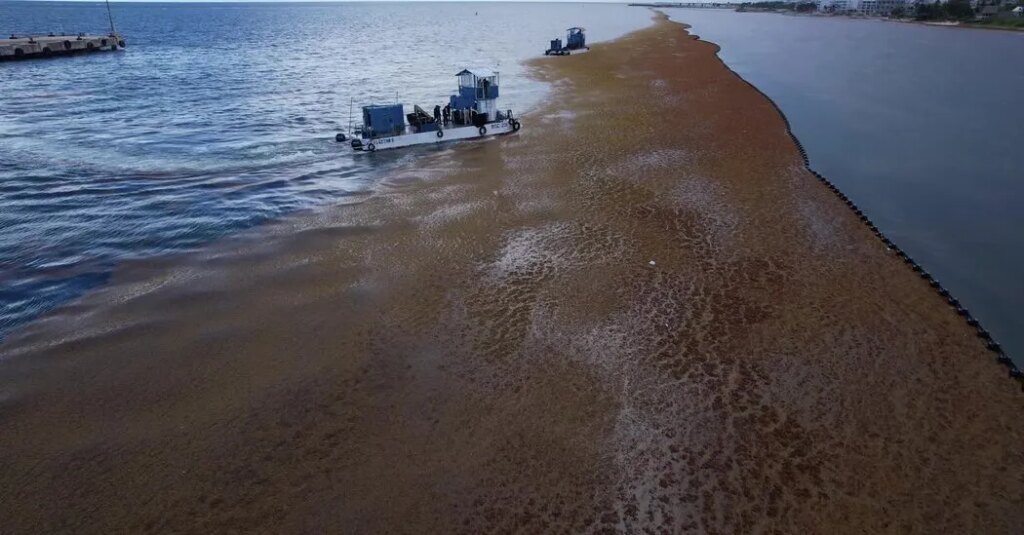
Cmdr. Álvaro Villanueva and his crew were a half mile off Mexico’s coast last month when they spotted their target: a mustard-brown seaweed known as sargassum that had massed to gargantuan size.
The Mexican Navy had been after this patch for hours, monitoring its approach via satellite and tailing it with a drone to help establish a closer heading.
Switching on conveyor belts that extended from the stern of the ship into the water, the crew began to haul in streams of seaweed, dumping it onto the hull, where workers packed it in with a bulldozer. It was one of the best days of the Mexican Navy’s sargassum-hunting season: more than 400 tons of seaweed removed in just a few hours.
The operation amounts to the front line of Mexico’s war on sargassum, declared earlier this year as the seaweed choked off the country’s tourism industry.
“It all joins up and keeps growing,” Commander Villanueva said on another recent trip to sea. He stood on the bridge of his ship, the Natans, a one-time garbage collecting vessel that was retrofitted to suck sargassum out of the water. “We call them agglomerations when a cluster forms that’s the size of a soccer field.”
Since spring, when the sargassum bloom begins an annual period of growth, thousands of tons of the seaweed have washed up on Mexico’s Caribbean shores every day, blighting a part of the country with an economy built on its turquoise water and powdery white sand.
With climate change helping to fuel a record expansion of the seaweed throughout the Caribbean and up the coast of the U.S. — reaching as far as North Carolina this summer — the Mexican efforts are being held up as a potential test case for a sustainable solution.
“Our beaches are filthy, the smell is horrendous,” Santia Bradshaw, Barbados’s minister of environment, national beautification and fisheries, said this month at a global sargassum conference in Cancún, the Mexican resort town. “Small island developing states need the support of our regional brothers and sisters.”
Sargassum is a naturally occurring macroalgae that serves as a habitat for marine life in the North Atlantic. Christopher Columbus was the first to document its presence there on a voyage in 1492.
Since 2011, however, ocean currents and winds have swept the seaweed out of its home and into the open ocean, where ideal conditions — rising ocean temperatures, direct sunlight and abundant nutrients, including agricultural chemical runoff — have caused it to double in volume every five years. The Great Atlantic Sargassum Belt, as the bloom is known, now stretches from the Gulf of Mexico to Brazil and the west coast of Africa.
“Nothing grows this fast,” said Chuanmin Hu, director of the Optical Oceanography Lab at the University of South Florida. “The territory has increased, meaning more countries suffer from sargassum today, and the intensity of sargassum inundation for a given region has also increased.”
The Mayan Riviera, Mexico’s most popular beach destination, running from Cancún to Tulum, has borne the worst of the growth, with dominant ocean currents dragging the seaweed toward its shores in mega strands.
So far this year, nearly 23 million tons of sargassum flowed into the western Caribbean Sea, according to satellite data collected by Mr. Hu’s lab, the largest amount ever recorded in the region.
The record season, which is expected to subside by November, joins a list of factors depressing tourism numbers across the country, including higher travel costs brought on by the war in Iran and an episode of cartel violence in February that paralyzed the Pacific beach destination Puerto Vallarta.
In the first seven months of this year, airport traffic across the state of Quintana Roo, which includes the Mayan Riviera, decreased by about 6 percent and hotel occupancy by nearly 4 percent, according to the latest state data. Tourism providers from wait staff to wedding vendors have felt the burn.
At the summer peak of the sargassum season in Puerto Morelos, a small beach town an hour south of Cancún, “the ocean didn’t look blue, it was the color of chocolate,” said Mirta Miranda, a worker at a souvenir shop.
As a result, tourists have stayed away and sales have sunk, forcing longtime restaurants to close and workers to take unpaid time off. Snorkeling excursions, a popular draw to the town, situated right off the region’s most important reef, dropped from four boats a day last year to one, said Israel Vázquez, an instructor.
“I’m asking for more time on rent, cutting back on food, reducing expenses, stretching the beans with more water,” Ms. Miranda said.
Up and down the coast, seaweed has invaded the picturesque scenery. Alongside rows of plush hotel loungers and thatched-roof bars, crews work the beach over with rakes and front loaders, collecting sargassum into 10-foot heaps. If it’s left to dry out in the sun, the sargassum starts to decompose and reeks of rotten eggs. With prolonged exposure, the gases decomposing sargassum releases — primarily hydrogen sulfide and ammonia — can be harmful to humans.
Some tourists ignore it, running over piles to fill pails with seawater and posing for photos with clumps of seaweed underfoot. But for many, it’s a bummer.
“It’s yucky!” said Nadia Roque, a financial assistant from Toronto who was celebrating her honeymoon at an all-inclusive resort in Playa del Carmen. “We tried to travel all the way down here just to enjoy the ocean and when we face this kind of situation, it’s not really comfortable.”
In July, President Claudia Sheinbaum of Mexico announced a $115 million investment to expand the Navy’s efforts to collect sargassum at sea. A new ocean-faring vessel with an even greater capacity than the Natans is scheduled for deployment by the end of the year, and the government has plans to buy and outfit two more similar vessels in 2027, according to Rear Adm. Topiltzin Flores Jaramillo, who leads the military’s efforts.
The Navy is also bolstering its fleet of smaller, more nimble boats that can trawl a segment of the waters closer to shore, Rear Admiral Flores said.
“All the work is done under the blazing sun,” Admiral Flores said. “It’s incredibly exhausting.”
From January through the end of September, the Navy collected nearly 25,000 tons of sargassum at sea, more than double the amount pulled in during the same period last year amid another heavy season, according to a government report. Still, that represents less than a third of the sargassum that washed ashore and was collected by workers on the beach.
With the arrival of the new ships next year, Mr. Flores said, the Navy expects to invert the two counts — collecting more sargassum at sea than on land.
Whether the Navy’s mission can keep up with warming oceans and an expanding sargassum belt is an open question. But their practices are already being adapted by other countries in the region. The Dominican Republic, which also saw record sargassum totals this year, has expressed interest in buying a sargassum-collecting ship from Mexico, the Mexican environmental ministry said this summer.
What to do with all the harvested sargassum is the focus of a burgeoning industry that drew environmental and business leaders to the Cancún conference earlier this month.
In between stalls for next-generation containment barriers and autonomous collection boats, vendors showed off a range of products made from recycled sargassum: concrete pavers used in the construction of a passenger train station, liquid fertilizer, even creams and lotions.
Funding from the European Union, the World Bank and other governmental and international organizations has helped dozens of companies expand into global markets. Sophisticated infrastructure, like a treatment hub with the capacity to process up to 4,000 tons of sargassum a day being developed by the Mexican government, is beginning to come online.
The goal is to create a circular economy where sargassum collection — an expensive endeavor — is incentivized for governments and private businesses, taking some of the burden off countries that can’t afford to operate their own collection methods. Throughout the conference crowd, though, more capitalistic motivations were also apparent.
“There’s a real high-volume global business to be had,” said Steven Keays, a Canadian whose company Thalasso extracts a compound from sargassum that can be used in cosmetics.
On the company’s website, the meddling seaweed has been rebranded with a new, perhaps aspirational nickname: “blue gold.”
The post Facing Waters ‘the Color of Chocolate,’ Mexico Declares War on Seaweed appeared first on New York Times.