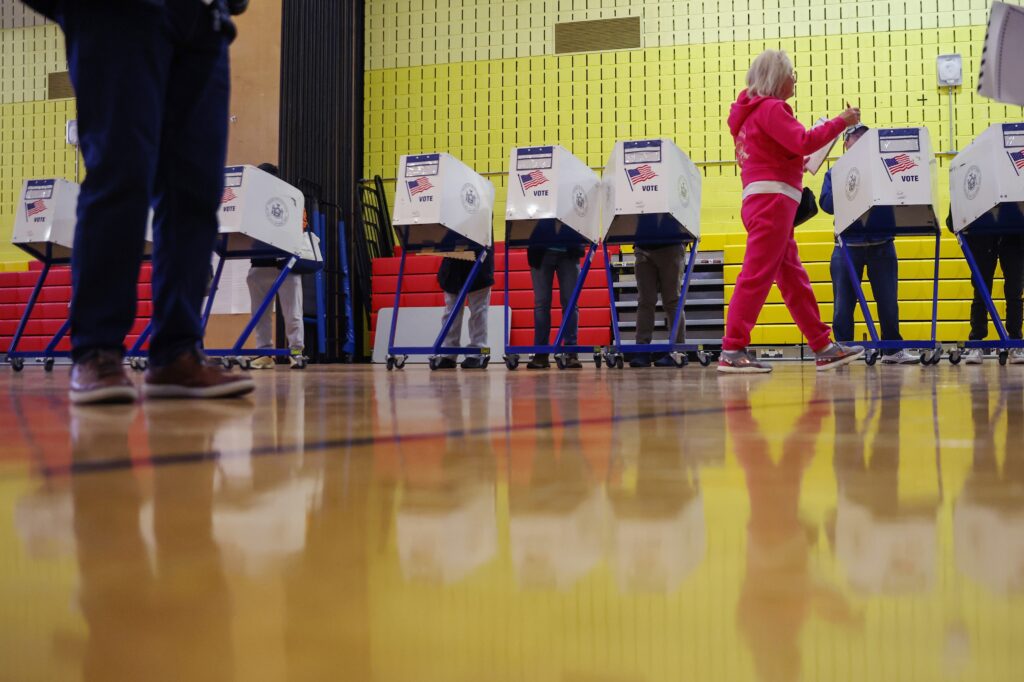
Jacqueline Wallace, a Jamaican national who had applied for a U.S. green card, was asking about student aid at a junior college when a school employee asked her to register to vote. Wallace signed up as a Republican and filled out the 2024 Florida GOP primary ballot that arrived in the mail, her attorney said in court.
Last year, in a push to investigate what President Donald Trump has alleged is a Democratic scheme to perpetuate voter fraud by noncitizens, the Justice Department charged Wallace with making a false statement in order to vote and illegally casting a ballot as an alien. The first charge is a felony, the second a misdemeanor.
After she pleaded guilty to the misdemeanor this spring, federal prosecutors touted the outcome as a win for Operation Take Back America, the Trump administration’s effort to “repel the invasion of illegal immigration” and combat transnational cartels.
To U.S. District Judge Mark E. Walker, however, Wallace’s actions were something else: an honest mistake. At sentencing in April, the judge said Wallace, now 54, had not intended to commit a crime and was not part of an organized plot to sway the presidential election.
If anything, said Walker, who was appointed to the federal bench by President Barack Obama, it was Trump and his allies — “everybody from the leader of the free world all the way down” — who were undermining public faith in the electoral system by falsely claiming Democrats were rigging elections.
He sentenced Wallace to time served.
As the midterm elections approach, the Trump administration is again ramping up attempts to root out voting by noncitizens. The Justice Department and the Department of Homeland Security are devoting massive investigative resources to the effort, and they have announced indictments in more than 20 states across the country in recent weeks.
Authorities have charged more than 180 people with illegally voting or registering to vote as noncitizens since the start of Trump’s second term, according to a Washington Post analysis of those cases. Roughly 70 percent of those people were charged in the last two months.
None of the cases includes allegations of an organized effort by Democrats or anyone else to cheat by drawing noncitizens to the polls. Rather, they appear to involve isolated incidents scattered throughout the country, many with defendants who told authorities they were simply confused about voting rules.
“A noncitizen ballot for a Republican is just as illegal as one for a Democrat, and the Department will prosecute both,” Justice Department spokeswoman Kiersten Pels said in an email. “As for the suggestion that these are confused people who didn’t understand the rules: many of these defendants falsely swore they were U.S. citizens to register, and many later lied under oath about it on their naturalization applications.”
The fraud allegations represent a tiny portion of the tens of millions of votes cast in federal elections across the country. Senior Trump aides have framed their effort as the tip of the iceberg.
During a news conference with Attorney General Todd Blanche in late September, Homeland Secretary Markwayne Mullin said his agency is investigating more than 1,600 cases and “getting to” as many as 300,000 possible instances of fraud. He offered no details to support those figures.
Defense attorneys accused the administration of a witch hunt aimed at driving public doubts about election security and a pretense for Trump and his allies to undermine the midterm results if Republicans lose.
“If these cases were in fact rampant, we would see a lot more. They have searched high and low to scrape up these few,” Katherian D. Roe, who heads Minnesota’s federal defender’s office, said in an email when asked about 11 Justice Department indictments in that state in September. Her office is defending several of those charged.
Bruce Udolf, an attorney in South Florida, said that while the number of cases filed there remains statistically insignificant, there is a danger that immigrants who are U.S. citizens and eligible to vote “might be intimidated or frustrated from voting.”
Those charged hail from more than 50 countries, The Post found. At least two thirds are legal permanent residents with green cards that permit them to work — but not vote — in the United States.
Democrats and Republicans make up about an equal share of the 61 defendants whose party affiliations The Post was able to verify through public voter registration records. Several individuals told investigators they voted for Trump in 2024, court records say. Other defendants never voted at all but were charged with falsely registering to vote.
Nearly two dozen people have been convicted so far, including 11 charged this year.
Wallace’s attorney, Richard Higdon Smith, said his client had no overt political leanings and registered to vote only because the junior college employee was eager to sign her up. The area in Panama City, Florida, where the college is located, is largely a Republican stronghold, he said.
Others who said they registered and voted by mistake include:
- a University of Michigan student from China who, after voting in 2024, realized he was ineligible and called local election officials seeking to claw back his ballot;
- Marva Cook, 66, who was adopted as a child and told agents she lived most of her life believing she was born in the U.S. and therefore was a U.S. citizen. She discovered while searching for her biological parents as an adult that she had a German birth certificate;
- a 64-year-old Guatemalan man who accompanied his U.S. citizen wife to vote in California. Though he told poll workers he was not a citizen, they encouraged him to cast a ballot anyway, saying if he was ineligible his ballot would be weeded out, he later told agents;
- an Indian man in Minnesota who said he signed up to vote while completing what he thought was a routine online registration related to his state driver’s license. “I just clicked through it,” the man, Mukeshkumar Somabhai Chaudhari, told the Fillmore County Journal.
“Sometimes the narrative gets ginned up that there are all these noncitizens who are part of a conspiracy to be registered as voters and would vote in a particular way,” said Derek T. Muller, an election law professor at the University of Notre Dame. “That’s not what we’re seeing. It’s not happening at scale, and it’s isolated incidents across the country with no clear partisan pattern.”
As next week’s midterm elections draw closer, the Justice Department and DHS have issued a near daily stream of announcements highlighting small tranches of new cases. Their social media feeds feature photos and videos of accused illegal voters being arrested by agents wearing tactical gear, as ominous music plays in the background.
The Justice Department has tasked each of the 93 U.S. attorney’s offices across the country with prioritizing noncitizen voting cases.
DHS has cast an increasingly wide net, scouring publicly available state voter rolls and examining more than 150 nonprofits it suspected of helping migrants illegally register to vote across the country. Those efforts appear to have produced few results, according to internal agency records reviewed by The Post.
In September, DHS temporarily reassigned hundreds of fraud detection officers from Citizenship and Immigration Services to look for voter fraud. Typically those workers would be screening applications from immigrants seeking legal status in the U.S. for false information.
DHS said it has reviewed more than 100 million records in its efforts to target illegal voting.
Homeland Security Investigations, the investigative arm of Immigration and Customs Enforcement, also has taken a leading role. HSI field offices were assigned dozens of potential cases to review in late summer, but the push in each office unearthed only a trickle of prosecutable crimes, said one agent involved in that effort at the time.
“Voting illegally is a crime, and I’m okay with investigating crimes,” the agent said, speaking on the condition of anonymity out of fear of retribution. “But I think many resources were being pushed at a national level for us to investigate one or two cases.”
“In the course of my investigations,” the agent said, “I found no widespread voter fraud.”
Asked about the relatively small number of prosecutions, Blanche said investigations are difficult and time-consuming, and he suggested the mounting cases are indicative of a larger problem.
“We’re talking about 10 cases today. We talked about 22 last week, 15 the week before. At some point, it has to become meaningful to the media,” Blanche said.
At the same time, he acknowledged that investigators have not uncovered a pattern and said some people accused of voting illegally might have been confused or did not actually cast a vote.
Some cases have faced pushback in court.
In early October, a federal judge in Miami dismissed a case against Chelsea Michelle Cox, a Jamaican national and South Florida resident, after concluding that the law under which the government charged her was unconstitutional.
Like scores of others, Cox was arrested for violating 18 USC 611, a misdemeanor count making it illegal for noncitizens to vote. It is by far the most frequent charge by the Justice Department in the voter-fraud cases.
Prosecutors said Cox was living in the country illegally after overstaying a tourist visa and accused her of using a false birth certificate from the U.S. Virgin Islands to register to vote. Udolf, her attorney, said Cox has lived in the country for more than three decades, working and raising a family. For the past two years, he said, she has been undergoing dialysis treatment, and she had a kidney transplant a few months before being charged.
Udolf said he read a 1993 essay by constitutional law professor Jamie Raskin, now a Democratic congressman from Maryland, published in the University of Pennsylvania Law Review. The article said the blanket exclusion of noncitizens from voting was not constitutionally required.
After doing more research, Udolf argued in Cox’s defense that Congress had overstepped its authority in passing 18 USC 611 because the Constitution says that states set the eligibility requirements for voters, not the federal government. U.S. District Judge David Leibowitz agreed, throwing out the case.
Leibowitz, an appointee of President Joe Biden, applied his ruling solely to Cox. But legal experts said the decision could have broader ramifications if upheld on appeal. Similar challenges have been filed in several other pending voting cases.
Prosecutors have also faced challenges proving intent. To secure a conviction, they must demonstrate that noncitizens knowingly violated election laws by casting a ballot or registering to vote.
In March, prosecutors in Florida’s Southern District — which has filed at least a dozen voter-fraud-related cases — charged Wilner Renaud, 60, a Haitian national who has lived in the U.S. for more than three decades, with four felony counts of making false statements in order to vote and one misdemeanor count of voting in 2022.
Daniel Rashbaum, Renaud’s attorney, said prosecutors offered his client a plea deal for time served, but Renaud elected to take his chances with a jury trial.
Renaud, who was living in a homeless shelter at the time of his arrest, had completed a citizenship test, Rashbaum said, and had never misrepresented himself in dealings with the government. When Renaud received a voter registration card from Florida, he believed it gave him the right to cast a ballot.
During a pretrial hearing in May, Evan Kuhl, a federal public defender who represented Renaud at the time, suggested that the case was political in nature.
He asked HSI Special Agent Ashley Olsen, who had investigated Renaud, why she had begun every one of her investigative reports with a paragraph crediting the investigation to an executive order by Trump related to “preserving and protecting the integrity of American elections.”
Olsen responded that she had been instructed to do so by her superiors.
In subsequent questioning, Olsen said she was unable to recall who won the 2020 presidential election and demurred when asked if Biden’s victory was legitimate.
“I’m not sure,” she said. “I mean, according to the polls, he won.” A DHS spokesperson declined to discuss Olsen’s testimony, saying the agency does not comment on personnel issues.
The jury acquitted Renaud on all charges.
Rashbaum, who served for five years as a federal prosecutor in the same office that brought the case against Renaud, noted that his time there was spent on terrorism, health care fraud, securities fraud and violent crime cases.
“One might inquire why in the Southern District of Florida, where we have a wealth of other types of crimes, the federal government is spending its time on this,” he said.
Joyce Sohyun Lee contributed to this report.
The post Trump officials charged 180 noncitizens with voter fraud. We looked at each case. appeared first on Washington Post.