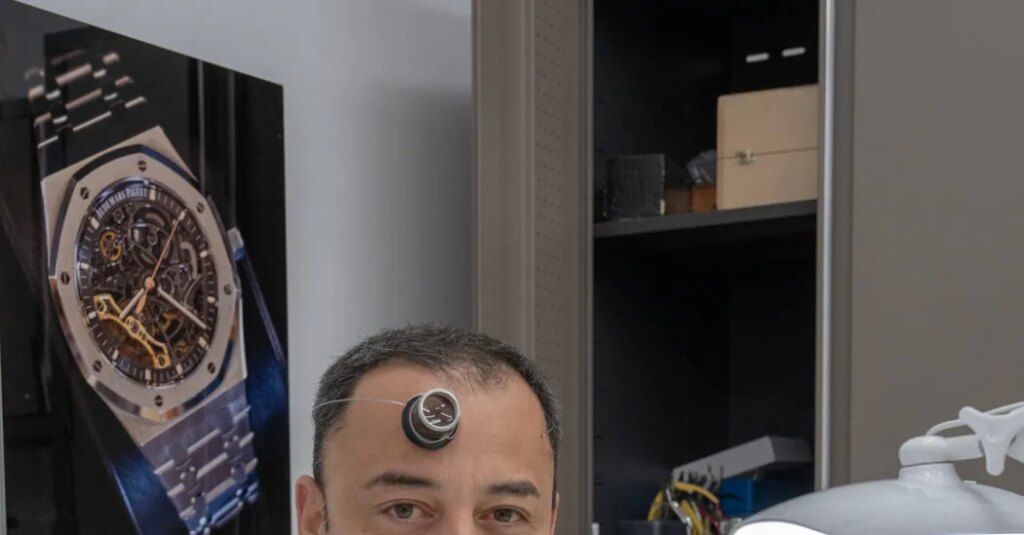
When asked if he gets nervous working on watches worth millions, Daniele Del Vecchio shrugged. “One sold for over 10 million,” he said, then began describing the minuscule replacement parts he has made for such watches.
He was referring to a Patek Philippe Ref. 1518 perpetual calendar with chronograph in pink gold and with a gilded dial. Experts have said they are aware of just 15 examples of the watch, known as a pink-on-pink and produced from 1946 to 1951. In December 2021, Sotheby’s New York sold that particular one for $9.6 million.
In preparation for the auction, Mr. Del Vecchio had disassembled the timepiece so he and Sotheby’s experts could check the condition and the internal serial numbers for authentication. It was the kind of thing he has done many times over the years for auction houses and select collectors from his shop in Greenwich, Conn.
Rich Lopez, a senior vice president and the senior international watch specialist for Sotheby’s, said in a phone interview that Mr. Del Vecchio was “like a neurosurgeon. If you want someone to be precise, you go to him.”
And Janet Tham, a vice president and specialist of watches and clocks for the Americas at Christie’s New York, said in a phone interview, “We trust Daniele to work with us in handling some of the most expensive watches that we’ve ever sold.”
Playing With Clocks
Mr. Del Vecchio, 43, grew up in Telese Terme, a city north of Naples. He briefly followed his father and two uncles to the Carabiniere, Italy’s national police force, but then turned to watches, a boyhood attraction that had he said began in his mother’s jewelry store. “I was born and raised in the store, and at the time we used to go to Naples with my father to buy gold,” he said, recalling that he used to observe the goldsmiths, who also repaired watches and clocks.
“It fascinated me,” he added. “I was looking at how they were setting the hands, putting a crystal on it and how they fixed clocks.”
At 10 or 11 years old, Mr. Del Vecchio said, he began tinkering with inexpensive plastic clocks. A friend of his father’s worked for the Swatch Group and used to help with repairs in the store.
“He saw that I was playing with the clocks,” Mr. Del Vecchio said, recalling that he used to watch the man closely as he worked. “I learned by stealing with my eyes on the job. I still do today.”
Keeping Focus
In 2008 Mr. Del Vecchio attended a course on mechanical watch repair at a training center in Switzerland run by ETA, the Swatch Group’s movement manufacturer. He later attended three more courses there as well as various programs offered by Omega, Cartier, IWC and others.
He initially used his training to repair watches at his mother’s shop. “You still have good watches there, but the number of watches we have here is crazy,” he said, gesturing at the bustle in his Greenwich shop.
In Italy, “maybe I had one Rolex a month to fix,” he noted. “Here I have — God help me!”
In 2010 — shortly after marrying his wife, MaryEllen, an American who at the time was a marketing representative for Elizabeth Arden — Mr. Del Vecchio immigrated to the United States. Initially, Mr. Del Vecchio said, he worked for his father-in-law’s construction company in Greenwich and did watch repairs for local jewelers in the evenings.
Then in 2012, he opened his own business, Daniele Watchmaker, offering services such as crystal repairs, battery replacements and bracelet sizing. (The term watchmaker is often used to describe both builders of watches and service technicians, as the skills overlap.)
His business has expanded over the years and now has a full suite of equipment, including lathes, laser welders and pressure testers, and a staff of three additional watchmakers. He also has plans to sell and trade pre-owned watches in an adjacent retail space and while there is no opening date yet, he expects it to be ready in a few months.
Mr. Del Vecchio said the interruptions of day-to-day business caould affect his focus when he was working on a watch. “You have to start all over because you get distracted, the phone, the email, the bell.”
So he takes home what he calls “big pieces,” such as complicated mechanical watches from Patek Philippe, Breguet or A. Lange & Söhne. “I stay up until one, two o’clock in the morning,” he said, “and it’s very quiet.”
Lint and Dragons
In recent years authenticating vintage timepieces has gone from a relatively casual enterprise to a guarantee demanded by elite clients. “I can’t tell you how many times people have tried to pull the wool over our eyes,” Mr. Lopez of Sotheby’s said.
Asked to estimate how many fakes he sees in a year, he replied, “Honestly, I would probably say 10 percent. There is always someone at these huge numbers that we’re dealing with right now that is going to try to push the envelope across the table.” And that is where Mr. Del Vecchio’s authentication services have proved crucial.
Mr. Del Vecchio drove into Sotheby’s Manhattan offices on a cold winter night early last year to examine a Rolex Daytona Ref. 6263 with what is called a Paul Newman dial, featuring numbers in an Art Deco font and bold squares as timing markers.
Sotheby’s was preparing the watch for auction but a prospective buyer had said the dial appeared to be scratched and Mr. Lopez was concerned. “On the Paul Newman, you know, a scratch down the center is catastrophic,” he explained, adding that at the time such a flaw could have cut the price to as little as $200,000 from about $400,000.
“I went with my pajamas on,” Mr. Del Vecchio said recently, then complained, “I don’t like the cold. In Southern Italy, we don’t have the cold we have here, but I went.”
Mr. Del Vecchio disassembled the Rolex in the wee hours, located a tiny piece of lint masquerading as a scratch and simply blew it off the dial.
Later in 2025, Mr. Lopez asked Mr. Del Vecchio to drive immediately to upstate New York to examine a watch.
“I said, ‘It’s July 4 tomorrow. I want to go on the boat’,” Mr. Del Vecchio recalled. “He said, ‘Please, please’, so we went.”
The watch had been described as a Rolex Oyster Perpetual with a dial depicting a coiled dragon in cloisonné enamel created by Nelly Richard, who worked for the Swiss dial maker Stern Frères in the 1940s and ’50s. Rolex does not disclose its production quantities, but experts have said there are fewer than 10 so-called “Dragons” worldwide.
“I said, ‘Daniele, it looks right,” Mr. Lopez recalled. “‘It looks right, but I need someone to uncase it so I can check the dial.’”
The next morning Mr. Del Vecchio opened the watch on the owner’s kitchen table. He and Mr. Lopez determined it was a genuine 18-karat gold Rolex Ref. 6100 “Dragon” from 1954. Five months later, Sotheby’s sold the watch for $1.75 million.
Still Learning
Mr. Lopez said such experiences had helped Mr. Del Vecchio become a better watchmaker: “He has that confidence now. He always had it, but when you pair it with experience, it’s amazing.”
Mr. Del Vecchio noted that he was still learning his craft. “Nobody’s a god of the watch world. You have a few people there, the best, the best. I’m not there yet. But I’m getting there.”
He looked out the window of his shop.
“Maybe one day when I will have time, am retired, I will make my own watch for myself. One piece only.”
The post If You Want Precision, ‘You Go to Him’ appeared first on New York Times.