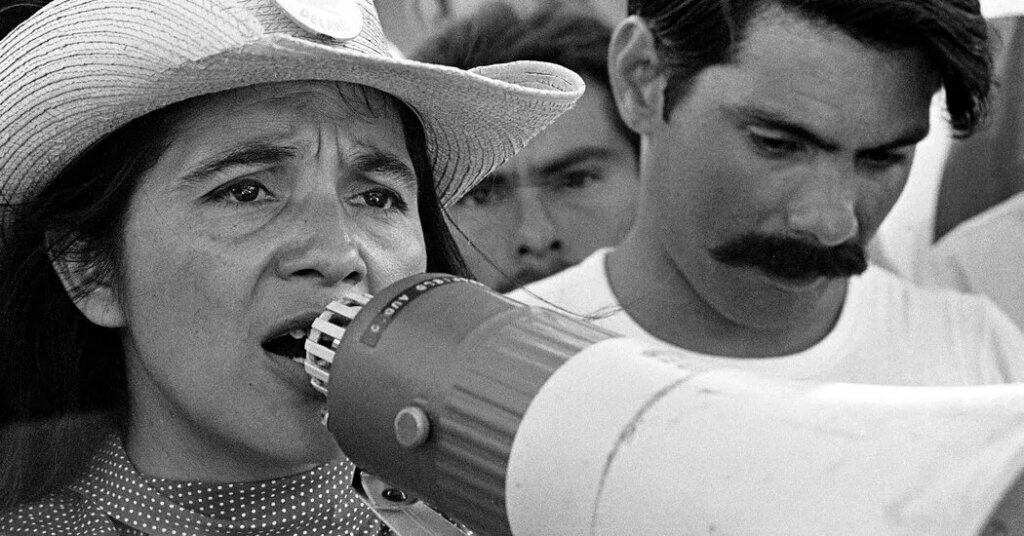
Dolores Huerta, who with Cesar Chavez founded what became the United Farm Workers and led strikes and boycotts in the 1960s and ’70s that unionized many California table-grape growers, changing laws and the lives of thousands of migrant laborers, died on Wednesday at her home in Bakersfield, Calif. She was 96.
The cause of death was cancer, Erik Olvera, a spokesman for her family, said.
Ms. Huerta, who became a kind of Mexican American folk hero, depicted in murals and ballads, was the union’s vice president for nearly four decades and, until Mr. Chavez’s death in 1993, his second-in-command. He was the charismatic — and, it was later revealed, abusive — leader; she, the skilled organizer who coordinated walkouts and boycotts under a black Aztec eagle banner and negotiated pathbreaking contracts with agribusiness.
But there was a long-hidden dark side to her years by Mr. Chavez’s side. She was, by her account, raped by him — an assault she never spoke about publicly until early 2026, when she was interviewed by The New York Times as it was reporting on the extensive evidence that Mr. Chavez had also groomed and molested underage girls as young as 12.
“I saw him, again, as my boss, as my hero, as, you know, somebody that would do the impossible,” Ms. Huerta told The Times. “I never talked about it to anybody, and the reason I didn’t is because I just didn’t want to hurt the movement.”
On picket lines and in civil disobedience protests, Ms. Huerta and Mr. Chavez practiced the nonviolent civil rights strategies of the Rev. Dr. Martin Luther King Jr. She was arrested 22 times, roughed up by strikebreakers and once severely beaten by a police officer, suffering broken ribs and a ruptured spleen that left her disabled for months.
The mother of 14 children, Ms. Huerta sometimes changed diapers between organizing meetings and nursed her babies during breaks in negotiations. Her children often lived with friends and supporters, ate donated food and coped with frequent moves. Most grew up to become activists and professionals, including a lawyer, a physician, performing artists, a therapist, business administrators and a chef.
Ms. Huerta also championed immigrants’ and women’s rights and was an ally of progressive Democrats like Gov. Jerry Brown of California, who signed legislation she sought; Senator Robert F. Kennedy, whose murder she witnessed; and President Barack Obama, who awarded her the Presidential Medal of Freedom, America’s highest civilian honor, in 2012.
Mr. Chavez and Ms. Huerta founded the National Farm Workers Association in 1962 with little but a dream of an organization to help migrant laborers who toiled long hours at backbreaking work for low wages and with no job security, and to challenge abuses, including exposure to toxic pesticides, by powerful California growers.
“People thought we were crazy,” Ms. Huerta told The Salt Lake Tribune years later. “They asked: ‘How are you going to organize farm workers? They are poor, powerless immigrants. They don’t have any money and they can’t vote.’”
But by 1965, they had 1,200 members and enough clout to join Filipino workers in a strike against table-grape growers in the Delano area of the San Joaquin Valley, and later in the Coachella Valley of Southern California. It was a bitter fight. The growers brought in strikebreakers, and the local police ignored repeated acts of harassment and violence.
When one grower began selling grapes under another’s label, Ms. Huerta and Mr. Chavez called for a boycott against the offender’s products. The F.B.I. placed both labor leaders under surveillance for suspected Communist ties.
But the strike won the support of some other unions, including the United Auto Workers, and of Senator Kennedy, who attended a rally in Delano on March 10, 1968. “The world must know,” he said, addressing the crowd of 4,000, “that the migrant farmworker, the Mexican American, is coming into his own right.”
The senator then handed Mr. Chavez a piece of bread. Mr. Chavez had been fasting for 25 days, taking only water, and weighed 140 pounds, having lost 35. Accepting the bread, Mr. Chavez broke his fast. It was a crucial moment for both sides in the strike.
The union had recently declared a national boycott of all California table grapes, and Ms. Huerta was already in New York City organizing what became one of America’s most successful produce boycotts, a cause célèbre that, polls showed, drew the support of 17 million households and thousands of food stores.
Table-grape sales plummeted. Several growers caved and signed contracts. In 1970, the Delano growers capitulated en masse. Most of the industry soon followed, granting first-time benefits to workers.
Membership in the renamed United Farm Workers Organizing Committee swelled to a record high of 80,000; as an affiliate of the A.F.L.-C.I.O., it became the United Farm Workers in 1972. Later strikes against lettuce and table-grape growers and the Gallo Winery led to another triumph: passage by California’s Legislature in 1975 of the nation’s first major farm-labor law outside Hawaii.
Signed by Governor Brown, the Agricultural Labor Relations Act guaranteed California farm workers the right to organize unions and required employers to bargain for contracts in good faith. Migrant workers became eligible for medical insurance, employer-paid pensions and other benefits, including mechanisms to challenge abusive working conditions.
In retrospect, it was the high point for the union. Its membership fell sharply in later years as growers signed with the rival Teamsters union, as strikes and boycotts lost their cachet and as the U.F.W. was hit by internal squabbles and, in an increasingly conservative nation, was no longer seen as a social cause, but as a conventional labor union struggling for political and popular support.
Ms. Huerta continued her activism. She spent four months in Washington lobbying lawmakers to pass the Immigration Reform and Control Act of 1986, landmark legislation that granted amnesty to millions of undocumented immigrants.
But at a news conference scheduled to celebrate the victory, Ms. Huerta was nowhere to be seen, having not been told of the event. To her, it was a reflection of the sexism and machismo culture that permeated the union.
“I realized afterward they just wanted to get me out of the way so they could take credit for the work,” she said of her male co-workers in remembering the news conference. “Straight male-chauvinist trick.”
She did not describe the internal atmosphere publicly until she was interviewed by The Times for its 2026 investigation, when she also revealed Mr. Chavez’s abuse. Ms. Huerta said that he raped her inside a vehicle in a secluded California grape field in 1966, when she was 36 and he was 38 or 39. She decided not to report the assault to the police because of their hostility toward the movement, she told The Times, and because she feared that no one in the union would believe her.
She said that two of her children were the products of sexual encounters with Mr. Chavez, including the rape — baby girls who, by her arrangement, were raised by others. She said she had not been aware of his abuse of underage girls.
“Unfortunately, he used some of his great leadership to abuse women and children,” she said.
Reporting by The Times also showed that many other women in the union faced sexual assault and harassment from men they worked with, including senior managers. Interviews with former union associates and an examination of archived records suggested that a number of women complained at the time that Ms. Huerta often failed to support them and rebuffed their complaints of sexism.
Dolores Clara Fernández was born in Dawson, N.M., on April 10, 1930, the second of three children of Juan Fernández and the former Alicia Chávez Hernandez. Her father, a coal miner, became a union leader and a member of the New Mexico Legislature.
After her parents divorced, she and her two brothers were raised by their mother and a grandfather in Stockton, Calif. Her mother worked as a waitress, a cannery worker and a cook before buying and operating a hotel, where she sometimes housed and fed migrant workers at no charge.
“My mother was a strong woman and she didn’t favor my brothers,” Ms. Huerta told Susan Ferriss and Ricardo Sandoval-Palos for “The Fight in the Fields” (1997), a companion book to a PBS documentary of the same name. “There was no idea that men were superior. At home, we all shared equally in the household tasks.”
After graduating from Stockton High School in 1947, she earned a teaching certificate at Stockton College (now San Joaquin Delta College). She taught in an elementary school, but quit in frustration. “I couldn’t stand seeing kids come to class hungry and needing shoes,” she told The San Diego Union-Tribune.
In 1950, she married Ralph Head, a high school classmate. They had two daughters; the marriage ended in divorce. She had five children with her second husband, Ventura Huerta, whose surname she kept after their divorce. She later had four children with Richard Chavez, a brother of Cesar Chavez’s, in a long-term domestic partnership with him.
Her survivors include 13 of her children, 24 grandchildren, 23 great-grandchildren and seven great-great-grandchildren.
Ms. Huerta was in her 20s when she became involved in community organizing, working for the Community Service Organization, a Latino civil rights group in California founded in 1947. She met Mr. Chavez in 1955, at a fund-raising dinner in Oakland, where she was introduced to him by a C.S.O. co-founder, Fred Ross Sr., a veteran grass-roots organizer who had mentored him.
In 1960, she organized the Agricultural Workers Association, two years before she and Mr. Chavez formed the National Farm Workers Association. It was in 1960, Ms. Huerta told The Times in 2026, that Mr. Chavez first made a sexual advance toward her. She described feeling pressured to have sex with him in a hotel room during a working trip in San Juan Capistrano, Calif.
Their encounters and the confrontations she witnessed in the fields were not the only moments of violence that affected Ms. Huerta. She stood with Senator Kennedy in 1968 as he celebrated his victory in the California presidential primary from a stage at the Ambassador Hotel in Los Angeles, then joined his entourage passing through a basement pantry, where he was shot by an assassin.
In 1988, at a demonstration against Vice President George H.W. Bush, then a presidential candidate, outside a San Francisco hotel where he was speaking, Ms. Huerta was seriously injured in an unprovoked attack by a police officer wielding a baton. She won a settlement with the city for $825,000, money that she used to benefit migrant workers. The city also agreed to change crowd-control procedures.
After her recovery, she took a leave from the union and traveled for two years for the Feminist Majority Foundation to promote women candidates for public office. She later became a mentor to many elected officials, including Hilda L. Solis, a four-term congresswoman who was President Obama’s labor secretary from 2009 to 2013 and the first Hispanic woman to serve as a cabinet officer.
Ms. Huerta stepped down as an officer of her union in 1999 after 37 years. In 2002, she became founding president of the Dolores Huerta Foundation, which helps communities organize health, environmental, educational and economic projects.
Her portrait was known to hang in some U.S. embassies. She was showered with awards, including 15 honorary degrees, and at the 2008 Democratic National Convention in Denver, she formally placed Hillary Clinton’s name in nomination for president.
Mr. Huerta is widely believed to have coined the phrase “Sí se puede” (“yes we can”), still a common chant at Democratic campaign rallies and marches, and which Mr. Obama adopted as his presidential campaign slogan. (He acknowledged it was hers in his remarks about her at the Medal of Freedom ceremony.)
Her life was extolled in “Dolores,” a 2017 documentary by Peter Bratt. In 2019, Gov. Gavin Newsom of California proclaimed an annual Dolores Huerta Day to commemorate her “lifelong pursuit of justice.” In a 2020 interview with The Times, she was asked why movements like hers transcended borders.
“I think it’s because of the people who are involved,” she said. “And this is the reason I, at the age of 90, continue to work. When people come together and take collective action, whether it’s in a march, whether it’s in a union election or, most important, come together to vote, this is how we make change.”
Manny Fernandez and Sarah Hurtes contributed reporting.
The post Dolores Huerta, Labor Leader and Force for Civil Rights, Has Died appeared first on New York Times.