Simcha Rothman, a pillar of Israel’s hard right, gazes from his hilltop settlement in the West Bank at pomegranate trees, vineyards and, in the distance, the Judean Desert’s barren hills falling away in a haze toward the Dead Sea.
“This is our land,” he says, “historically, biblically, religiously and lawfully.”
Most of the world, and the three million Palestinians who live there, side with international law against that view. They call Israel’s 59-year occupation of the West Bank illegal, along with the settlements that now blanket the land known to most Israelis as Judea and Samaria, the birthplace of the Jewish people.
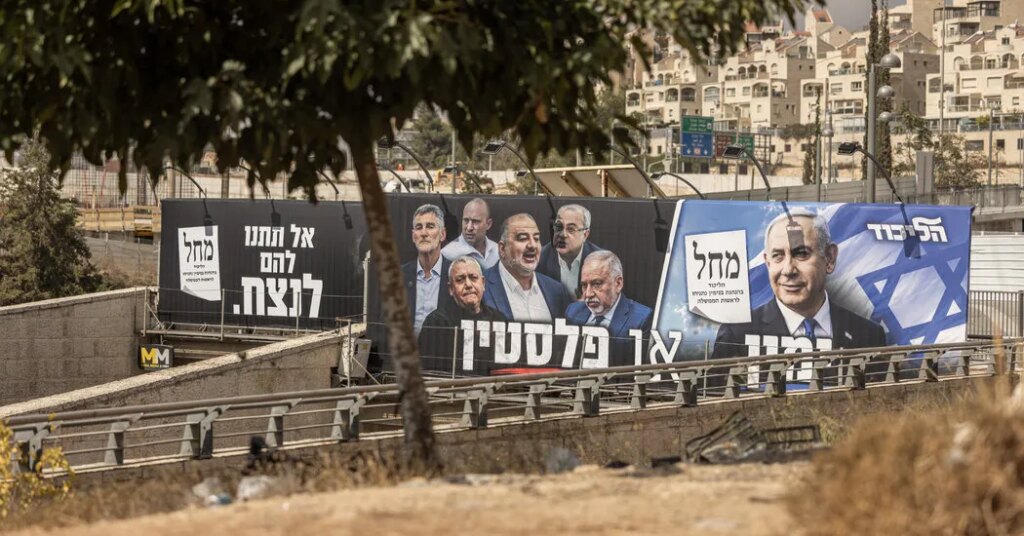
This settlement, called Pnei Kedem, a cluster of houses that has grown to 90 families from 16 since Mr. Rothman moved here 18 years ago, is reached along roads from Jerusalem now lined with bedraggled Israeli flags — and dotted with the election billboards of Bezalel Smotrich, Israel’s firebrand finance minister, who leads Mr. Rothman’s Religious Zionist party.
“Smotrich: Deeds not words!” the posters say.
Those deeds include soaring settler violence against Palestinians and the rapid spread of wildcat outposts, the clusters of caravans through which the Israel of Prime Minister Benjamin Netanyahu stamps on the land its clear intent: permanent control of the West Bank.
A big man with a wide-eyed gaze and a relentless conviction, Mr. Rothman, 46, waves away the violence. “If Judea and Samaria were a city in the United States,” he tells me, “it would be considered one of the safest cities.”
As for the land he sees as deeded by God to the Jewish people, it is nonnegotiable. “No to a Palestinian state, ever,” he says. “Any sovereign nation between the river and the sea that is not the state of Israel means our destruction.”
In Israel’s watershed Oct. 27 election, the country’s very identity appears at stake. On one side, an ever more strident and violent nationalism, often messianic in tone, has seeped into Israel’s fabric.
On the other, opponents appalled by this lurch to the right still cling to a diverse nation and some trace of the charter of Israel’s foundation in 1948, which calls for “complete equality of social and political rights to all its inhabitants, irrespective of religion, race or sex.”
Prominent among them is Yoav Segalovitz, 67, a soft-spoken former Israeli police officer who has crossed entrenched barriers to become a candidate for an Arab party, Raam, in the hope of preserving those founding ideals.
It is something no other centrist Zionist has ever done.
Mr. Segalovitz, over the course of a long conversation at the kitchen table in his modest ground-floor Tel Aviv apartment, says he is convinced that the vision of Israelis like Mr. Rothman, “whom he knows well and calls “a crazy guy, a very smart guy,” signifies “the end of the state of Israel, if you really want to be a democratic Jewish state.”
In its place, at best, there would be a single state ruling another people “with no equal rights” for Palestinians.
Mr. Segalovitz’s mission has something of the quixotic in that Israel’s hard-line ideological shift seems entrenched. Still, in an election that is too close to call, he could play a critical role in broadening the opposition alliance and so giving it a majority.
Israel is on edge. Two-state dreams died a death on Oct. 7, 2023. The brutal Hamas-led attack that day, which took some 1,200 lives and 251 hostages, exposed what Yotam Margalit, a professor of political science at Tel Aviv University, called “the rawest nerves and deepest fears” of the Israeli people.
No opposition leader speaks of Palestine now. Use of the word is left to Mr. Netanyahu, known as Bibi, one of whose slogans is “The Right or Palestine!” Over his cumulative 19 years in office, fear has always been the emotion he wields most effectively.
So two influential Israelis, Mr. Rothman and Mr. Segalovitz, both believe they have a moral duty to adhere to convictions completely opposed to each other. Which vision prevails may determine the nature of the Jewish state for years to come.
“We are at the decisive battle,” said Yuval Shany, a professor of international law at the Hebrew University of Jerusalem. “If, following one catastrophe after another, liberals still can’t win this election, many will conclude the game is up.”
Zionist From the Start
Mr. Rothman grew up in Bnei Brak, a hub of ultra-Orthodox Judaism east of Tel Aviv. His father was a banker, his mother a university administrator.
One of four children, he says he followed the beliefs of an observant Jewish family to arrive at his current convictions, nothing more.
“There was no epiphany,” he says. “I did not come from the left and move right, or abandon a secular family to become religious. In the terms used today, I was a religious Zionist from the start.”
He studied law, earning a degree from Northwestern University in the United States and Tel Aviv University, and in 2013 co-founded the Movement for Governability and Democracy to counter his obsessive bugbear: that Israeli democracy suffers from excessive judicial oversight of elected officials.
His hard-line convictions had been cemented when he traveled in 2005 to the southern Gaza Strip and witnessed the eviction by the Israel Defense Forces of 8,600 Israelis from 17 settlements.
“When I left, I told the people of nearby Kibbutz Be’eri what would happen because we were kicked out of Gaza,” he tells me. “And it did.” The kibbutz was one of the places hardest hit on Oct. 7.
Mr. Rothman’s brand of brash provocation has proved persuasive in a world where pouring scorn on liberal democracy has become routine.
He thinks the left lost in Israel because it believed in a two-state solution to the Palestinian conflict and people realized it was “a waste of time.”
He thinks there is no reason Israel should give anything to suffering Gazans because “no other country that I know gives food to people who shoot at them.”
Elected to the Knesset in 2021, Mr. Rothman, who chairs its Constitution, Law and Justice Committee, was a leader of the government’s push for sweeping judicial revisions in 2023. He became so notorious for what was widely seen as an attempt to curb democratic checks and balances that armed guards had to protect his home.
“I was target number one!” he tells me with some pride, dismissing the enormous protests at the time as an expression of the left’s frustration at losing elections.
An S.U.V. whisks him in a half-hour to and from the Knesset. The suburban West Bank scene on these roads bears no relation to the adjacent Palestinian reality of random checkpoints, routine humiliation and growing confinement.
Mr. Smotrich denies the existence of the Palestinian people and declared last month that, “We need to do in Judea and Samaria what we did in Gaza.”
I ask Mr. Rothman, seated in his Knesset office, if he shares this view.
“Yes, I sign onto that, what is the problem with that?” he says. Mr. Smotrich, he contends, merely meant that it is essential, in confronting Palestinians, to “destroy terror infrastructure, take away the weapons, then kill all the terrorists.”
The dismissal of all Palestinians, whether in Gaza or the West Bank, as potential “terrorists” and the use of the euphemistic “neutralize” to describe Israeli killing of them has become a routine ideological weapon of the right.
It seems inconceivable to Mr. Rothman that a Gaza redux in the West Bank might trouble anyone. “Judea and Samaria should be part of the state of Israel and Israeli law should apply there,” he says.
Would the Palestinians there then have the vote?
“No.”
Why?
“Because more than 80 percent of them supported Oct. 7,” Mr. Rothman says, using Israeli shorthand for the deadliest day in Jewish history since the Holocaust.
Breaking Barriers
New faces have been few and far between in this election, as have new ideas. The campaign is scarcely about policy, substance, or even Israel’s devastating conduct of the Gaza war that has left more than 74,000 Palestinians dead, according to Gaza health officials.
It is about the survival, or removal, of Mr. Netanyahu, as a means to change the country’s direction.
The strongest presence in this movement has been Gadi Eisenkot, the centrist former chief of the Israel Defense Force and the anti-Bibi from central casting: humble, honest, low-key, uncharismatic, a man whose son was killed fighting in Gaza “while Bibi’s son was tweeting from Miami,” as Gershom Gorenberg, an Israeli author, put it.
But if there has been a single bold political upstart, it has been Mr. Segalovitz, who rose to the rank of major general over 28 years as a police officer.
A quiet man with a melancholic smile that masks passionate conviction, he professes a deep belief in the “freedom, justice and peace” embraced by David Ben-Gurion, the country’s first prime minister, at the declaration of Israel’s independence 78 years ago.
His decision to run with the Arab party Raam was, he says, driven by the conviction that this election presents a last chance to salvage such principles from the brutalizing impact of wars and Mr. Netanyahu’s rule.
To the right, his move is pure provocation. Raam, a Hebrew acronym for the United Arab List, is led by Mansour Abbas, who is regularly denounced as a supporter of terrorism by Mr. Netanyahu’s allies.
“I wanted to break the political walls between Arabs and Jews,” Mr. Segalovitz tells me. “I’ve been called Muhammad Segalovitz, a Hamas supporter, had insults from all over, but it doesn’t matter.”
Born, raised and still living in Tel Aviv, he shuns any guards and refuses to carry a weapon. What he has done, he insists, has to be seen as “normal.”
With Mr. Abbas, there are many differences, Mr. Segalovitz acknowledges.
“He is religious. I am secular. He’s an Arab, I’m a Jew. He’s conservative, I’m liberal. But the main issue for me is not to look at the problems, but the opportunities.”
Such talk in Israel, land of maximalist political statements, now often laced with hatred, has become rare in its readiness to compromise over differences.
Mr. Abbas said in 2021 that Israel was “born as a Jewish state” and “that is how it will remain.” This, for Mr. Segalovitz, was sufficient recognition, given his own Zionist convictions.
Israel, he insists, “must change compass.” Alluding to Israel’s Arab, or Palestinian, citizens, he says: “It’s against our national security to exclude, politically, the 21 percent of the population that work everywhere in Israeli society.”
Mr. Segalovitz’s long-pondered decision is important in one imminent regard. Polls differ but are nearly unanimous in predicting that neither Mr. Netanyahu and his allies nor the opposition will gain the 61-seat majority in the 120-member Knesset needed to form a government.
But with the support of Raam, which is expected to win five or six seats, Mr. Eisenkot and his so-called “change bloc” could attain the majority needed to oust Mr. Netanyahu.
It is unclear whether the opposition would take this step. (Raam was part of a short-lived government once before, in 2021, in which Mr. Segalovitz, then of the centrist Zionist Yesh Atid party, served as deputy national security minister.)
Mr. Segalovitz’s presence as No. 2 on Raam’s candidate list, and so almost certain to be elected, may make governing with it more palatable.
Itamar Rabinovich, a former Israeli ambassador to the United States, sees Mr. Segalovitz’s decision as critical for the center and center-left in Israel.
Given the demographics of a country where the birthrate of the ultra-Orthodox far exceeds that of secular Israelis, “the center-left only has a future through partnership with the clear majority of the Arab population that has accepted the state, thinks Israel is a done deal.”
“History will judge Segalovitz as a very brave leader,” Firas Badhi, the mayor of the Arab town of Kfar Qara, told me. “He and his family will pay a heavy price, but he is standing up to a government that does not see the Arab citizen as equal and has no qualms about declaring this.”
Mr. Badhi calls himself a loyal citizen of Israel even if he cannot feel the patriotism of a Jew for a Jewish state. “The suffering of peace is better than the suffering of war,” he tells me.
Mr. Rothman, however, thinks Mr. Segalovitz is afflicted by “Stockholm syndrome.” He accuses Raam of having links to the Muslim Brotherhood, a charge Mr. Abbas has denied. He cannot believe that a Jew would have anything to do with a party “whose core goal is to destroy the state of Israel.”
Mr. Segalovitz is equally outraged. His decision to run with the Arab party, he tells me, “is a moral duty, an ethical one, a Jewish one.”
Which Israel?
The rightist backlash against liberal democracy has been broad, sweeping through Europe and the United States. In Israel, the rightward shift has been compounded by war, insecurity and forms of religious-Zionist conviction and prophetic fever that invoke God to justify violent land grabs.
This is the ideological backdrop to the election. Mr. Netanyahu, who seemed doomed after the Oct. 7 attack, has revived his fortunes through the assassinations of the leaders of Hamas, Hezbollah and Iran, as he has stood with the global far right in the name of what he calls a “civilizational alliance against Islam.”
But Mr. Netanyahu’s unfinished military operations in Gaza, Lebanon and Syria have stretched Israel to the limit. Reservists are called up for a previously unheard-of 200 or more days of duty a year. Debate rages over whether ultra-Orthodox Jewish men should remain exempt from the draft.
“It’s a really rough time,” Mr. Segalovitz told me. “In this period you are looking for leadership. For direction. For a future. And you can’t see it.”
There is no euphoria over the regional dominance of the Israel Defense Forces. The West Bank is boiling over. A mood of anxiety and exhaustion prevails.
“Of course, Israel should be very concerned about the dead in Gaza,” said Mr. Gorenberg. “But it’s easier to have universal concerns when your son, daughter or father are not in combat, or dead.”
So Israel is holding an election in which it is not debating the issues the rest of the world thinks it should be agonizing over.
In 1988, Abba Eban, who served as Israel’s deputy prime minister, predicted that the “major perils” confronting Israel “would emerge from the stupendous folly of attempting to enforce a permanent Israeli jurisdiction over the one and a half million Arabs in the West Bank and Gaza.”
Nobody listened and, almost four decades later, Israel confronts an election to decide which country it wants to be.
It pits Mr. Rothman against Mr. Segalovitz, an absolutist convinced of God’s bequest of all the land of Israel to the Jews against a man convinced that the Zionist dream, and Israel itself, can only be saved if the rights of Palestinians are recognized.
If the opposition wins there will almost certainly be a commission of inquiry into the Oct. 7 attack, a new Israeli outreach to the world, and a serious attempt to end the impunity afforded violent settlers.
“It’s the mission of my life, of our lifetime,” said Shaul Meridor, a candidate for Mr. Eisenkot’s Yashar party. “This hope for a better Israel, a righteous Israel, a democratic and liberal Israel, to get it back somehow.”
For Mr. Rothman, Israel has already changed irrevocably. What drives the right, he tells me, is its connection to Judaism, and “more and more people define themselves as Jews more than Israelis.” So can tribalism erode nationhood.
Mr. Segalovitz believes still in his pluralist country. “Mr. Netanyahu only cares about some of the people,” he says. “But I think Israel is much stronger than any leader.”
Lia Lapidot contributed reporting from Jerusalem, Tel Aviv and Kfar Qara.
The post Two Candidates, Two Israels, One Nation in the Balance appeared first on New York Times.