Flávio Bolsonaro’s political party continued to raise questions on Monday about the Brazilian election results, even as it released a statement that indicated it would accept them. Mr. Bolsonaro himself has refused to accept defeat.
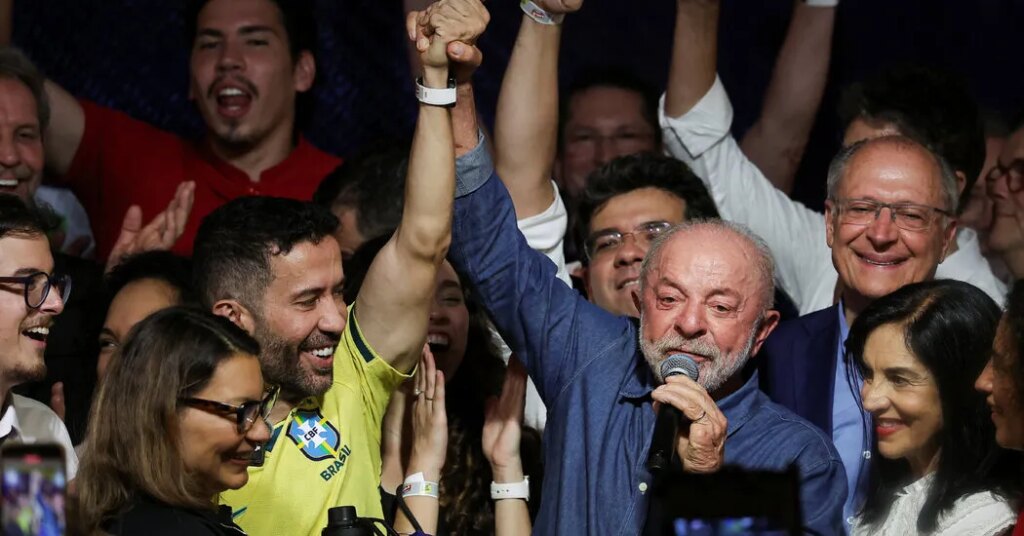
Mr. Lula received 51.8 percent of the vote in Sunday’s election, compared with 48.2 percent for Mr. Bolsonaro, with nearly all ballots counted. His victory ended a string of seven consecutive presidential election wins by right-wing candidates in Latin America, delivering a setback to a movement encouraged by President Trump.
Mr. Bolsonaro’s Liberal Party addressed the result in a social media post on Monday.
“We recognize the presidential result proclaimed by the Superior Electoral Court (TSE), but we believe the questions raised must be properly clarified within a balanced and democratic political debate,” the party said.
Brazil’s Supreme Court on Monday ordered the police to seize Mr. Bolsonaro’s passport as part of an investigation into his links to a lawyer accused of laundering more than $1 billion. Mr. Bolsonaro has denied doing business with the lawyer and called the investigation political persecution. He said he would comply with the order and had “never considered” leaving Brazil.
Mr. Lula became the first presidential candidate since 1989 to win after finishing second in the opening round. In just three weeks, he added more than 10 million votes, gaining ground across the country.
Here’s what to know:
Why is the election result significant?
Mr. Lula accomplished what no candidate had done since Brazil restored direct presidential elections in 1989: He won after finishing second in the opening round this month. In each of the nine preceding elections, the first-round leader won the presidency, either outright or in a runoff.
Mr. Lula tried and failed to overcome such a deficit in 1989. After finishing second to Fernando Collor de Mello, he rallied support from defeated rivals and surged in the polls. He ultimately lost in the runoff, 53 percent to 47 percent.
His victory on Sunday added another reversal to an extraordinary political career. Mr. Lula, 80, helped found the Workers’ Party under military rule and lost three presidential elections before winning in 2002. Jailed and barred from running in 2018, he returned to defeat Jair Bolsonaro in 2022 after his corruption convictions were annulled the previous year. He has now won an unprecedented fourth term.
Mr. Lula framed his candidacy as a way to defend democracy, protect Brazil’s sovereignty and prevent the Bolsonaro family’s return to power. Flávio Bolsonaro, 45, promised to restore his father’s conservative agenda while casting himself as a more moderate successor.
The result also halted a regional advance by the right. Although President Trump did not openly champion either candidate in Brazil, as he had in two other elections in Latin America, his administration tried in subtle ways to bolster Mr. Bolsonaro’s campaign. Mr. Trump told reporters on Monday that “it looked like another rigged election,” without offering evidence to substantiate the claim.
Mr. Lula, who has repeatedly defied Mr. Trump, said the surge of rallies in the past week “was a demonstration that this country refuses to be anyone’s backyard.” It was an apparent reference to the United States, which has been trying to exert new levels of control over Latin America through measures such as tariffs, sanctions and election intervention.
What happened on Election Day?
Mr. Lula’s margin of victory, 3.6 percentage points, was wider than it was four years ago. Few pollsters had predicted his comeback.
At a news conference, Mr. Bolsonaro refused to recognize the result and said he would seek to have the election annulled. He described a court’s decision to extend voting hours as a “dirty trick,” adding, “What happened today was not normal, and it was even unacceptable.”
Both candidates had requested the additional time. Mr. Bolsonaro said that flooding in a part of the country where he had strong support would unfairly hurt him, while Mr. Lula accused public officials of deliberately slowing public transportation in areas where he had won in the first round of voting.
A judge decided minutes before polls closed to extend hours at all polling stations. But by the time of the announcement, some polling centers had already closed and their voting machines had shut down, preventing them from reopening.
What comes next?
To seek to have the election annulled, Mr. Bolsonaro’s party will need to petition the authorities for a review of the results. Since Brazil’s return to democracy, no presidential election has been annulled.
In the 2014 election, the losing party requested an audit, but the review found no evidence of fraud and the results were upheld. In 2022, the Liberal Party similarly challenged Jair Bolsonaro’s election loss but failed to provide evidence to support its accusations and was fined by a court.
Flávio Bolsonaro’s Liberal Party has two possible paths to challenge the result, said Raquel Machado, a professor at the Federal University of Ceará. It could seek a technical audit to determine whether unequal voting conditions affected the outcome, potentially leading to an annulment of the election. Or it could pursue an abuse-of-power case through the Superior Electoral Court’s inspector general, which could disqualify Mr. Lula and his running mate, Geraldo Alckmin, even after they take office.
But Professor Machado noted that many polling stations had closed by the time the Supreme Court’s order was made public and that there had been no significant influx of voters after 5 p.m. local time.
Mr. Lula’s Workers’ Party could bring its own challenge over restrictions on public bus services on Election Day.
The results were a surprise to investors, who saw Mr. Bolsonaro as the more market-friendly of the two candidates. After Mr. Lula’s win, Brazil’s benchmark stock index fell more than 10 percent as trading began on Monday. The currency, the real, was down more than 8 percent against the dollar, on course for its sharpest single-day weakening against the dollar since 1999.
Adeel Hassan and Silvia Ribeiro contributed reporting.
The post What to Know About Brazil’s Election, and What Comes Next appeared first on New York Times.