Arash Ahmadzadeh is a musicologist and guitar professor at the Breuillet Conservatory in France.
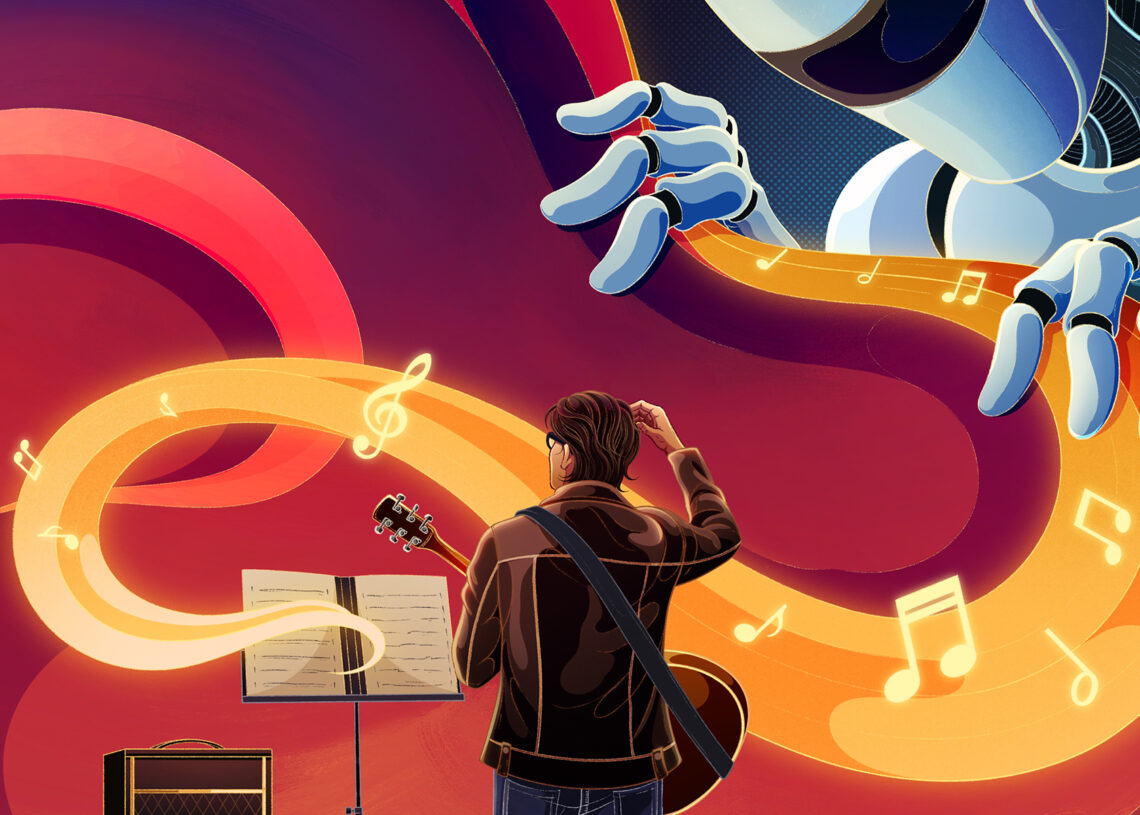
A student recently asked me to teach him how to play a piece of baroque music he found on YouTube. He had already spent hours trying to learn it from a score posted alongside the video, but he was having trouble. Some passages made little practical sense on his instrument, the classical guitar.
He had no idea the piece was generated by artificial intelligence. For both of us, the immediate cost was time and frustration. But it exposed a larger problem: AI-generated music is proliferating, and it may be changing people’s sense of what is musical.
“Music is a universal language” and “music transcends borders” are captivating phrases, but they are not quite true. Musical taste is shaped by culture, repeated exposure and training. As musicologist Sasan Fatemi explained, a listener raised on Western classical music may initially struggle to make sense of Peking opera or the music of the Aka people of Central Africa.
That’s because, as cognitive scientist Marcus Pearce has detailed, musical enculturation is a process through which listeners acquire internal models of a musical style from exposure to the music around them, beginning in early life. In a 2005 study, psychologists Erin Hannon and Sandra Trehub found that 12-month-old infants already responded to musical rhythms in culturally specific ways that were not evident at six months.
Nor does this learning necessarily take years. In a 2010 experiment, researchers Psyche Loui, David Wessel and Carla Hudson Kam found that after just 25 to 30 minutes of listening to melodies based on an unfamiliar musical scale, participants could recognize structural patterns, even in melodies they had never heard before. Much of this happens without people paying much attention. They hear music in elevators, restaurants and on their way to work. Even incidental listening helps shape what sounds familiar.
As people listen, they develop preferences, begin to anticipate where a melody might lead and recognize when something sounds satisfying or out of place. Even without formal musical training, they acquire a sense of what makes music work.
If even brief exposure to an unfamiliar musical system can shape expectations, what might prolonged exposure to AI-generated music teach people? It’s unclear, but it’s a question that cannot be ignored.
Generative AI changes not only the quality but also the scale of that exposure. In July, the streaming service Deezer reported that fully AI-generated tracks exceeded half of all new music uploaded to it at peak levels, accounting for about 90,000 tracks a day. Those tracks still represented only a small share of listening on Deezer. For now.
So far, the debate over AI music has understandably centered on authenticity, copyright and livelihood. One response to this might be: So what? Bad music is hardly an invention of AI. Human beings have always written dull, repetitive and derivative music. Nor does a piece become worthless simply because software played a role in creating it. AI may eventually become another useful musical tool, as recording technology, synthesizers and notation software did before it.
But what happens when listeners cannot tell what they are listening to? I do not go looking for AI-generated baroque music. Yet it appears among my searches and recommendations, and I do not always notice a disclosure before I start listening. People are also not necessarily good at recognizing it. Researchers Junsong Chang and Yueqi Jing recently conducted a blind-listening experiment in which musically trained listeners were asked to identify music as either AI-generated, human-AI collaborative or human-composed. They could not do so reliably.
That’s because the flaws of AI-generated music — a wrong note, an awkward rhythm, an unnatural voice — are no longer obvious. That matters when musical expectations are still being formed. Humans learn how harmony creates and releases tension, and how stylistic conventions can be followed, bent or deliberately broken. They may not be able to name those conventions, but they feel them.
My guitar student had treated that AI-generated score as something from which he could learn. He assumed that if the piece was presented as baroque and accompanied by notation, there must be a musical reason for what was on the page. He questioned his technique, not the music. Why would he suspect otherwise? A score carries an implicit promise: that someone has thought about why those notes belong together. But what if no one had?
I do not want AI-generated music banned. What I want is an informed ability to choose. Platforms should make the origin of fully AI-generated music unmistakable and allow listeners to opt out of receiving it in their recommendations.
Some platforms have already introduced guardrails. Deezer excludes any detected AI-generated music from its algorithmic recommendations and editorial playlists. Spotify recently labeled some artist profiles as “AI Personas” and excluded them from editorial and algorithmic recommendations by default. YouTube requires creators to disclose AI-generated music and can also apply labels of its own. But a label and a choice are not the same thing.
I used to start my mornings by listening to a playlist of baroque favorites while I made my coffee. Lately, though, I have had to stop every few minutes to check whether the composer is even real. That’s more than just an annoyance; for generations, we music lovers have developed a sense of what belongs together, what surprises us and what moves us. AI can assemble notes in a way that sounds like music, but whether it really is music ought to be a question for human ears.
The post The future could disfigure your musical ear — without you even knowing appeared first on Washington Post.